COMMUNITY BUILDING
Propulsion, not absorption: New initiative aims to help skilled new ‘olim’ succeed in Israel
Amid worry about of Israel’s brain drain, a government-backed initiative is betting that the key to Israel’s future lies in its skilled new immigrants — and the networks that make them want to stay
Courtesy/Nevo Network
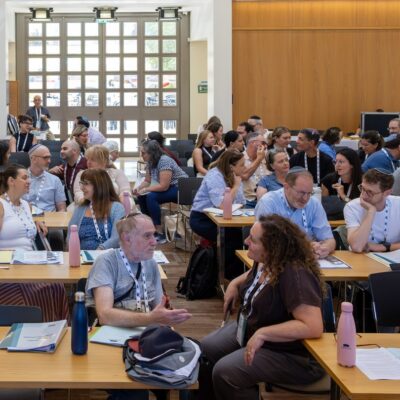
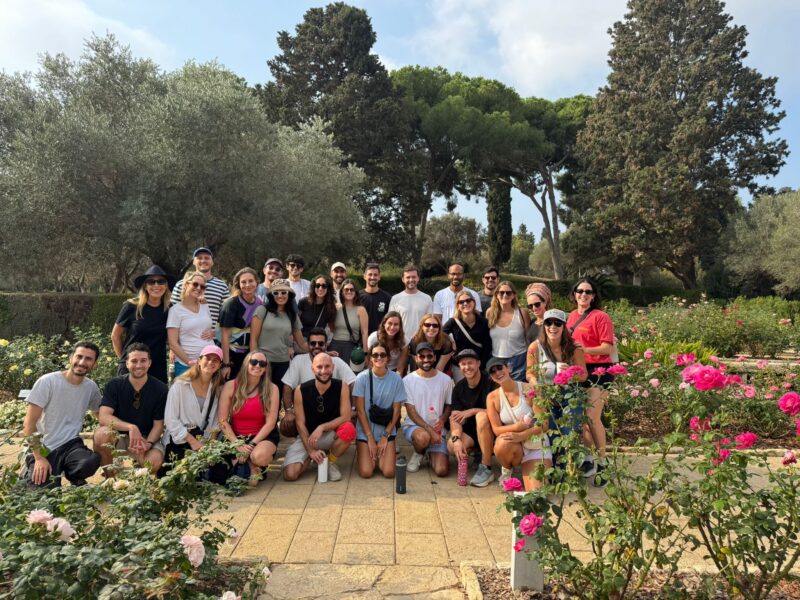
Participants in a Nevo Network cohort visit the Ramat Hanadiv gardens in Zichron Yaakov, Israel.




 Add EJP on Google
When Rebecca Katz made aliyah, she did what most highly skilled olim (Jewish immigrants to Israel) do: she figured it out. She built a career in tech, learned to navigate Israeli bureaucracy and eventually found her footing.
Then she had children — and realized she needed to learn how to be a parent in Israel. It was her experience in Nevo Network, a professional community for highly skilled olim, that had shown her what intentional support could look like. “I experienced the shift from building a career in Israel to building a family here,” she said, “and realized how much support is needed in that next chapter as well: not just to arrive, but to truly build a life.”
The goal of helping olim thrive in Israel is the animating idea behind Gaya, Nevo’s new nationwide initiative that launched last month with an $800,000 government grant from Israel’s Immigration and Absorption Ministry.
Israel is in the middle of a charged national conversation about “brain drain,” beginning during the 2023 judicial overhaul protests and intensifying in the wake of the Oct. 7 terror attacks. The Israeli press is rife with stories about high-profile departures of tech workers, academics and healthcare workers, and economists and think tanks have been warning that the country could be hemorrhaging human capital. Against that backdrop is Gaya’s premise to invest — seriously and intentionally — in olim who are committed to stay.
What Gaya promises its members is primarily the sense of belonging that native Israelis absorb through army service, university friendships and decades of shared history, and which olim often spend years searching for.
Abbey Onn, Nevo’s executive director, who is originally from North America, was brought in by investor and philanthropist Michael Eisenberg to work on an immigration push for engineers at a time when Israel faced an acute shortage of technical talent. The effort failed.
“The ROI didn’t make sense,” Onn told eJewishPhilanthropy, using the acronym for “return on investment.” But in diagnosing why, she identified something else: a critical gap not in aliyah investment, but in what comes after. “There’s a lot of investment in aliyah and not a ton in olim,” she told Eisenberg. “I want to use that and try to build something for olim specifically.”
The observation that anchored her thinking: “One-in-three English-speaking olim leave Israel within three years, because they either don’t find a romantic partner or don’t find a professional path,” Onn said. It is a figure the Immigration and Absorption Ministry cannot officially confirm — when an Israeli citizen leaves, they remain a citizen, and there’s no mechanism for the state to know why they’ve gone or if they’ve gone for good.
Nevo’s response was a cohort-based fellowship, modeled loosely on programs like Wexner fellowships and the Schusterman Family Philanthropies’ ROI Community, that selected roughly 30 high-skilled tech olim per year from across 26 countries. The selection criterion was not prestige or seniority. “It was that they had this spark, this desire to really build something to make things better here,” Onn said. Over six-plus years, the program has built a network of more than 180 alumni. Its retention rate — 91% — stands against a national backdrop where roughly a third of olim depart within their first few years.
Nevo was recently awarded the Herzog Prize for extraordinary impact on aliyah for its work.
Eisenberg, Nevo’s board chair and founding donor, took that track record to the Immigration and Absorption Ministry. “Look what we built,” he told them. The ministry issued an RFP in December 2024, and Onn won the grant.
“I made aliyah 33 years ago,” Eisenberg told eJP, “and it took me a long time and a lot of hard work and a lot of running around to create a network and find people and integrate into Israeli society. What Nevo cracked — and what Gaya will crack — is setting up professional networks for olim.”
The traditional Israeli absorption apparatus was built to help immigrants blend in — to learn the language, navigate the bureaucracy and find their footing as quickly and quietly as possible. The assumption is that highly skilled immigrants bring something Israel needs and that the question is not whether they can adapt, but whether Israel is prepared to leverage what they bring.
According to Eisenberg, the missing piece for new olim is not information — it’s a sense of belonging. “We are not absorbing them. We are empowering them. This is a propulsion center. Not an absorption center.”
For Eisenberg, investing in olim is a massive bet on Israel’s future. “Israel is a fast-growing country, and every oleh who comes is coming from a larger, more established country. When you think about the next 100 years of Israel — we’re going to grow a lot. We need to scale up. People who come from bigger, scaled-up countries bring expertise on how to do things at scale, he said.
In the age of AI, he added, this is compounded: “Countries that produce agency, not dependency, will be much more successful in the coming decades. We grow agency at scale.”
Nevo’s proof of concept is its alumni. The fellowship’s approach — intentional community, peer trust, structured mentorship — has generated civic infrastructure that extends far beyond the organization itself.
Two Nevo alumni, struck by the lack of equivalent community for Russian-speaking olim, built Reboot — and launched it the day Russia invaded Ukraine, pivoting immediately to serve 14,000 Russian-speaking Israelis in tech. MiliumTech, another alumni initiative, has matched over 6,000 returning IDF tech reservists with C-level mentors. And Rebecca Katz, having experienced firsthand what intentional community could do professionally, applied the lesson to parenthood in Israel.
“Building community has a ripple effect,” she sayssaid. “I experienced firsthand what happens when people intentionally create spaces where others can connect, grow, share opportunities, and genuinely help one another succeed. It changed the way I think about belonging in Israel — not just professionally, but personally.” That experience became Raising Sabras (native-born Israelis), a community for olim parents navigating the particular challenges of raising children in a country they weren’t born in.
“Meaningful communities don’t happen by accident,” Katz said. “They need intentional spaces where people feel seen, supported, and connected.”
Zack Blank, a hi-tech professional and a Nevo alumnus, described the peer dynamic in terms that resonate with anyone who has tried to build professional relationships across cultural lines. “Nevo lets us network without networking,” he sayssaid. “We don’t need to vet each other. Everyone in Nevo has already been vetted — they’re smart, kind, and good at their jobs. So you can focus on making personal connections and then lean on the group whenever you have a professional question.”
For Blank, that translated into concrete career support — guidance through contract negotiations, promotions, strategic questions about implementing AI — in a professional environment where cultural context often makes such conversations difficult for olim to have with Israeli colleagues.
Gaya’s mandate is to take what Nevo built in tech and extend it across the Israeli economy — medicine, engineering, education, entrepreneurship — and beyond Israel’s geographic center. The government grant funds three cohorts of 50 olim each, organized not as a single large community but as what Onn termed “a personal board of advisors” — tight, sector-specific groups of like-minded people facing similar professional challenges. The initiative has set an aggressive target to engage upwards of 500 olim annually by the end of 2026 and expand to 900 active members by the end of 2027.
The first cohort will focus on olim soldiers and reservists. The second will be women in tech. The third is still being shaped. Each group begins with an intensive one-day seminar and is supported through events and mentorship — with the long-term goal of connecting participants into a national network that cuts across sectors and communities.
Onn and her co-architect, Shajar Epsztein, are building through partnerships rather than from scratch. For the medical sector, they are already in conversation with Sheba Medical Center, which employs a significant number of olim doctors and nurses.
To unlock the full 3 million NIS government grant, Nevo has launched a $350,000 USD matching philanthropic campaign — a structure that gives donors a 4:14-to-1 leverage model, with every private dollar immediately amplified by state investment. It is, by the standards of Israeli civil society fundraising, a compelling mechanism. The government has already validated the need.
“Aliyah is just the first step. The real challenge for Israel is retention and finding a sense of belonging. Too much elite global talent arrives in Israel and struggles to break through cultural and professional barriers, said Onn. “Gaya will allow us to ensure that every skilled oleh finds opportunity and belonging across all vital sectors.”
With rising antisemitism rates and with diaspora Jews watching Israel face its greatest challenges yet, the case for investing in retention of skilled olim has never been more legible. “Anybody who cares about the future of Israel — its economy, its ability to scale, its place as a country where Jews from around the world can come and succeed — should want to invest in this,” Eisenberg said.
The aim is not merely to retain talent. It is to build the conditions for something less quantifiable — the sense that choosing Israel was not a sacrifice but a beginning. As Epsztein puts it: “I want olim to feel that Israel chose them back.”
Related News
HIGHER EDUCATION
As Jewish donors reconsider academia, Jan Koum doubles down, endowing Israel studies at Stanford
CLOSING WORDS
In AZM address, Cosgrove links communal ‘orthodoxy’ on Israel to rising anti-Zionism among young Jews

MAJOR GIFTS
Center for Jewish History celebrates 25 years with a $25M matching grant
ADVANCING A VISION
N.Y. federation donates $1M toward building shared-society center named for peace activist killed on 10/7
PRESIDENTIAL REBUKE
Israel’s Herzog: Mamdani ‘makes no effort’ to hide disdain for Israel, Jews must fight back