WHAT YOU SHOULD KNOW
Jewish groups uneasy as U.S. signs MOU with Iran
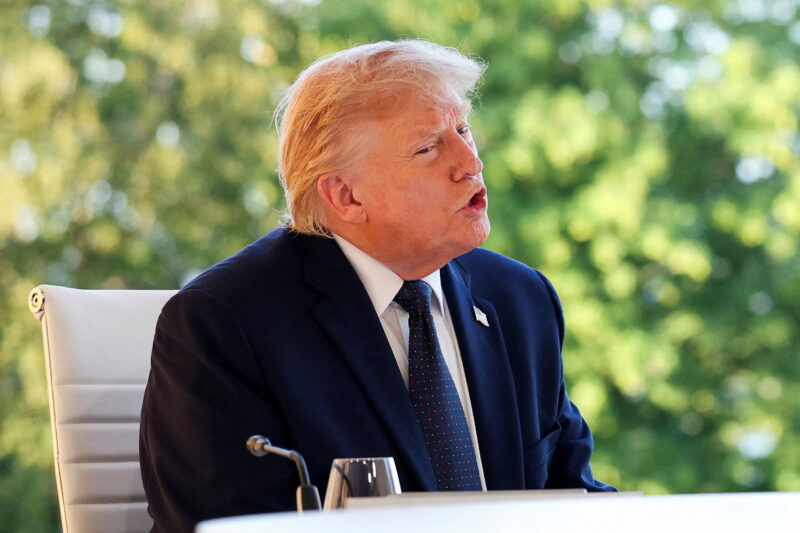
Isabel Infantes / POOL / AFP via Getty Images
US President Donald Trump attends a working dinner with G7 leaders during the G7 summit in Evian, central-eastern France on June 15, 2026.




 Add EJP on Google
For many in the Jewish communal world, as the United States and Iran enter advanced talks to formalize and expand the current ceasefire, the moment will feel somewhat familiar, with many similarities to the lead-up to the 2015 Iran nuclear deal alongside fresh obstacles and complexities to navigate.
The emerging agreement — details of which remain sketchy — has raised grave concerns in Israel and among its supporters, as the memorandum of understanding appears to leave the Iranian regime in place, potentially providing it with financial relief and without putting explicit curbs on many of its most distressing projects, namely its support for terrorist proxies around the world and its ballistic missile development program. The former in particular is not only a concern for the State of Israel but also for world Jewry, which has regularly found itself targeted by terrorist groups and individuals acting on Tehran’s behalf.
Without the full details of the agreement, it is impossible to assess its merits, yet Jewish leaders and organizations have expressed unease at the proposed MOU, which the White House is describing not as a final agreement but as a framework for negotiations. Some groups — those more hawkish on Iran and those more critical of President Donald Trump — have already denounced the arrangement, while more mainstream groups have adopted a “wait and see” approach, expressing concern but withholding judgment.
“The announced MOU kicks off a new 60-day window for talks. We look forward to learning the full details of the framework for these negotiations, including whether the deal preserves the sovereign right of our democratic ally Israel to respond to the security threats it confronts,” AIPAC said in a statement.
The progressive lobbying group J Street said that it “welcomes” the agreement.
In the years leading up to the 2015 signing of the Iran nuclear deal, the so-called Joint Comprehensive Plan of Action, Israel was also sidelined as its greatest ally — Washington — and its greatest external enemy — Tehran — negotiated an agreement that would have tremendous influence over its long-term national security.
Then too, the American Jewish community, which generally advocates for Israel, found itself navigating a fraught reality, balancing its communities’ various political opinions and affiliations, some of which clashed internally and some of which broke with those of the administration.
While there are similarities between the current negotiations and those of the JCPOA — both in regards to the content of the discussions and the complicated position that Israel and its allies find themselves in — there are also substantive differences.
The Iranian regime today finds itself both weaker and more emboldened than it was pre-JCPOA, having emerged intact for now after two major waves of joint American-Israeli attacks, even as those strikes have devastated much of the country’s military capabilities.
For Israel and the American Jewish community, however, the more significant difference is that the current talks are being led by a Republican president, who has regularly and repeatedly been lauded for his support for Israel, particularly in its campaign against Iran.
In part because of the efforts of Israeli Prime Minister Benjamin Netanyahu and his American allies as they unsuccessfully sought to thwart the 2015 JCPOA — including a divisive speech in Congress against then-President Barack Obama at the invitation of Republican leaders — support for Israel has become an increasingly partisan, Republican issue. Having allied so closely and publicly with Trump, particularly on Iran, it will be difficult to suddenly oppose him and to find allies, in the U.S. and internationally, who will do the same.
While there is broad consensus in Israel about the threat posed by Iran and the need for a robust military and diplomatic response to it, the country today is suffering from far greater internal turmoil than it was ahead of the JCPOA, a situation that will likely only worsen ahead of national elections this fall. Going into these talks, Israel also has more allies in the region than it did pre-2015, having normalized ties (under the first Trump administration) with the United Arab Emirates and Bahrain, and also improved relations with Morocco.
The American Jewish community also enters this new debate far more splintered and divided than it was pre-JCPOA. The already extant divisions among U.S. Jews regarding Israel have deepened significantly in recent years, particularly in the wake of the Oct. 7 terror attacks. This could be seen clearly earlier this year during the war with Iran, when a J Street poll found that most American Jews said they opposed American military action against Iran and a Jewish People Policy Institute survey of so-called “connected” Jews also found that support for the war was diminishing over time.