WHAT YOU SHOULD KNOW
Jewish groups join growing chorus of condemnations against Minnesota ICE raids
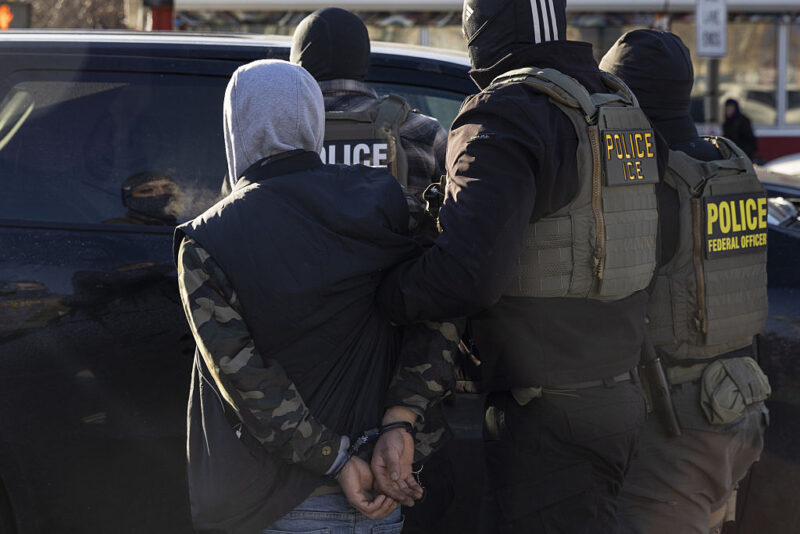
Mostafa Bassim/Anadolu via Getty Images
Federal agents arrest a man after stopping and questioning him in the street during an Immigration Enforcement Operation in Minneapolis on Jan. 14, 2026.




 Add EJP on Google
After an initially muted response to the immigration crackdowns in Minnesota, the Jewish communal world is increasingly voicing its opposition to the police violence that has been seen in the state and to the Trump administration’s raids in general.
Though some progressive Jewish groups immediately condemned the actions of Immigration and Customs Enforcement after an agent shot and killed Renee Good during a protest two weeks ago, most Jewish communal organizations initially refrained from directly commenting on the matter. In recent days, as the raids have continued — and the number of casualties in them has risen — local and national organizations have begun issuing statements on the matter and opening up about their efforts on behalf of the state’s immigrant communities.
Late Monday, the Minnesota Jewish community issued a statement on behalf of more than two dozen organizations and synagogues of all denominations raising deep concerns about the “current volatile situation throughout the Twin Cities and Minnesota,” noting that the crackdowns are directly affecting members of the Jewish community. And on Wednesday, the Reform, Conservative and Reconstructionist movements issued a joint statement condemning “in the strongest terms, the violence with which the Department of Homeland Security is enforcing American immigration law.” In conversations with eJewishPhilanthropy, local and national Jewish leaders stressed that this is not simply a debate about immigration, but an issue of the use of state violence against immigrants and citizens alike.
The new statements from Jewish groups come as public opinion generally is moving against ICE. A recent Economist/YouGov poll found that a plurality of respondents, 47%, believe that the agency is making Americans less safe and a 46% plurality thinks that ICE should be abolished.
The current Jewish communal response to the federal government’s immigration policies and enforcement tactics stands in contrast to the Jewish community’s reactions to the first Trump administration’s efforts, particularly its so-called “Muslim ban” in 2017, which mainstream Jewish organizations swiftly, forcefully and publicly opposed. This shift appears to reflect the major changes that the American Jewish community has undergone since then, particularly in the wake of the Oct. 7 terror attacks and the rise in global antisemitism that followed during Israel’s ensuing war in Gaza. In that time, the Jewish community has broadly adopted new priorities, adjusted alliances — after being disappointed by some former partners’ reactions, or lack thereof, to the Oct. 7 attacks — and changed its advocacy tactics, as it grapples with a new reality in which communal security is a top issue.
Indeed, Good was killed as the Jewish community was still reeling from the deadly terror attack in Sydney, Australia, and days later, the Jewish communal world’s attention was drawn to the arson fire at a Jackson, Miss., synagogue.
Since Oct. 7, many mainstream Jewish organizations have de-emphasized immigration advocacy, David Bernstein, the founder and CEO of North American Values Institute and the head of the Jewish Council for Public Affairs from 2016-2021, told eJP. This is part of a de-emphasis of domestic policy in general.
“They worry that if they play out their domestic concerns, they may lose influence on their foreign policy concerns or their core concerns around Jewish security and national security,” he said, especially when Iran and Israel are at the forefront of their minds.
Additionally, he said, some Jews feel that “the previous administration went too far in opening the door to undocumented immigration and that some corrective action was warranted, even if they feel that what we’re seeing now went way too far.”
Bernstein noted that one of the core examples of a Jewish organization that has shifted its priorities post-Oct. 7 is the Anti-Defamation League, which has actively pivoted from its past efforts in support of civil rights to focusing more on combating antisemitism. ADL’s actions “trickles down” to other organizations, Bernstein said, “but it’s also [that] the other organizations are making a similar, if not identical, calculation.”
The ADL, which decried the first Trump administration’s “Muslim ban” in 2017, has not publicly commented on the current Minnesota raids, neither through the national organization nor through its regional Midwest office. In a statement, the ADL told eJP that it has made combating antisemitism its “north star” and noted that it continues to work with immigration groups such as HIAS, the National Hispanic Christian Leadership Conference and the League of United Latin American Citizens. “In that manner, our approach remains consistent,” the group said.
Amy Spitalnick, CEO of the Jewish Council for Public Affairs, also acknowledged that there has been a shift in Jewish communal politics over the years, but advocated a return to those values.
Speaking out against the force that ICE is using “is precisely the sort of position that was considered consensus in our community five, eight years ago,” she said. “None of this should feel new or a shift for the community. It’s more, ‘How do we remind people this is where we’ve always been in our values?’”
Spitalnick accused “more extreme voices” in the Jewish community of painting these positions as “partisan or overly political, but speaking up about attacks on communities and our democracy has always been at the core of what the Jewish American community does.”
While the debate over ICE and the tactics that the agency has been using have been debated within the Jewish community since President Donald Trump took office, “over the last month, it just really felt it came to a head,” Rabbi Rick Jacobs, president of the Union for Reform Judaism, told eJP, explaining the timing of the joint statement.
“We just felt that it was critical for us to raise our voices, because what’s happening is really not who we are, it’s not who we are as Americans, it’s not who we are as Jews. It doesn’t mean that we don’t have legitimate criticism of the immigration policies, but [America] actually [has] laws,” he said.
Rabbi Jacob Blumenthal, CEO of the Rabbinical Assembly and United Synagogue of Conservative Judaism, who also signed the cross-denominational statement, told eJP that the issue hits close to home for many Jews, who are the descendants of immigrants. “That immigrant history is not so removed from our present reality,” he said. “It does feel personal to many of our people.”
Jacobs told eJP that the Jewish community should be able to stand for multiple values, including immigration, democracy and fighting antisemitism, concurrently. “You can stand up against antisemitism. You can fight for Israel. You can do all those things at the same time. We are a strong, smart people. To think that we can only do one thing at a time is not giving us the credit that we deserve,” he said.
The statement released by 26 Minnesota Jewish organizations represents the largest joint communication that David Locketz, rabbi at Minnesota’s Reform Bet Shalom Congregation and co-chair of the Minnesota Rabbinical Association, can recall in his 22 years serving the city. The statement took over a week to draft after Good’s death because everyone is so busy “reacting to things real-time on the ground,” Locketz told eJP.