WHAT YOU SHOULD KNOW
Funders look to rewrite a positive Jewish narrative at final day of JFN conference
courtesy/jfn
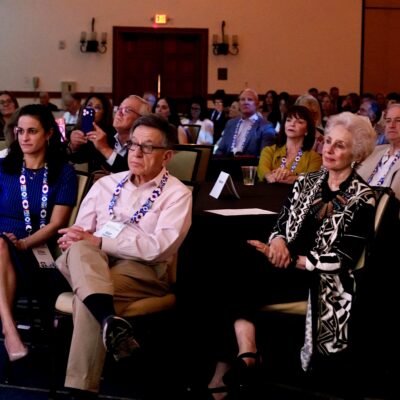
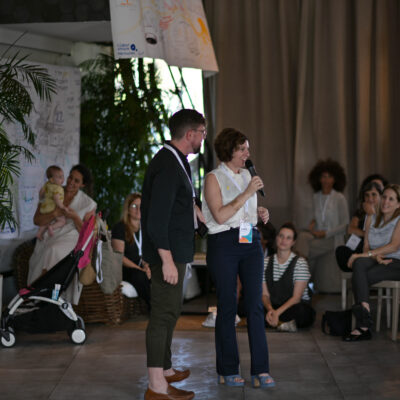
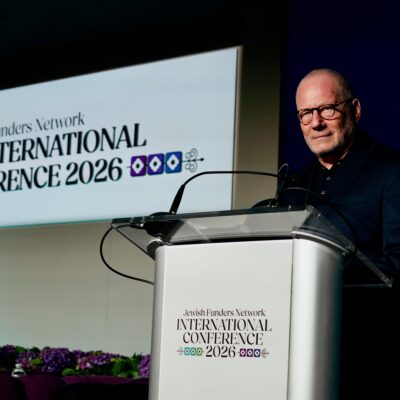
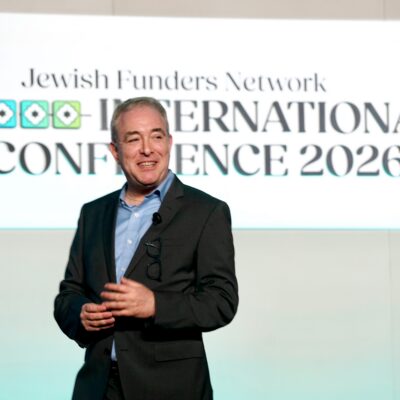
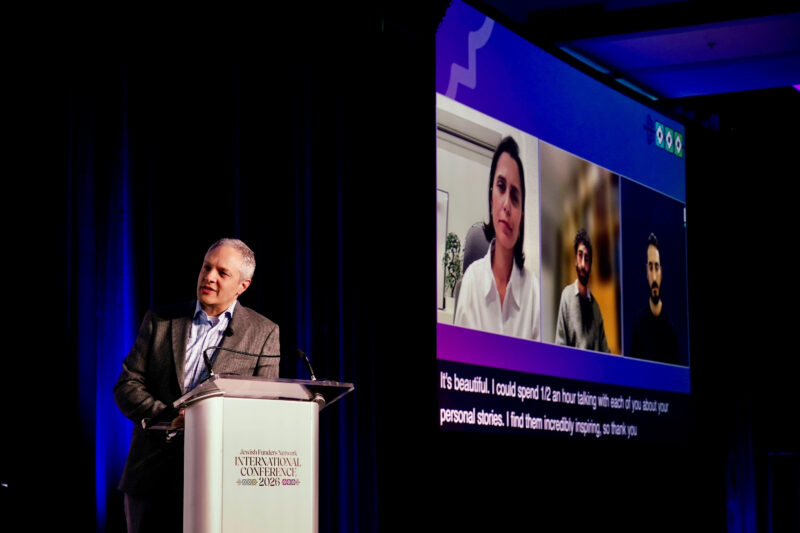
The Jewish Funders Network International Conference in San Diego on March 16, 2026.




 Add EJP on Google
SAN DIEGO — As the curtain closed on this year’s JFN International Conference yesterday, attendees made to-go plates with rice, beans and hummus and hugged each other goodbye. Then, dozens of the roughly 600 attendees didn’t leave. Instead, they lounged on tan couches outside the conference resort, basking in the California sun, leisurely picking at their Israeli salads.
The word for this is “lingering,” when a person is reluctant to leave, possibly because he or she is enjoying themselves or because they want to take in more.
The conference had programming after the event officially ended, including a Jewish Climate Trust cruise and the launch of JFN’s Day School Affinity Group, but for many who stayed, it was about taking in last moments with friends.
Compared to Monday’s programming, which included JFN President and CEO Andrés Spokoiny’s list of action items for funders to focus on and the announcement of a $2 million matching campaign to heal Israel, Tuesday’s programming was lighter. The San Diego conference was attended by funders and representatives from philanthropic foundations, many excited that their investments into day schools were paying off and dreaming up the next chapter in the Jewish narrative.
Being at the conference was “a dork-out” moment for first-time attendee Jerami Schecter, who was representing philanthropist Sophie Nahum, the funder behind The Last Ones, an organization that honors the final survivors of the Holocaust through documentaries and media, told eJewishPhilanthropy. “To me, these are celebrities,” she said about being with Jewish leaders and funders. Although she knew the time to leave was nearing, she was in no rush to return home to Miami.
For the past year, she has primarily been speaking with philanthropic peers virtually, so it was a thrill for her to meet them in person. She even had to purchase a new pair of pants for the event, she said.
Meeting Megan Hyman, president and CEO of the Dallas Jewish Community Foundation, was a highlight of the conference for Schecter. She said she immediately knew Hyman was “her person” when she spotted her powder blue cowboy boots.
In a room a few feet from where Schecter was beaming, over 60 attendees were celebrating the launch of the JFN’s Jewish Day School Affinity Group, the idea for which was birthed at last year’s conference in Nashville, Tenn. The affinity group is made up of 13 funders: the Adelson Family Foundation, Arnee R. and Walter A. Winshall, Crown Family Philanthropies, Jewish Foundation of Cincinnati, Jim Joseph Foundation, Kopelman Foundation, Lisa and Arieh Coll, Mayberg Foundation, Suzanne Priebatsch, The Beker Foundation, The Naomi Foundation, The Zalik Foundation and the Israeli Diaspora Affairs Ministry’s UnitEd initiative.
Before attendees broke into discussion groups, wrestling with topics including enrollment, affordability, the teacher pipeline and taking advantage of new tax cuts, Paul Bernstein, CEO of Prizmah, spoke about the day school movement’s recent growth.
Only a decade ago, “people were questioning whether day schools would have a future, and it really was not a priority in any national organizations,” he said. Today, 101,000 students are enrolled in non-Haredi day schools, marking a 7% increase over four years ago.
“Our broader community is increasingly recognizing this extraordinary and life-shaping role and power of Jewish day school education, not only as a path to academic excellence or Jewish literacy, but it’s one of the strongest ways that we can invest in Jewish peoplehood itself,” Amy Schlussel, JFN project manager of the affinity group, said. “Day school leaders, day school professionals, day school investors have been patiently waiting and asking about how philanthropy can help move the entire field forward, and this momentum only matters if everyone in the room carries it forward and translates this energy into action.”
The morning itself began with the conference’s final plenary describing the importance of telling stories .
Instead of humans referring to themselves as homo sapiens, Latin for “wise man,” author Jonathan Gottschall suggested a better moniker: Homo fictus, Latin for fiction man or story man.
“Man is a storytelling animal,” he said. Humans instinctively tell stories and create meaning from their experiences and what they see, but recently, people have been curating “radically different movies [from the information], movies with crisscrossed heroes, crisscrossed villains, totally different morals of the story,” he said. And this is exacerbated by social media and AI.
Still, the stories people tell themselves and each other can be used to “build bridges of narrative across our cultural divides,” he said. “Jewish people are living inside the greatest and the oldest story ever told… History has swirled you around in nightmarish centrifugal forces, and those forces did scatter you to the edges of the earth, but your stories held you together.”
Sarah Hurwitz, former speechwriter for President Barack Obama and First Lady Michelle Obama, and The Times of Israel’s Haviv Rettig Gur then took the stage to discuss the narratives driving Jewish life today.
“If I had a headline for the story that American Jews have been telling ourselves, it would be something like this,” Hurwitz said. “We, unlike Jews before us, somehow managed to escape history.” In America, Jews told themselves, hard work and ambition could lead to success, but post-Oct. 7, that narrative has crumbled.
“Democracy and liberalism are being subsumed by populism and illiberalism on both the right and the left; things like expertise, achievement, financial success, these are now suspect,” Hurwitz said. “So rather than being admired for our accomplishments, we’re increasingly being vilified for them. In addition, the battle against antisemitism today, it isn’t just in courts and legislatures and in traditional media, it is very much online. It’s on social media, which very much shapes how people think and feel and act.”
Israelis, on the other hand ,have cultivated a different narrative, Rettig Gur said, one about a nation that was scattered in the Diaspora, which refound its identity.
“Jews came in their millions to Israel because they suddenly had this surge of identity,” he said. “They suddenly felt this deep sense of a need to return to the old and true and authentic identity and leave behind all the separate, contingent kinds of identities, the dependence on others, the fragility and vulnerability and meekness of other people’s cultures and nations.”
But that narrative, too, has failed the Jews, he said, because Israel forgot it is a country of survivors, people who escaped pogroms and expulsion, who came to the country because they had nowhere else to go.
Losing this connection to its history, puts Israelis on the wrong side of the increasingly common worldview, which divides people in two: those with power — Israelis, in this case — and those without it. In this worldview, there is an expectation that the underdogs will eventually prevail as they can bear the burden of suffering, which the powerful cannot do.
But unparalleled power is not the full story of Israel, he said. “Israelis are actually much more resilient,” and post-Oct. 7, Israelis are realizing their resiliency. “We have begun to discover our story and therefore to discover our strength.”
For Hurwitz, the problems Americans are facing cannot be solved by simply investing in day schools, she said, though that is important. “The deeper challenge that we have right now… is that we finally need to reckon with the decisions that Jews in Western Europe made during our transition to modernity years ago, because those decisions have very much shaped American Judaism, and they have very much come back to haunt us today.”
The Jewish people, she said, essentially put “a Protestant cookie-cutter into Jewish tradition, and they ditched or deemphasized everything that didn’t fit, including 2,500 years of post-biblical texts that are the beating heart of Judaism.”
Jews need to realize, she said, they are not simply a religion, but “a joinable tribe/peoplehood/family that is based on a textual tradition.” In that narrative, Jews in Israel are not simply people who share the same religion as American Jews, but family members. The story post-Oct 7 should be about the Jewish community embracing their tribe and 4,000 years of wisdom.
“Maybe comfort and acceptance should not be our highest values,” Hurwitz said. “Maybe social exclusion is actually not the worst thing in the world.”
The plenary ended with Alon Ohel, a 24-year-old Israeli pianist who was kidnapped on Oct. 7 from the Nova Music Festival and spent 738 days in captivity in Gaza, playing two songs for attendees, via a taped video. While in captivity, music gave him comfort as he sang music to himself in his head and was transported into another world.
Throughout his ordeal, Ohel said he clung to hope. “I chose life,” he said to the audience after saying that he had contemplated suicide in captivity. Even before seeing the footage, he knew people were protesting and loved ones were fighting for him. “I know Israel. I know my family.”
Ohel’s return was not “just a miracle,” his mother said in the video. “We worked for it.”
The session was capped off with the announcement that the JFN conference would return to Israel next year, on March 14-17 in Tel Aviv, three years after the last JFN conference in Israel — just a few months after the Oct. 7 attacks.
The weather in Tel Aviv in March is typically in the upper 60s, only slightly below San Diego’s never-changing, not too hot, not too cold temperature. The White City also has many exceptional tan couches overlooking the coast — the perfect setting for some high-quality lingering.