EXCLUSIVE
Full World Zionist Congress power-sharing agreement shows bloat, no plans to address voter fraud
The document, which will be put to a final vote on Sunday, significantly increases budgets and adds many new departments to the WZO with unclear mandates
Judah Ari Gross/eJewishPhilanthropy
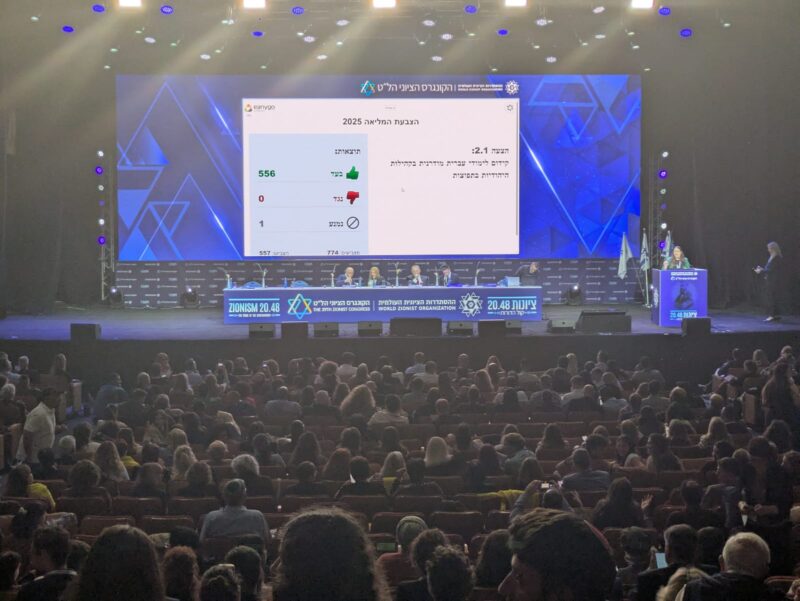
Delegates vote in the 39th World Zionist Congress in Jerusalem on Oct. 29, 2025.




 Add EJP on Google
The full World Zionist Congress power-sharing agreement, which will be put to a vote on Sunday, shows significant budget increases for existing offices and a major expansion in the number of departments. It also includes no plans to address the rampant voter fraud that plagued this year’s elections, according to a copy of the document that was shared exclusively with eJewishPhilanthropy.
The agreement comes as the so-called National Institutions — namely the World Zionist Organization and Keren Kayemeth LeIsrael-Jewish National Fund — are facing growing scrutiny for waste and corruption. The criticism, which is coming increasingly from figures within the Zionist system, particularly focuses on allegations of cronyism, inefficiency and pork-barrel spending, particularly by creating well-paying positions with little to no demands. Earlier this month, the centrist Yesh Atid party announced that it was withdrawing from the WZO and KKL-JNF, calling them “corrupt.”
The deal, which was signed by representatives of the relevant parties, will be put to a vote on Sunday by the congress’ executive committee, the Vaad Hapoel, where it is expected to pass.
The full 16-page agreement, written in Hebrew, has been kept closely guarded by the negotiating teams, with even some members of the Vaad Hapoel not receiving the document, despite having to vote on it. Critics of the agreement told eJP that this was likely to avoid scrutiny and pushback ahead of the vote.
The agreement expands the number of departments within the World Zionist Organization from the current 14 to at least 21, though this may expand to 24. The purposes of the new WZO departments are not included in the deal, and their names do not clearly indicate their missions or how they differ from existing ones. What, for instance, will be the difference between the “Tikkun Olam and Social Involvement Department,” which will be led by a representative from the center-left bloc, and the “Social Justice in Israel and the Diaspora Department,” which will be led by a representative from the center-right?
The heads of these departments receive compensation similar to an Israeli government minister —roughly $200,000 pretax — and with an assistant and driver. In addition, the deal allows the heads of certain departments and other senior roles to hire additional senior staff members.
As has previously been announced, the agreement splits the leadership of the WZO and KKL-JNF in two, granting each bloc a half-term as chair. The WZO will first be led by a representative of the right-wing bloc, specifically from World Likud, followed by someone from the left. KKL-JNF will first be led by a representative of the center-left faction, followed by someone from Likud.
The agreement does not include the names of candidates for different positions, though these too will have to be approved by the Vaad Hapoel. While there is clear agreement on the identities of two of the incoming leaders — World Likud’s Yaakov Hagoel as WZO chair for the first half-term and World Mizrachi’s Rabbi Doron Perez as WZO president for the full five-year term — the issue of who will serve as chair of KKL-JNF, an organization that controls more than 10% of the land of Israel and has a budget and political influence to match, has yet to be resolved. One name that has been rumored to be in the running for the position is Gil Segal, a former CEO of the Yesh Atid party. Segal has not publicly commented on the matter, and Yesh Atid announced that if Segal takes the position, he would lose his affiliation with the party and said that there would be a “suspicion of corruption that must be investigated.”
The agreement significantly expands the budget and standing of the WZO presidency, which had been a largely ceremonial role. As president, Perez will have a staff that is the same size as that of the chairs of the WZO and KKL-JNF. The president will also gain an additional budget of $600,000 annually, split evenly between three projects: a “Unity of the Jewish People Taskforce,” “initiatives to strengthen Jewish-Zionist identity among young people in the Diaspora” and to support the celebration of Israeli national holidays around the world, such as Yom Ha’atzmaut and Yom HaZikaron.
Though its supporters tout the deal as a bipartisan effort — splitting power between the right and left — in addition to excluding the far-right Otzma Yehudit party, which was a prerequisite for the center-left, the agreement also keeps out the centrist Kol Israel-General Zionists faction. Insiders told eJP that this was a form of punishment by the center-left bloc over the faction’s opposition to an earlier proposed deal.
In an opinion piece in Israel’s Maariv newspaper, Kol Israel Chair David Yaari, who currently serves as a vice chair of KKL-JNF, wrote that the latest congress represented a “crisis of faith” and called for the National Institutions to undergo fundamental reform.
“It is not too late to bring back the Jewish People’s faith in the congress, which is supposed to represent it, all of it — from all sides, directions and opinions,” he wrote. “If we know how to execute a real pivot, we will be able to return to Zionist what has been taken from it: direction, value and soul.”
The agreement substantially increases the budget for the World Zionist Organization by $22 million annually, with the potential for further increases based on a consumer price index. It also allocates significantly higher budgets to Zionist federations around the world, including doubling the budgets of the largest ones — U.S., France, Canada, U.K. and Argentina — and increasing the rest by 75%. Zionist youth movements will also see their funding increased by 50% under the deal. It calls for an unspecified amount of greater funding of other educational activities for Israeli youth, including for informal education programs, pre-army preparatory programs, student villages and military yeshiva programs (hesder yeshivot).
In a win for progressives, the agreement demands equal funding for all Jewish denominations, including a newly recognized “humanist-cultural stream” of Judaism.
The agreement allocates funds for several large projects, including some $30 million to renovate the entrance to the Har Herzl national cemetery in Jerusalem, $3 million for the adjacent Herzl Museum and $15 million for Independence Hall in Tel Aviv. The deal also allocates $2.4 million annually to “strengthen Jewish identity through Zionist activities and Zionist leadership development among students on [college] campuses in the Diaspora.”
The deal frequently discusses the growing needs of Israel and world Jewry in the wake of the Oct. 7 terror attacks and past two years of war. It includes a $106.6 million allocation by KKL-JNF for reconstruction projects in the Gaza border region.
Absent from the agreement, which includes policy plans for the coming five-year term, is any mention of the widespread fraud that plagued the World Zionist Congress elections this year, not only in the United States but in virtually every country that held a vote this spring, which was almost exclusively intended to benefit religious and right-wing parties. A member of the center-left bloc, speaking on condition of anonymity to discuss internal politics, told eJP that the issue was raised during negotiations and that a decision was made not to push for election reforms in the deal out of a sense of “unity.”
This does not mean that the WZO cannot address the matter before the next elections in 2030, but indicates that this will not be a priority and that is not a consensus issue, despite warnings that the fraud damages the integrity of the National Institutions and makes it more difficult for slates to convince people to vote.
The agreement bars WZO educational programs from including “controversial” topics, without designating what that entails and how it would be determined.
Related News
HIGHER EDUCATION
As Jewish donors reconsider academia, Jan Koum doubles down, endowing Israel studies at Stanford
ADVANCING A VISION
N.Y. federation donates $1M toward building shared-society center named for peace activist killed on 10/7
PRESIDENTIAL REBUKE
Israel’s Herzog: Mamdani ‘makes no effort’ to hide disdain for Israel, Jews must fight back
EXIT INTERVIEW
Elizabeth Sokolsky, longtime EVP of Birthright Israel, to retire next year

MAGICAL EXPERIENCE
Shefa launches psychedelics retreat for Jewish professionals suffering burnout