WHAT YOU SHOULD KNOW
Excitement, anxiety as Israeli kids head back to school
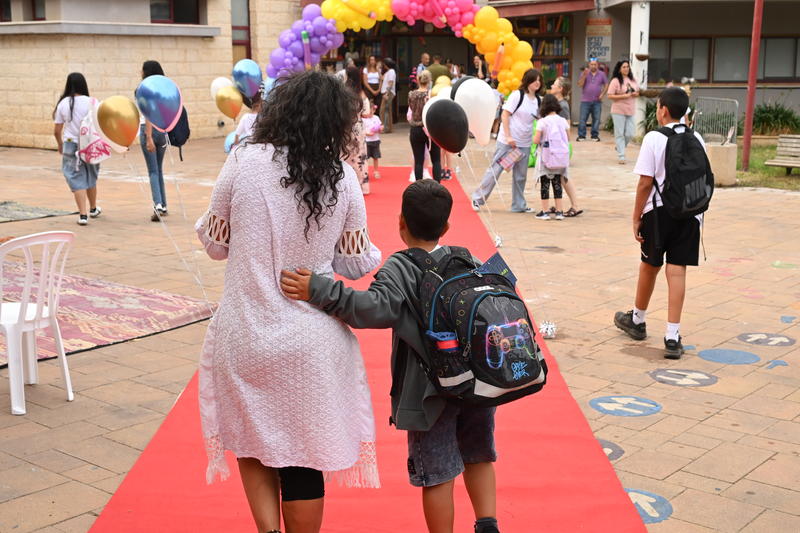
Michael Giladi/Flash90
Children arrive to their first day of school at the Gamla School in the northern Israeli town of Katzrin, on Sept. 1, 2026.




 Add EJP on Google
Millions of Israeli parents breathed a collective sigh of relief this morning: School is back in session.
While in the United States, different states, counties and districts start their school year on different dates, in Israel (and most of the rest of the world), all children return to school on Sept. 1 — the one exception being Haredi boys, who generally start at the beginning of the Hebrew month of Elul, which this year began on Aug. 14.
But alongside the excitement and pride as some 2.6 million Israeli kids made their way to roughly 28,000 schools today — including some 180,000 kids starting first grade (one of them being this proud reporter’s son) — there are also grave concerns about the state of the country’s education system in general and particularly its ability to handle the growing emotional and social needs of Israeli children following nearly three years of continuous war and stress.
Israel’s Education Ministry declared that, in schools across the country, the first week of the year would focus on “strengthening belonging, resilience and interpersonal skills.”
“The start of the year on this path rests on the understanding that effective study cannot take place separate from the student’s emotional and social world,” the ministry said in a statement. “Throughout the year, these principles will be integrated into educational and pedagogical work, through a connection between resilience and belonging and study, achievement and ability.”
As part of a broader understanding about the risks to students posed by social media and screen usage, many schools across the country, including all middle schools, have banned cellphones on their premises.
As has been reported in these pages, a recent study by the social policy-focused Taub Center think tank found that hundreds of thousands of Israeli children with at least one parent who performed reserve duty are struggling with greater emotional and behavioral issues than their peers, and they are less prepared for elementary school.
These greater challenges come as Israel’s education system faces a shortage of teachers, both overall and particularly in math and science. This is most acute in the country’s geographic center, where there is a need for at least 200 more teachers.
In a Kan radio interview this morning, Israeli Education Minister Yoav Kisch acknowledged the shortages and the fact that, as a result, some teachers are being forced to teach more than one class-load of students at a time, but said that such cases are rare. “These are some of the pressures that we are dealing with. Can I say I love it? The answer is no,” he said.
Carmel Blank, a senior researcher at the Taub Center and at Netanya’s Ruppin Academic Center, told eJewishPhilanthropy in June that a major investment was needed to improve the country’s early childhood education system, which is responsible for roughly a fifth of all Israeli children.
“If we don’t change the system and don’t invest billions of shekels within the system, we will not get the change that the system needs,” Blank said, noting that the State of Israel is willing to allocate significant funds for national security. “But this safety also means helping… children thrive and develop.”
This year, Israeli schools will also focus on financial literacy and integrating artificial intelligence, as well as more generally boosting science and math education. This comes as recent test scores have shown a marked decline in Israeli students’ performance in these areas — the sharpest drop among developed nations — and amid new reports that have found that Israeli teachers tasked with teaching science lack training in the field.
“Sometimes there aren’t appropriate teachers. This has existed in the [school] system for years, and didn’t emerge yesterday. We are doing the most that we can for training teachers,” Kisch said.
In his radio interview, the education minister acknowledged Israel’s dropping international test scores, but blamed it on the country’s security situation, which disrupted schools.