WHAT YOU SHOULD KNOW
Baseless hatred, out. Fruitful debate, in.
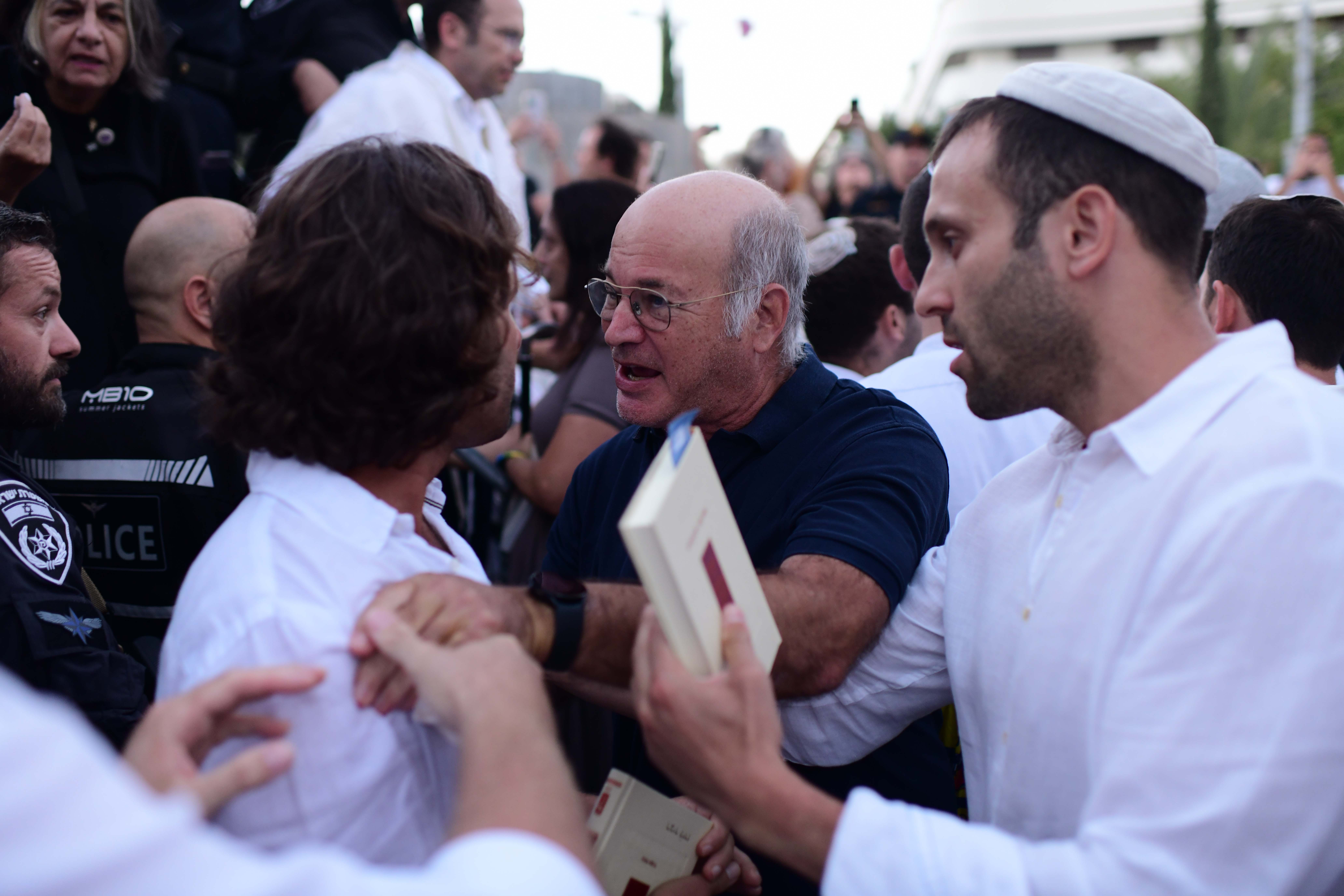
Tomer Neuberg/Flash 90
Secular activists argue with Orthodox activists over the placement of a gender divider during a public prayer in Dizengoff Square in Tel Aviv for Yom Kippur on Sept. 24, 2023.




 Add EJP on Google
We are living in a time of feuds, of division and polarization, and of dehumanization and ignorance. And we are also in a time of profound urgency, of both grave challenges and consequential opportunities.
And that combination represents a two-fold shame. It is a shame because the Jewish People — never a particularly large population — is unable to come together to most effectively address those challenges and take advantage of those opportunities. And it is also a shame because the increasingly sectarian divisions on display within Israel, the U.S. and world Jewry more broadly obscure the genuine, fruitful, principled debates that could help better inform the Jewish community’s path forward.
As Jews around the world mark Tisha B’Av tonight and tomorrow, mourning and commemorating the destruction of the temples in Jerusalem, along with other historic tragedies that befell the Jewish People, many will draw comparisons to and warn of the threat posed by sinat hinam, baseless hatred, the traditional reason given for why the Second Temple was destroyed by the Romans.
Such warnings are well-based. As Anu Museum of the Jewish People educator Naama Klar quipped last week at a rare gathering of Israeli religious Zionist and Diaspora non-Orthodox leaders, the reason why baseless hatred is widely accepted as the reason, and not any of the others offered in the Talmud, is “because it is the right answer.” For a small, geographically dispersed, heterogeneous people like the Jews, baseless hatred is acutely toxic.
In Israel, particularly, as the country prepares for national elections this fall, the type of senseless, divisive hate has already emerged, making true debates about the country’s path forward more difficult to hold.
The right-wing Religious Zionism Party has a markedly different worldview and set of priorities than the progressive Democrats Party — about security, religion-and-state issues and civil rights. But that debate — a critical discussion to be had in a country without a constitution — is not taking place when the Religious Zionism Party posts an AI-generated video on its Instagram, giving Reform Rabbi Gilad Kariv, third on the Democrats Party’s slate, the nickname “bar mitzvahs for dogs.” Repeating a baseless canard about Reform Jews does not advance a serious debate about religion or politics, about the differences between Reform and Orthodox Judaism; it shuts down those discussions — and alienates more than a third of American Jews to boot.
To be sure, Yair Golan, the head of the Democrats Party, has faced his own criticism for using dehumanizing language, referring to residents of an illegal West Bank settlement as “subhuman” in 2022. (Following a backlash, he apologized for using the term, but stood by his criticism.)
In a primetime address last night, Israeli President Isaac Herzog warned of exactly this, calling on all sides to be respectful and to accept the election results.
“I call on the people of Israel, in a clear voice: remember that elections are not a civil war. Disagreement and criticism are the lifeblood of our democracy, but our belonging to this place, and our responsibility for our shared future here — for our children, for our grandchildren — come before all else and are the highest priority,” Herzog said.
But while baseless hatred is indeed a threat to Jewish continuity, shutting down debate and disagreement cannot be the solution.
In his commentary on the book of Genesis, Haamek Davar, 19th-century Rabbi Naftali Zvi Yehuda Berlin, known as the Netziv, understands the Tower of Babel, built by a people who spoke the “same words,” as representing a people with no disagreement — a dystopian possibility.
“And the ‘same words’ can also be seen as the fact that they would kill whoever did not think like them,” he wrote.
Honest, frank discussions make you question your priors and see an issue from a new angle. It can sharpen and improve your position, addressing the weak points.
“In an argument for the sake of truth, both sides win, for each is willing to listen to the views of its opponents, and is thereby enlarged,” Rabbi Lord Jonathan Sacks wrote in his commentary on Parashat Korach, which introduces the distinction between arguments for the sake of heaven and arguments for power.
For the Jewish community going forward, not only on Tisha B’Av but for the months and years to come, the challenge will be in knowing how to distinguish between senseless hatred and rigorous debate.
“A healthy culture protects places that welcome argument and respect dissenting views. Enter them and you will grow, others will grow, and you will do great things together,” Sacks wrote in his 2020 book, Morality. “But resist with all your heart and soul any attempt to substitute power for truth. And stay far from people, movements, and parties that demonize their opponents.”