WHAT YOU SHOULD KNOW
After latest flare-up, Israel’s tour guides are still hanging on — barely
Hadas Parush/Flash90
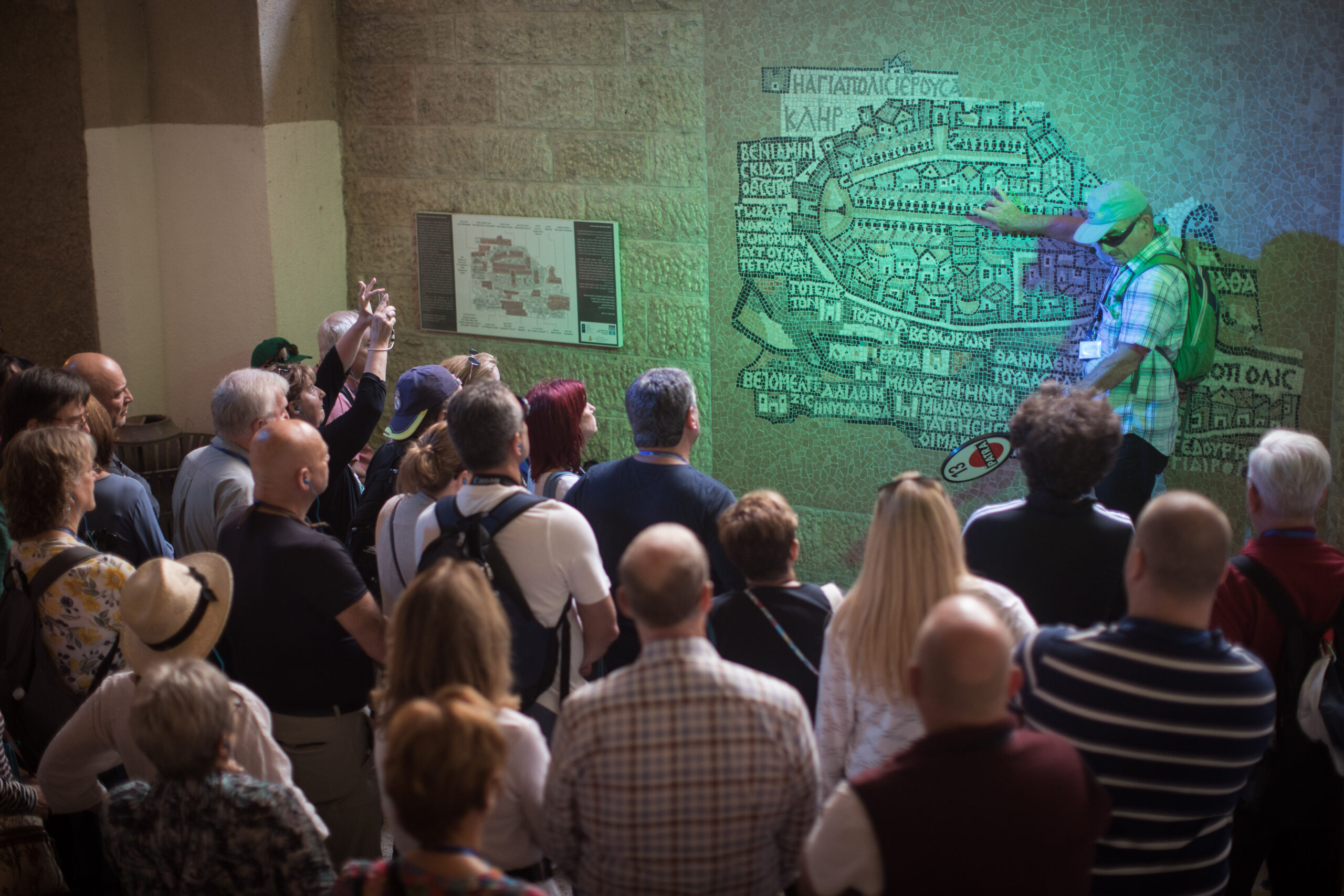
A group of tourists listen to a tour guide in the Cardo in the Jewish Quarter of Jerusalem's Old City, on Nov. 3, 2019.




 Add EJP on Google
One Israeli tour operator doesn’t go out for coffee anymore. Another has an application for nursing school sitting on her desk, waiting to be submitted. Still another pivoted to virtual tours.
With the Israel travel field decimated over the last six years by a crippling pandemic followed by the Oct. 7 terror attacks and nearly three years of constant war, tour operators — the unsung and often unsupported heroes of the field — are hurting.
This week’s one-day battle between Israel and Iran, coming just as tour guides are beginning to gear up for the prime summer season, has further flung the already battered field into a state of deep uncertainty.
As missile barrages from Iran and its proxies in the region sent Israelis scrambling back to bomb shelters, for Israeli tour guides, those sirens represented more than just an attack on their lives but on their livelihoods as well. And they come ahead of a summer period that, for many guides, represents the bulk of their annual income. Every missile and siren is another cancellation email waiting to be sent.
“There is no stability,” Pauline Kelif Scheiner, 46, a tour guide since 2008, told eJewishPhilanthropy today.
Another guide, who lives in the Golan Heights and has been guiding for the past five years, told eJP that the downturn in the industry affects not only their bottom line but their mental health. “I am counting shekels because of how much income I’ve lost in the past four months. I am not going out for coffee. I don’t feel like I have a reason to get up in the morning,” the guide said.
Most tour guides (some prefer to be called tour educators) are not employed by the tour operators who use them, and instead are atzmai, or independent — the Israeli classification for a freelancer or someone who is self-employed. Even when their income drops due to war, this status makes it more challenging for them to claim unemployment benefits, which are normally calculated based on monthly paychecks — a problematic measurement for a field that is seasonal in nature.
Tour educators are also only compensated once a group lands in Israel, assuming it does. If a group cancels, they do not get paid. Having already blocked off those dates, they scramble to fill them, unlikely to find a weeklong group and instead are forced to settle for day or half-day guiding gigs that usually pay less.
“For tour guides, it didn’t start on Oct. 7[, 2023,],” said Kelif Scheiner, who lives with her husband and three daughters on Kibbutz Almog, north of the Dead Sea. “It started with COVID… and when we finally, finally started working again — then Oct. 7 happened.”
During the COVID-19 pandemic, she didn’t wait at home. Like many of her colleagues, she reinvented herself entirely. “Tour guides with cars just became taxi drivers. I worked in so many different jobs that have nothing to do with tourism,” she said.
But even as she adapted, she never lost sight of what the profession demands. “You cannot be a tour guide if you do not love people. You cannot be a tour guide if you do not love this profession — it demands so much of you. You spend long days away from home, sometimes a week in a row, three weeks in a row,” she said. “When you are with a group, you are so devoted to it. You cannot do it halfway. This is what makes a good tour guide. They are not just a tour guide, they are an educator.”
The essence of the work, she said, goes beyond reciting facts and dates. “You need to open up and invite them into your home and your heart and your thoughts. That’s what makes the difference between someone who repeats facts and dates and a true tour guide.”
The financial toll has been severe. Several guides told eJP that since COVID, there has not been a serious minister who truly understands the field of tourism at the Tourism Ministry. The current minister, Haim Katz, was a trade unionist before entering politics and also heads the Ministry of Construction and Housing and the Health Ministry.
While airlines and hotels, which tend to invest heavily in lobbying, have received financial assistance from the government through the crises, tour guides have largely been left with nothing. “What we received was so small and so little that people lost everything they had,” Kelif Scheiner said. “Some of my tour guide friends sold their houses, sold their cars, and lost everything.”
On her desk sit the forms to enroll in nursing school — filled out twice. “I would stop doing the thing I love doing the most, that defines who I am, because I miss stability for my family. I always had this hope that tourism would come back,” Kelif Scheiner said.
Amy Ben Dov has spent the last 30 years guiding visitors through the country she has called home for the past 34 years. For Ben Dov, who attended Jewish summer camps throughout her life, this work is deeply personal — so much so that she and her husband have built their lives and their livelihoods around guiding. She focuses primarily on the Reform movement’s NFTY youth group, as well as private family tours and individuals, while her husband guides Birthright trips — a strategic division of labor that has allowed them to balance home life and guiding life.
“Since COVID, this has been the biggest challenge of our careers,” Ben Dov said. “Most tour guides love being outside, and to replace our jobs with retraining as a teacher inside — what we do is much more all-encompassing. We are able to use the land as our classroom.”
Like Kelif Scheiner, Ben Dov and her colleagues pivoted during COVID, stepped into virtual tours for communities outside of Israel. “Then we went back to work. We were so happy and building towards our future — and then everything came crashing down, for us but also for all of Israel. Our challenge was personal and professional: how to continue forward, having enough work to support our family. And to reimagine Israel — to learn how to talk about Israel in a post-Oct. 7 world.”
That reimagining is not just emotional — it is existential for the industry. An Israeli travel industry veteran, who has 25 years of experience in the field, told eJP: “In our business, the human component is the key to our success. Israel has amazing tour operators and travel professionals working with the American market — and how do we manage to keep them?”
The answer, warned the industry veteran, who asked not to be named, is not guaranteed: “Our treasure and our secret sauce is our tour educators and staff. If you put them on furlough or unemployment every time there’s an escalation or a major crisis in our region, who is going to do this important work?”
A second industry professional was even more direct: “If we don’t compensate our tour educators, we are going to lose them in the future.”
Ben Dov understands what would be lost. “People who come for the first time think they’re getting a tour guide like they would get in Paris or London,” she said. “But the guide’s role in Israel is to be a facilitator of experience, a connector to our shared history and a window into a lifelong relationship with Israel and Israelis.”
Kelif Scheiner has not yet sent in the nursing school forms. Her hope, though fragile, is not entirely gone. And the guide in the Golan is holding on to something too. “We do our best,” she said, “and there is some greater plan we cannot see right now. Leaving it up to faith. Or using faith as comfort.”