The Dialogue of Jewish Peoplehood: Millennial Children of Intermarriage




 Add EJP on Google
 [This essay is from The Peoplehood Papers, volume 17 – Engaging Millennials with Jewish Peoplehood What Does It Take? – published by the Center for Jewish Peoplehood Education.]
By Fern Chertok and David Mittelberg
Jewish Peoplehood is the subjective claim of belonging and commitment to the local and global Jewish collective and captures the extent to which this connection is a defining element in one’s sense of self. It is also important to keep in mind that Jewish Peoplehood is not fixed or impervious, but instead, like a dialogue, it is influenced by interactions with and experience of the communal environment. There is no group with which to better see the potential for and importance of the Jewish Peoplehood dialogue than young adult children of intermarriage.
Children of intermarriage in the millennial generation, born between 1981 and 1995, are more likely than their older counterparts to identify as Jewish in young adulthood (Pew Research Center, 2013). Millennial children of intermarriage, also represent half of their generation of Jews. We have used interview and survey data collected as part of a large-scale study of millennial young adults[1] to explore the Jewish Peoplehood dialogue between children of intermarriage and the Jewish community.
Jewish formal and informal education reaffirms collective identity, builds the reservoir of shared memories and provides, in microcosm, the experience of Jewish community. Unfortunately, the typical child of intermarriage lacks these childhood experiences. For many, not becoming a bar or bat mitzvah is emblematic of their sense of being outsiders to the experience of being part of the Jewish community. As one young man expressed it; “I’ve kind of missed out on the whole bar mitzvah thing. Everybody I’ve ever known has had one and I didn’t.”
We reanalyzed survey data using four empirically derived dimensions of Jewish Peoplehood: collective belonging – identification with the Jewish people; personal responsibility – commitment to the welfare of other Jews; connection to other Jews – the desire to have personal Jewish networks; and Jewish capital – the possession of cultural knowledge and skills.
On all four of these dimensions, children of intermarriage without childhood Jewish education rate themselves lower than peers from with two Jewish parents or peers from intermarried homes with a history of Jewish education.
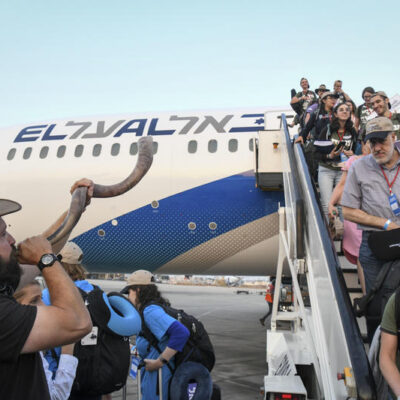
Many children of intermarriage enter young adulthood claiming a connection to the Jewish collective but feel that it rests on a limited foundation. However, experiences during young adulthood, such as Birthright Israel, can restart the Jewish Peoplehood dialogue. Young adult programs provide many of the Jewish Peoplehood experiences that children of intermarriage missed including connection to a peer group with whom to build shared memories. Being accepted to participate in Birthright, for many, represents formal validation of their claimed sense of connection to the Jewish people. As one young adult put it, “The first thing they say when you get off the plane is ‘welcome home.’ I left there feeling like these are my people.” With the exception of Jewish capital, participation in Birthright increased all dimensions of Jewish Peoplehood.
The takeaway is that the Jewish Peoplehood dialogue of children of intermarriage can be prematurely truncated and diminished through the absence of childhood experiences. But, perhaps most importantly, it can also be restarted and recharged in young adulthood.
[1] For full details of the study see Sasson,T., Saxe,S., Chertok,F., Shain,M., Hecht,S., & Wright,G.(2015). Millennial children of intermarriage: Touchpoints and trajectories of Jewish engagement. Waltham, MA: Cohen Center for Modern Jewish Studies, Brandeis University.
Fern Chertok is a Research Scientist at the Cohen Center for Modern Jewish Studies at Brandeis University. David Mittelberg is Chair of the Steering Committee, International School, Associate Professor for Sociology on the Faculty of Graduate Studies and former Chair of the Department of Sociology at Oranim. Together Fern and David conduct research on the measurement of transnational Jewish Peoplehood and its development in youth and young adults.
An earlier draft of this piece was presented at the “Wrestling with Jewish Peoplehood” conference, April 10-11, 2016.