Opinion
SAFETY FIRST
When all else fails: Filling a gaping hole in our communal security strategy




 Add EJP on Google
In Short
In spite of best efforts, the last line of defense against an antisemitic act of violence may be you or me. Time to get ourselves prepared.
As the executive director of a New York City synagogue, the assault at Central Synagogue a few weeks ago on Shabbat was a shocking, but not unexpected, nightmare-come-true.
To be sure, this was a partial security success. Central Synagogue’s on-site security team detained the attacker within minutes. While he still managed to assault a congregant and security guard while being escorted out, no one was seriously injured — or G-d forbid, killed.
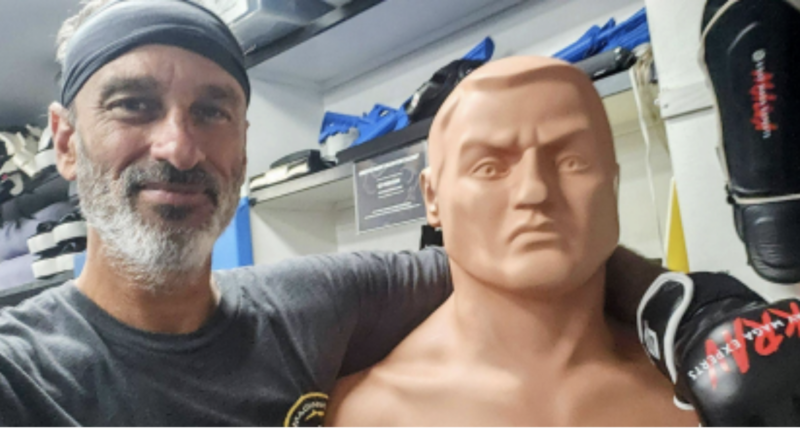
Courtesy
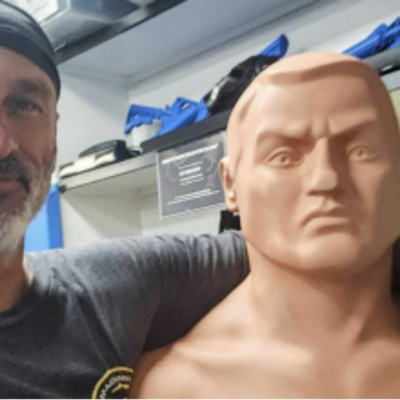
The author and his Krav Magen "training buddy."
We can thank the organized Jewish community for the investment that has led to the transformation of synagogues from “arms open” to “doors closed.” Thanks to organizations like the UJA-Federation of New York-funded Community Security Initiative (CSI), the Community Security Service (CSS), the ADL, JCRC and slew of generous philanthropists, our shuls are grateful recipients of government grants for vehicle barriers, metal detectors, and panic buttons; volunteer security team training and active-shooter drills; more (and more!) security guards; and NYPD squad cars parked outside our buildings.
And the coup de grace that keeps this new reality top of mind for me, lest I forget, is that each Friday morning as I am busy preparing for Shabbat, I receive a bulletin detailing the latest known security threats to shuls nationwide, with pictures and descriptions of suspicious persons who tried to enter a service, or asked questions about when Hebrew school meets, or sat in a vehicle taking pictures of the entrances, or dropped a bag of excrement on the steps. I cut and paste these into my expanding security binder each week, and force our team to review the latest threats before doors open for services. Good Shabbos!!
But what happens when all of our prevention efforts fail?
While the security guards stopped the bad guy at Central just in time, the other preventive efforts failed. He wasn’t identified on an FBI watch list, nor was a photograph shared of him casing the shul the week before. It’s unlikely he was stopped at the door and questioned by a volunteer congregant trained to identify “suspicious people.”
What is going to happen when a more determined attacker gets by the security guards at the next targeted shul? Or a bat mitzvah party, a day-school picnic, a Jewish summer camp? I’m in those types of places all the time. How could I help protect myself? My family? Community?
With all the Jewish pundits admonishing us to respond to antisemitism by “doubling down on Jewish life,” I’m certainly not going to stop going to bat mitzvahs. And what about in non-specifically Jewish settings, just going about life like everyday Americans? What would I do if I was just sitting in a cafe, like Lior Zeevi and Daniel Levy were last March in San Jose, Calif., speaking Hebrew to my Israeli wife and son, and some thugs attacked, shouting, “Genocide!” Or if I was on the 5 train at the 14th Street-Union Square station when, as happened on June 10, 2024, here in New York City, a gang of masked idiots stepped on the subway and demanded, “Raise your hands if you’re a Zionist. This is your chance to get out!” I went to Zionist summer camp, and I admit, I often eat falafel on the subway. What would I have done?
What is happening now to Jews in America is real, it’s at a different scale than before and it’s getting worse. I’m not packing up my family and leaving — yet. So what should I do to keep living here in America, in New York, as a practicing Jew and a proud Zionist, without living in fear?
Israel is way more dangerous than New York. But they have strategies to cope with the fear.
Since 2023, Israelis have endured the massacre of Oct. 7, ongoing terrorism, rockets, missiles and war, with massive casualties. Yet a January 2026 Israel Democracy Institute survey found that 71% of Jewish Israelis said that, from the standpoint of personal safety, it was safer for Jews to live in Israel than abroad.
American Jews similarly report in a recent AJC survey that they feel increasingly unsafe since Oct. 7 despite the fact that according to the ADL, while antisemitic incidents have skyrocketed, “only” three Americans have been killed since 2023. (Not to minimize those tragedies… but it does give pause for perspective.)
Perhaps there is a difference between feeling safe and being safe.
Israelis certainly count on the institutions of government and the army to protect them. But they also have agency as individuals. Mandatory military service gives many experience and comfort with weapons and self-defense skills. Preparedness is embedded in the culture. “Shel mi zeh?” — Whose is this? — is the kind of question Israelis instinctively ask about an unattended package. None of that makes Israelis invulnerable, but it gives them a measure of self-confidence that each person can make a difference and be of help when, like happened on Oct. 7, all else fails.
What can we Americans do to be more prepared?
One idea is to train on how to save as many lives as possible in the event of a successful mass casualty attack, like in the very worthy program just announced by CSS and Magen David Adom to teach synagogue volunteers traumatic wound treatment.
I’d like to suggest another response, one that could help minimize casualties in the first place: offer self-defense training to every Jew.
Now, I’m a nice Jewish boy from the Connecticut suburbs, not a fighter. The only fight I ever got into ended with me getting punched in the face by a drunk fraternity student outside a pizza place in college. I’m not about to join the Marines or get a black belt in mixed martial arts.
But I did start taking Krav Maga (Israeli-born self-defense) classes about six months ago, and enrolled in one of CSS’ free training classes for synagogue security team volunteers. I’m here to report that after about a dozen Krav classes and a few hours of security and situational awareness instruction, I have not been transformed into an action hero. But I have learned how to become more aware of my surroundings. I’ve learned how to walk and stand in ways that project greater confidence, and make me less of a target. I’ve practiced basic defenses against some typical threat situations (like a belligerent guy on a subway, or a chokehold in a bar). And, most importantly, I’ve learned how to better create opportunities to de-escalate situations, and get away from danger.
I certainly don’t have the skills or ability to intervene in the case of a determined, much less an armed, villain. But that is something I can not control. I do, however, feel a little more prepared, and a little more confident that I have at least done what I can to better the outcome in the event that I am faced with violent antisemitism in my personal or professional life.
My shofar’s clarion call this New Year: Wake up and get prepared.
On Rosh Hashanah, I blow the shofar for our shul. With each blast, I feel the hopes, dreams and aspirations of every soul in the congregation rising to the heavens. This year, I will be sending an additional intention upwards, a “tekiah gedolah” for our entire Jewish community to wake up, smell the rot of antisemitism, and invest in personal preparedness training for every Jew.
My prayer for the New Year is that every Jewish school, summer camp, JCC and synagogue be able to offer situational awareness and basic self-defense training to all Jewish teenagers and adults — free of charge.
A curriculum of just a dozen or so classes to start would boost self-confidence and readiness, and most importantly, increase our feeling of safety in an increasingly unsafe world for Jews. Our community institutions are hard at work trying to keep us safe. But when all else fails, as unfortunately, it is bound to do, the last line of defense will be one of us. Time to prepare.
Jeffrey Cahn is the executive director of Romemu, the New York-based multi-site synagogue. He has also held senior positions at the Zionist Youth Movement, Young Judaea and UJA-Federation of New York.