WHAT YOU SHOULD KNOW
Les Wexner faces congressional scrutiny, but limited reckoning from the Jewish world
Dustin Franz/Bloomberg via Getty Images
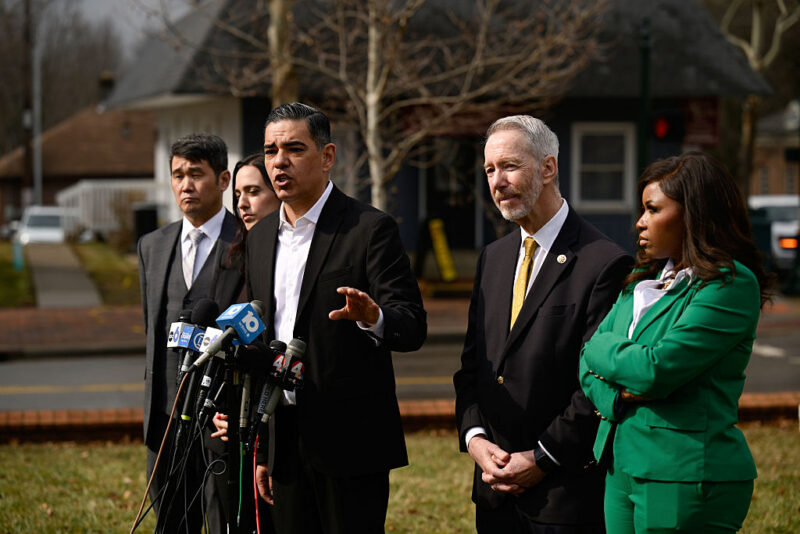
Representative Dave Min, a Democrat from California, from left, Representative Yassamin Ansari, a Democrat from Arizona, Representative Robert Garcia, a Democrat from California and ranking member of the House Oversight and Accountability Committee, Representative Stephen Lynch, a Democrat from Massachusetts, and Representative Jasmine Crockett, a Democrat from Texas, speak to members of the media following a House Oversight and Accountability Committee deposition with billionaire Les Wexner in New Albany, Ohio, on Feb. 18, 2026.




 Add EJP on Google
House Democrats on the Oversight Committee trekked to central Ohio yesterday to depose Les Wexner, the retail magnate and philanthropist whose eponymous fellowships have been the lifeblood of the American Jewish communal world for decades. The questions, of course, focused on Wexner’s longtime relationship with disgraced financier and convicted child sex offender Jeffrey Epstein.
With the release of “the Epstein files” — millions of documents connected to Epstein, who was found dead in his prison cell in 2019 — his many high-profile associates and contacts have come under renewed public scrutiny, including Wexner, who maintained a yearslong relationship with Epstein. These newly released files have, in some cases, shed light on previously unknown ties between wealthy and powerful individuals and Epstein, such as Dr. Peter Attia and Thomas Pritzker. In other cases, the documents have revealed apparent illegal activities among Epstein’s known acquaintances, as seen today with the arrest of the U.K.’s Andrew Mountbatten-Windsor, the former Prince Andrew, on suspicion of misconduct in public office in connection with his relationship with Epstein.
While Wexner’s name appears many times in the files, offering some additional details about their relationship — particularly its toxic end, when Wexner accused Epstein of stealing from him — the correspondence and documents that have come to light so far do not seem to significantly change what has been known for several years: Wexner maintained a close relationship with Epstein for many years, including when Epstein was allegedly involved in sex trafficking and other forms of abuse.
Wexner has repeatedly denied knowledge of Epstein’s predatory activities throughout those years. In a statement issued ahead of his deposition, Wexner — who has never been charged with any crimes connected to Epstein — again denied wrongdoing. “I was naive, foolish, and gullible to put any trust in Jeffrey Epstein. He was a con man. And while I was conned, I have done nothing wrong and have nothing to hide,” Wexner said, adding that he hoped to “set the record straight” about his relationship with Epstein.
The congressional deposition was held behind closed doors, but several of the representatives involved relayed a portion of what transpired in a press conference outside Wexner’s home in New Albany, Ohio. In general, they said, during the six-hour deposition, Wexner denied knowledge of Epstein’s activities and downplayed their relationship, which included Wexner giving Epstein power of attorney and appointing Epstein to the Wexner Foundation. The lawmakers responded to this with skepticism.
“He allowed Jeffrey Epstein to live in his homes, to have hundreds of millions of his dollars, to use his yachts and his planes. This was obviously a very, very close relationship, and so far, what we have seen is a denial of that relationship,” Rep. Yassamin Ansari (D-AZ) said. “I don’t think it is feasible or understandable or conceivable that any individual would not have an understanding of millions, if not hundreds of millions of dollars of their own money and can’t answer to those questions.”
Rep. Robert Garcia (D-CA) also said that, regardless of any personal involvement in Epstein’s sex crimes, “Les Wexner gave Epstein credibility and gave him the ability to commit some of the crimes that he did” by employing him as a money manager and a close business associate.
The congresspeople said they would continue the deposition at another date.
While Wexner is facing congressional scrutiny, there has been scant public discussion of his relationship with Epstein within the Jewish world. Some have ascribed this to communal reluctance to hold people in power to account, others imply a more conspiratorial tone of a coordinated campaign of silence.
The far likelier truth is that the current lack of communal reckoning regarding Les Wexner’s relationship is because the reckoning already happened. In 2019, when Epstein was indicted for sex trafficking, the Jewish world — in public and private fora — held a rigorous debate about Les Wexner. At the end of it, some Wexner fellows disassociated from the foundation over his relationship with Epstein; others, after grappling with the issue, decided to continue participating in its robust and prominent alumni network.
The current debate over Epstein and his unsavory interactions with a myriad of wealthy and powerful men can, however, open the door to a broader discussion about the expectations that we have for our leaders and for the philanthropists whose fortunes make the Jewish world go round.