Your Daily Phil: A northern Israeli mayor’s cry for help




 Add EJP on Google
Good Thursday morning!
In today’s edition of Your Daily Phil, we examine a recent outburst yesterday by the mayor of the beleaguered northern Israeli city of Kiryat Shmona during a meeting with government officials and what it means for the country’s North, and report on the release of the Jewish Climate Trust’s inaugural Jewish Guide to Climate Philanthropy. We feature an opinion piece by Jeff Green about applying insights from a 20-year career in the automotive industry to his more recent role in synagogue leadership, and one by Jay Greenlinger highlighting the need for more professional infrastructure and development opportunities geared toward early childhood educators. Also in this issue: Tanya Kak, Avishag Shaar-Yashuv and Mikhail “Misha” Libkin.
What We’re Watching
Iran has fired more than half a dozen missile barrages at Israel since 6:30 a.m. Israel time, the largest number of salvos launched in a five-hour period since the first days of the war.
The House Committee on Education and Workforce is holding a hearing on foreign influence at American universities.
What You Should Know
A QUICK WORD FROM EJP’S JUDAH ARI GROSS
Lashing out at the heads of Israeli ministries during a meeting with them yesterday in the western Galilee, Avichai Stern, the mayor of the war-battered northern city of Kiryat Shmona, lambasted the government for failing to protect the residents of his city, which is again being targeted relentlessly by Hezbollah. He accused the ministries of providing insufficient, slow and often elusive assistance for his community, which was struggling even before it entered the Lebanese terror group’s crosshairs in the wake of the Oct. 7 terror attacks.
Kiryat Shmona and the surrounding area were evacuated soon after the Hezbollah attacks began in late 2023 and have not come close to recovering two-plus years later, with the majority of the city’s residents refusing to return after a ceasefire went into effect in November 2024. Those who did return to the North have spent more time in bomb shelters than anyone else in the country over the past month. Unlike Tel Aviv and other areas of central Israel, which are being targeted by long-range ballistic missiles from Iran hundreds of miles away — giving residents several minutes to enter bomb shelters — Kiryat Shmona is being attacked by Hezbollah from just a few kilometers away, meaning residents are forced to spend nearly all of their time in bomb shelters. (That is assuming, of course, that they have access to bomb shelters, which many do not.)
Pounding on the table, Stern highlighted the grave shortage of bomb shelters in the city — a situation that the Israeli government has been aware of for decades — saying that the city, which before the war had a population of roughly 22,000 — has 4,700 housing units that don’t have bomb shelters that are up to code or have bomb shelters at all. “You haven’t provided them with fortifications until now, so at least provide them protection now. If you can’t, get them out of harm’s way! You don’t send a soldier to battle without a ceramic vest, right? Why are you putting civilians on the frontline without protection?” he said.
Getting increasingly agitated, Stern noted that this is a personal issue for him as well. “I have a 2 ½-year-old daughter and a 5-year-old daughter, whom I have to take to activities in a bomb shelter, and I am praying every time I make that trip [that there isn’t an attack],” he said. “Do any of you know what it’s like getting missiles with zero seconds of warning — with kids at home, with people with disabilities, with elderly people?”
Stern’s tirade exemplified the frustration and disappointment of many residents of northern Israel, who yet again find themselves under attack without the governmental attention and support that they need. Unnamed government officials responded to Stern’s accusations, claiming that he, not the ministries, was the cause of the delays in funding for Kiryat Shmona, adding an ad hominem allegation that Stern was trying to get the government to pay for the repair of his father’s synagogue — a claim Stern has rejected as a “distortion” of his efforts to secure funding for several synagogues in the city that don’t have bomb shelters.
Philanthropy professionals who focus on northern Israel and work closely with the local governments told eJewishPhilanthropy that the situation in Israel’s North is indeed dire, that residents are facing constant deadly attacks without the life-saving protections that they need and that the government has not made the North’s recovery a top priority.
Michal Cohen, the CEO of the Rashi Foundation, which runs a number of programs in northern Israel, denounced the government for both its “abandonment” of northern Israel, particularly as it relates to bomb shelters and fortifications, and for the unnamed officials’ aggressive response to Stern’s remarks. “During a war, who are you attacking?” Cohen fumed, adding: “We don’t have enough enemies from outside?”
While the American-Israeli war against Iran has drawn the lion’s share of media coverage over the past month, the conflict with Hezbollah and the ramifications for already-struggling northern Israel are even more significant and potentially devastating. While Tel Aviv is also under bombardment, few believe that the future of the city or of central Israel are at risk. Not so with Kiryat Shmona. “I went to sleep last night worried about Kiryat Shmona and I woke up this morning worrying about Kiryat Shmona — that has been a motif since the war started,” Sarah Mali, director general of Jewish Federations of Canada-UIA Canada, told eJP this morning. “There is a genuine question about the longevity of Kiryat Shmona as a decent stable city in the North and even more serious questions about its ability to thrive.”
GIVING BETTER
Marking first anniversary, Jewish Climate Trust releases inaugural Guide to Climate Philanthropy

The second day of this year’s Jewish Funder’s Network International Conference was not only the longest of the three-day gathering, but also the most intense, full of plenaries, workshops and discussions. Still, over 100 of the 600 conference attendees shed their blazers to trek to nearby Leichtag Commons, a Jewish community farm and education center, for a farm-to-table dinner under the stars celebrating the one-year anniversary of the launch of the Jewish Climate Trust and the unveiling of its Jewish Guide to Climate Philanthropy, reports eJewishPhilanthropy’s Jay Deitcher from the event.
Overlapping priorities: With the antisemitic attacks on Jewish institutions across the world and the war with Iran on the front of everyone’s minds, it’s “completely understandable” that “climate is not on the front page for Jewish funders right now,” said the Jerusalem-based Nigel Savage, CEO of JCT. Still, he and Sarah Indyk, managing director of JCT, said that climate philanthropy overlaps with most funders’ existing priorities, and the guide can help inform their giving. “What matters to you as a funder? Do you care about food insecurity and access? Do you care about next-gen Jewish engagement? Do you care about the organizational sustainability of your grantees?” Indyk said. “The Middle East is hotter and drier than most of the world, and the shared environment in Israel, in the region, is a huge opportunity to begin conversations, to build relationships and trust.”



UNDER THE HOOD
Alignment before ambition

“My father taught me one thing above everything else: become an expert at what you do. Not competent. Not capable. An expert. Be the person people look to when something needs to get done and done right. I carried that lesson into 20 years in the automotive industry… I also carried it with me when I made what many people considered an unlikely transition from the car business into synagogue leadership,” writes Jeff Green, executive director of Temple Sholom in Broomall, Pa., in an opinion piece for eJewishPhilanthropy.
A question, not an ask: “We convened a meeting of the congregation’s highest-capacity donors: business leaders, nonprofit professionals and longtime board members, people who had been invested in this institution for decades and had a clear view of where it stood. We did not walk into that room with an ask. We walked in with a question: What would it take for you to invest more deeply in this institution’s future? The answer was direct and unanimous: Show us that the foundation is in place, and we will be ready to invest at a different level. That was not a setback. That was a road map. … The moment our board saw that conversation fosters alignment rather than skepticism, the organizational momentum shifted, and we were on the road to growth and stability.”
PATHWAYS TO BELONGING
Elevating the profession of Jewish early childhood education

“Despite the central role that early childhood centers play in Jewish communal life, the educators who lead them are too often asked to do complex educational and leadership work without the professional infrastructure that other sectors of education take for granted,” writes Jay Greenlinger, dean of American Jewish University’s Masor School for Jewish Education and Leadership, in an opinion piece for eJewishPhilanthropy.
Strengthening the ecosystem: “Happily, the gatherings I attended over the past few weeks suggest that this reality is beginning to change. At both conferences, educators were not simply sharing classroom activities: they were exploring leadership frameworks, engaging with research on child development and Jewish identity and learning from one another about how to build thriving school communities through thoughtful pedagogy and relationship building.”
Worthy Reads
Compounding Traumas: In The Times of Israel, Sue Surkes spotlights the experiences of families displaced from the Gaza Envelope since the Oct. 7 attacks and still living in temporary housing while under fire in the current war. “The instability, the yearning of the children to see their friends, and the security-related fears of returning to the Gaza border are totally familiar to the Stern family from Kibbutz Be’eri. Eviatar and Gal Stern and their three young boys, now aged 9, 7, and 2, survived one of the worst onslaughts on any kibbutz on October 7. … The Sterns, all of whom are in therapy, are renting a house. They share a bomb shelter with the next-door neighbor. The night before Eviatar Stern spoke with The Times of Israel, there had been four rocket alerts. ‘The alerts trigger the kids,’ he said. ‘Every siren makes them jump. It’s hard for them to fall asleep at night. We talk about things as much as possible, about fears, nightmares, and terrorists. We’re all more anxious, edgy. There’s no school, no normal.’” [TOI]
A Changed Place: In The Atlantic, Rose Horowitch reports on the different atmosphere on campuses across the U.S. since the Gaza war ended and the Trump administration cracked down on protestors and academic institutions. “Universities began taking action against their own students before Trump could do so. At Yale, about 200 students began forming an encampment to protest Israeli National Security Minister Itamar Ben-Gvir speaking at an event near campus. Administrators told students to disperse, disciplined repeat offenders, and ended Yale’s association with a chapter of Students for Justice in Palestine. … At the same time, some academics think that the students themselves are different: Whether because of concerns about the worsening job market or a cultural shift rightward, they seem less interested in raising hell on campus.” [TheAtlantic]
A Different Mindset: In the Stanford Social Innovation Review, Tanya Kak argues that the value of an initiative or solution may sometimes be measured by something other than scalability. “For at least two decades, one question has structured much of how philanthropy and the social innovation ecosystem think about change: Can it scale? The question appears in grant applications, accelerator programs, and strategy documents. It makes sense: If a solution works for one community, surely the ethical imperative is to help many more? In a world of vast unmet needs, scale promises efficiency, reach, and speed. Yet something curious has happened as this logic has spread. Increasingly, promising ideas, organizations, and forms of collective action are all filtered through the same lens, held to the same standard. If it cannot scale, why would it be worth investing in?” [SSIR]
Word on the Street
In The New York Times, Israeli photojournalist Avishag Shaar-Yashuv discusses her photograph of a massive Iranian ballistic missile that landed outside an elementary school in the West Bank settlement of Peduel…
The Organisation for Economic Co-operation and Development, better known as the OECD, finds that philanthropic spending totaled $68.2 billion from 2020-2023, several billion more than was expected…
The National Ben Gamla Jewish Charter School Foundation is suing the Oklahoma attorney general and the state’s charter school board after its request to open a religious charter school was rejected; the lawsuit is expected to work its way to the Supreme Court as part of a broader effort in the state to permit state funding for religious charter schools…
The Holocaust Memorial Miami Beach, which is part of the Greater Miami Jewish Federation, has opened a new Education Center…
President Donald Trump named Mark Zuckerberg and Larry Ellison to the newly created President’s Council of Advisors on Science and Technology; the group will be co-chaired by White House AI czar David Sacks and tech advisor Michael Kratsios…
Jewish leaders in Chicago are raising concerns about the resignation of Nancy Andrade, who until this week served as the city’s commissioner on human relations, shortly after her commission released a report on how to address antisemitism in the city; the report, which was submitted last month along with recommendations for action, was then heavily revised by an outside firm hired by Mayor Brandon Johnson…
Semafor looks at the shifting priorities of climate justice activists, who have increasingly focused on issues related to Israel…
Jonathan Amiel, the head of McGill University’s faculty advisory board and a donor to the school, resigned from his position and is pulling his donations, citing the law school’s passage of a recent referendum calling on the school to boycott Israeli universities…
A Paul Klee print normally housed at the Israel Museum in Jerusalem has been unable to be transported to New York, where it was set to be included in an exhibition of the modernist artist’s work at the Jewish Museum, due to flight restrictions in place in Israel…
Delta announced the suspension of nonstop flights to Israel from Atlanta and New York through Sept. 5…
Mikhail “Misha” Libkin, the executive director of ORT Russia and a key figure in Limmud FSU, died suddenly on Tuesday at 42…
Major Gifts
The Keren Kayemeth LeIsrael-Jewish National Fund approved NIS 2.5 million ($800,000) in emergency funding to both Dimona and Arad, following severe missile strikes in the southern Israeli cities over the weekend…
Pic of the Day
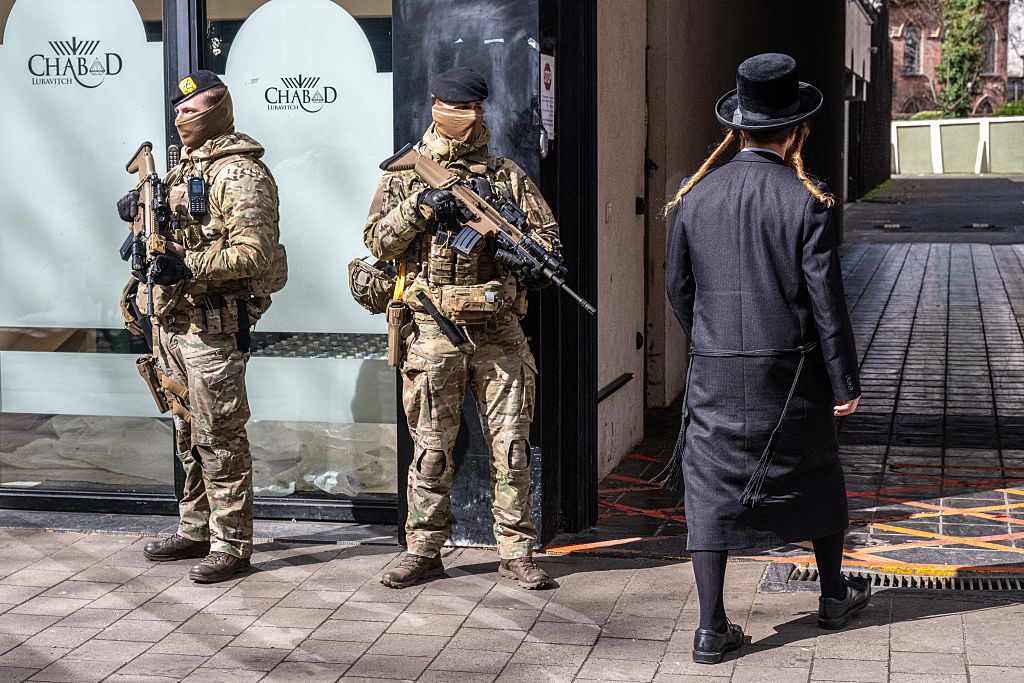
Belgian soldiers patrol the streets yesterday of a Jewish neighborhood in Antwerp, following a string of suspected terror attacks on Jewish targets in the country and across Europe.
The country’s defense minister, Theo Francken, announced this week that the military was deploying additional soldiers to protect Jewish sites in the country for at least the next three months.Some 100 Jewish day school educators from across North America attend the inaugural “Together We Thrive” conference on Monday, which was held at The Shefa School in Manhattan, focused on including students with learning difficulties in Jewish day schools.
“Learners in our schools have more needs than ever,” Rebecca Ritter, head of teaching and learning at The Shefa School, said in a statement. “This is a moment for us as a community to rise to the occasion and begin to build a ‘field’ for special education in mainstream day schools. Establishing a passionate community of practitioners, researchers and organizations will enable us to build this field together by developing a common language, shared assumptions, recognized expertise, standards for practice, a pipeline and leadership. This will impact the lives of tens of thousands of Jewish students.”
Birthdays

Actress best known for her roles in ABC’s sitcom “Suburgatory” and the USA Network’s drama “Mr. Robot,” Carly Chaikin turns 36…
Argentine-born, Israeli clarinetist who specializes in klezmer music, Giora Feidman turns 90… Former member of the Knesset for eight years, he held several ministerial portfolios, Rabbi Yitzhak Haim Peretz turns 88… Award-winning novelist and poet, her debut novel in 1973, Fear of Flying, has sold over 37 million copies, Erica Jong turns 84… Philanthropist active in the U.K. and in Israel, she is the founder of London’s Jewish Community Centre, which opened in 2013, Dame Vivien Louise Duffield turns 80… Southern California resident, Martin J. Rosmarin… Retired ENT surgeon, author of five books and former medical correspondent at ABC News and NBC News, Nancy Lynn Snyderman, MD turns 74… Molecular biologist and winner of the 2024 Nobel Prize in medicine, Gary Bruce Ruvkun turns 74… Chancellor of The Jewish Theological Seminary, she announced she will step down at the end of the 2025-26 academic year, Dr. Shuly Rubin Schwartz turns 73… Former president and CEO of the Ottawa-based Public Policy Forum, now an executive advisor at Deloitte, Edward Greenspon… Actress who has appeared in many movies over a 30-year career, in 2010 she was the winner of Season 11 of “Dancing with the Stars,” Jennifer Grey turns 66… Lori Tarnopol Moore… Patent attorney from Detroit, she currently serves on the Michigan State Board of Education, Ellen Cogen Lipton turns 59… Englewood, N.J., resident, Deena Remi Thurm… Co-founder of Google along with Sergey Brin, Larry Page turns 53… Founder, president and CEO of Waxman Strategies, Michael Waxman turns 52… Israeli actor and model, Yonatan Uziel turns 51… Curator and historian of Jewish art and history, Dr. Ido Noy turns 47… Talk show host who founded Israel Sports Radio, Ari Louis turns 43… Judoka in the under 52 kg weight category, she competed for Israel in the 2024 Olympics, Gefen Primo turns 26… Rapper and Internet personality, known professionally as Bhad Bhabie, Danielle Peskowitz Bregoli turns 23…