WHAT YOU SHOULD KNOW
Why Camp Lavi means so much to this Modern Orthodox community
Danielle Lustman
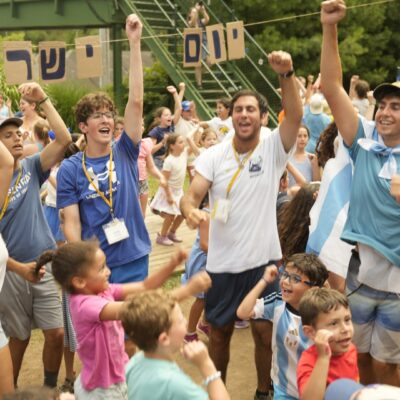
Camp Lavi campers raise funds to help launch the new nonprofit under the current director.




 Add EJP on Google
Rabbi Joshua Lookstein is a glass-half-full type of person, but this summer his optimism is being tested.
It was just one week before the late-June opening day at Camp Lavi in Lakewood, Pa., where Lookstein and his wife send their three children, when he heard the news about the Shabsels brothers’ bankruptcy that rocked the camp world. The New York-based brothers owned 30 for-profit camps — several of them Jewish, including Camp Lavi — and after the brothers double pledged assets and missed bond payments, racking up over $344 million of debt, they declared Chapter 11 bankruptcy in New Jersey in June.
Lookstein’s first question was whether Camp Lavi would still open. News came quickly that this summer’s sessions would run as planned, yet a question mark still hung over the future.
“My wife and I had some conversations throughout the summer about, ‘Where would we send our kids if there was no more Lavi?’” Lookstein, a member of the senior leadership at The Ramaz School in Manhattan, told eJewishPhilanthropy.
Camp Lavi is one of a handful of Modern Orthodox camps serving New York City, Westchester and Long Island, an area home to 430,000 Jews hailing from Orthodox households — 249,000 adults and 181,000 children, according to a 2023 UJA-Federation of New York Jewish community study. Kids travel from across the East Coast to attend the camp as well. Established in 1977, it presently serves 600 campers and 200 junior staff members per season; the latter are often working their first jobs: counselors, lifeguards, sports staff. Many of the campers’ parents are alums themselves. (Lookstein’s wife, for instance, attended and loved Camp Lavi.)
Keeping the news and rumors about possible sales from reaching the campers has been hopeless, parent Rachel Wolkinson Rubinstein told eJP. Campers heard counselors talking about it, and their parents talked about it, too. Her two sons attended the camp this year, one of them as a counselor, and she said they both witnessed investors arriving on the grounds via helicopter to scout out the property.
Understandably, the kids had a lot of questions.
Wolkinson Rubinstein’s 14-year-old son has celebrated his birthday with campmates every summer for the past seven years — a lifetime in childhood terms. This year, he came home crying, she said, worried he might not be able to celebrate with them next summer. Her 17 year old, too, has created memories to last a lifetime, and his campmates are following him into his next stage of life. “He plans on going to Israel with his Lavi crew and to college with his Lavi crew,” she said.
In the United States, camp is a fundamental part of creating and forming Jewish identity. A 2025 Stanford University and the Jewish Federation of North America 2025 study found that camp is the No. 1 place where Jewish teens feel that they can be themselves. Another 2025 study, performed by Leading Edge, showed that camp is an essential part of the Jewish leadership pipeline — over 50% of current Jewish professionals worked at a Jewish camp.
Ilana Rosenzweig, assistant director at Camp Lavi and mom to four campers, has worked at the camp for seven years. Prior to her current job, she was a day school teacher, but she left to help Camp Lavi out of passion for the institution.
The potential closure is “hitting me much harder as a parent than as an employee,” she told eJP. “I don’t know where I will send my kids. I can find another job.”
“At camp, Judaism isn’t simply taught. It’s lived. Shabbat is lived. Friendship is lived. Davening is lived. Religious Zionism is lived,” she said. “For seven weeks, Judaism is not something that happens for an hour or two in a classroom. It becomes the culture that surrounds a child every minute of every day.”
Rosenzweig grew up Modern Orthodox and estimates that 50% of the kids that she grew up with either are either not observant anymore or are Haredi. The loss of Camp Lavi would mean more than just the loss of another camp — it would be a blow to a movement that feels to her like a shrinking middle. “This is about preserving a vision of Judaism that combines deep Torah commitment with engagement in the modern world; a Judaism that believes in religious growth, intellectual curiosity, love of Israel and preparing young people to live proudly as observant Jews in contemporary society,” she said.
This summer, after a cooking demo, Rosenzweig gathered 20 of the youngest campers at the camp’s lake and led them through the toveling process, in which campers ripped stickers off new pots and pans, said the appropriate bracha and immersed the cookware in the water. She makes a point of trying to teach campers Jewish laws that wouldn’t be able to be put into practice quite like this in a school or home setting.
“Those are the moments they’re going to remember, and when they get older and they have to tovel their own dishes when they get married, they’re going to have this experience to reference,” she said.
For most of the summer, the threat of Camp Lavi closing was only theoretical, a topic of conversation, Lookstein said. It was only after the auction that the fears became a real possibility.
By early August, Camp Lavi was the only formerly Shabsel-owned camp property whose sale wasn’t official. Instead, according to court documents, debtors were “still analyzing the Qualified Bids.” The winning bidder of the camp, it turned out, was Ohel Children’s Home and Family Services, a mental health nonprofit that primarily caters to the Orthodox community. But Ohel’s plan was to use the campgrounds to serve its clients, not the current Camp Lavi families.
Camp Lavi parents, alumni and community supporters organized fast, creating a Change.org petition by the afternoon of Aug. 3 calling for the sale to be halted. Within a week, it was signed by over 4,280 signatures including rabbis and politicians. The parents hired a lawyer and created The Committee of Concerned Parents of Camp Lavi, which sent over 100 letters to the judge and, three days later, filed an objection to the sale. At the same time, debate raged through Modern Orthodox congregations and online: who was right, the parents or Ohel?
“I can’t believe Ohel is moving the Chicago Bears to Indiana,” joked Orthodox comedian Eli Lebowicz in a post on Facebook.
“Everybody has a tremendous amount of respect for Ohel, as an organization and as an institution,” Wolkinson Rubinstein said. “It’s more like, can you please find a different property?”
As a communal professional working with students, Lookstein said he has seen students benefit from Ohel directly and emphasized that the campaign is not about attacking an organization that is an asset to the community (he has no other connection to Ohel). He believes that the nonprofit expected, like he did, that bidders would include many buyers, who planned to use the campgrounds for different reasons. Some would run the camps as is, but other properties would serve new populations or become golf courses or hotels.
“I would bet Ohel just thought, ‘OK, everyone is starting from scratch now,’” Lookstein said, figuring they felt they were possibly bidding against hotels. “I would bet that Ohel was as shocked as anyone that the only camp that is possibly closing as it is is Lavi.”
While there are other sleepaway camp options for Modern Orthodox Jews in the city, including Camp Nesher in Lakewood, Pa., Camp Sprout Lake in the Hudson Valley and — a fellow Shabsels property — Camp Mesorah in Guilford, N.Y., Lookstein doubts the camps would be able to accommodate 600 new campers.
“I don’t want my kids to go to any other kind of camp,” Lookstein said. “I want my kids to go to a Modern Orthodox camp, and a Modern Orthodox camp that’s coed and that has a religious Zionist philosophy.”
Growing up, Lookstein attended the Orthodox, Hebrew-immersion Camp Massad in the Pocono Mountains of Pennsylvania. When Camp Massad closed in 1981, it was not just a camp closing — it was the end of a movement, Lookstein said. His father had attended Massad, and worked there during Lookstein’s youth. The community was devastated.
“When I got the news about the Shabsels, my first reaction was a text to someone who is an old Massad person who continues to have a dream of reopening it,” Lookstein said. “I wrote maybe this is an opportunity.”
By Sunday, Aug. 9, eJP learned, Ohel agreed to hand its winning bid for Camp Lavi to the second-place bidder, ensuring that the camp would continue operating in its current format. But the following day, everything fell apart. After the deal with the second-place bidder fell through, eJP was told by a source with knowledge of the matter that Ohel was seeking other interested parties who would run the camp grounds in its current format, but that everything needed to be decided by the board. The sale to Ohel is set to close five business days after Camp Lavi’s camp season ends: Thursday, Aug. 20.
Last Tuesday, the parents and supporters launched a crowdfunding page, with the goal of raising $4.75 million. By Monday, they had raised 66% of that, with UJA-Federation agreeing to match up to $500,000. An additional $1 million has been raised outside of crowdfunding campaign and there is a plan in motion to attain a $4 million loan and launch a new nonprofit, the Camp Lavi Foundation, Inc., which would be run by Sean Steinmetz, the current camp director.
Lookstein is helping the foundation strategize and find large donors. He and his wife have an allotted amount they donate yearly, but they made a donation “way beyond what we have ever really considered.”
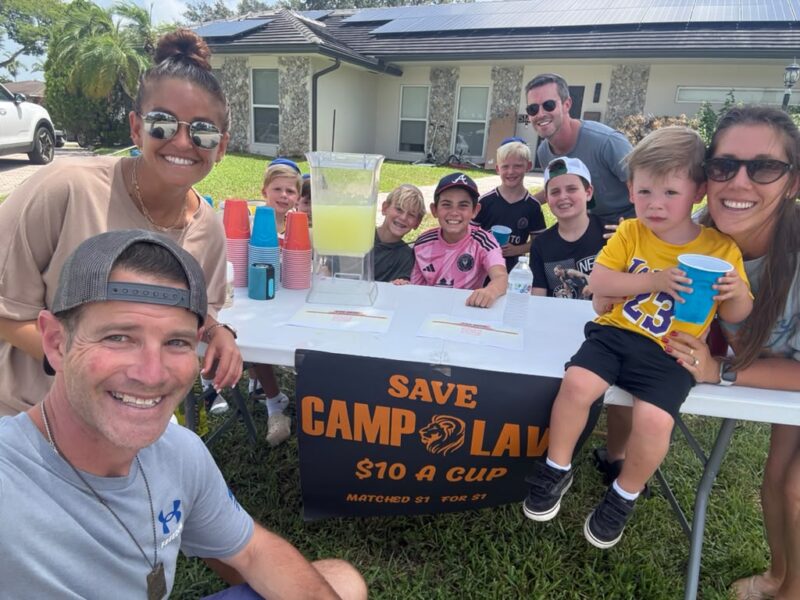
Kids are helping out too. Camp ended on Thursday, and already there have been camper-led basketball training fundraisers. Danielle Lustman shared that after her 12-year-old son returned home to Florida, he was bawling at the prospect of Camp Lavi’s closure; but then he took action, setting up a lemonade stand alongside his two brothers, also campers.
On Sunday, peddling $10 cups of refreshment in the 100-degree heat, the boys raised close to $10,000. Some customers paid upwards of $1,000 per serving. Many left without even drinking the lemonade.