TEXT STUDY
Two years on, the post-Oct. 7 Simchat Torah Challenge not only survives but thrives
Initiative launched by investor and philanthropist Daniel Loeb in 2024 has quickly taken on a life of its own, with tens of thousands of subscribers
Gershon Elinson/Flash90
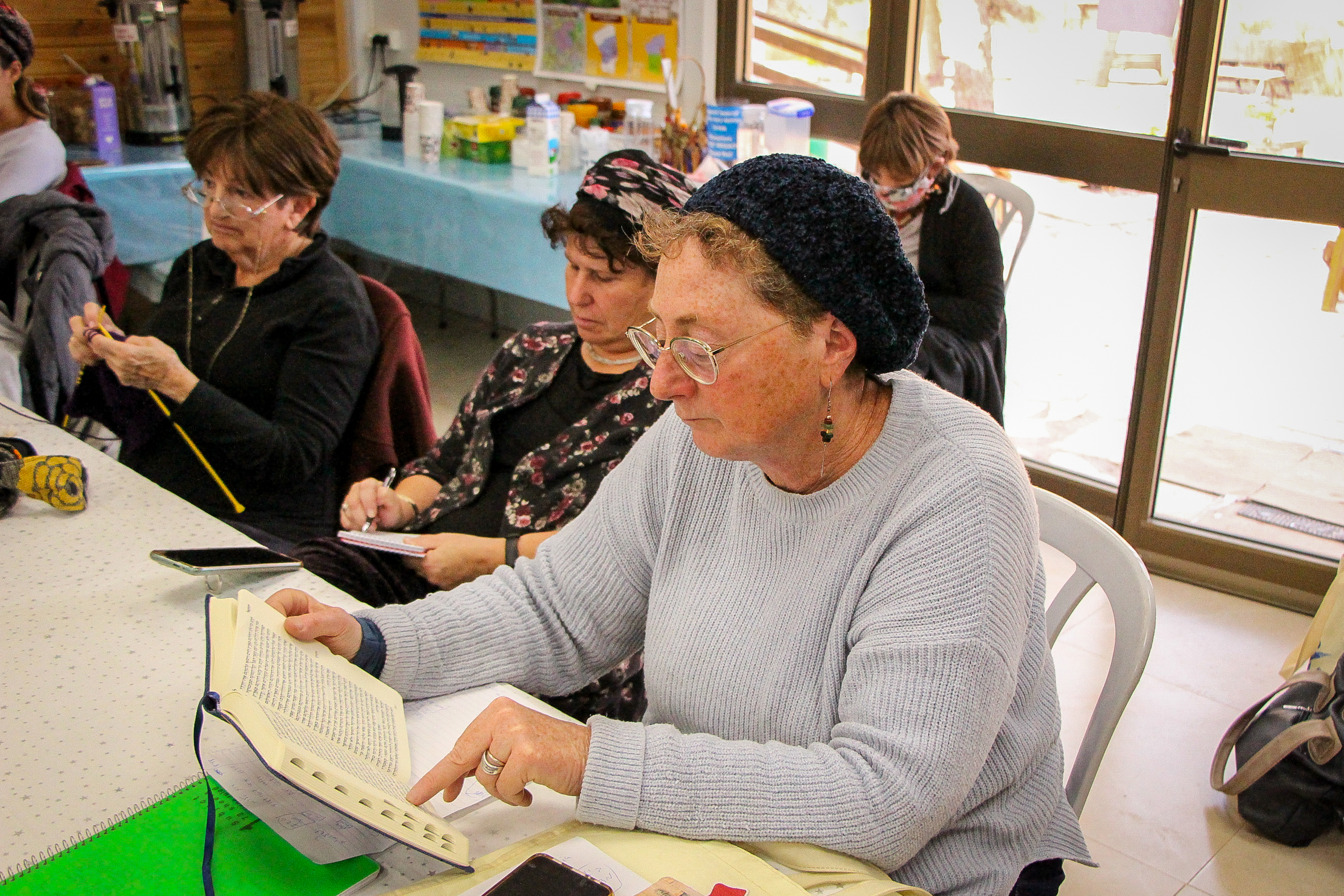
Illustrative. Students at a beit midrash for women study Torah in the Gush Etzion settlement bloc in the central West Bank on Jan. 3, 2023.




 Add EJP on Google
Two and a half years ago, news rumbled through the pews of American Jewish congregations of terrorists tearing through southern Israel on Simcha Torah in what would be the deadliest day for Jews since the Holocaust. Today, memories of first hearing about the Oct. 7 massacres still invoke horror, but at the same time, Jews across the world continue to turn to Simchat Torah for joy, marking the start of a new journey through the Torah, exemplified by the Simchat Torah Challenge, an initiative that emerged directly out of the tragedy of Oct. 7 and is not only continuing but thriving.
Launched by philanthropist and investor Daniel Loeb in fall 2024, the Simchat Torah Challenge organizers set the goal of inspiring 10,000 Jews to read the entire Torah in the year to come. Eighteen months later, the challenge has blown past those expectations, with 38,000 subscribers for the initiative’s weekly emails, which feature Torah insight and commentary. According to a November survey, 90% of respondents reported an improved connection to the Torah, with nearly one-third of participants saying they now talk about the week’s Torah portion every week.
Realizing the potential of the challenge was “a big sort of aha” moment, Andrea Fleishaker, deputy director of the Jewish life department at UJA-Federation of New York, which partners with the challenge, told eJewishPhilanthropy. Post-Oct. 7, “we were seeing Torah as a form of resilience and emotional support, really using Torah as a way to talk about identity and belonging, parenting and how [to] navigate family life, navigate your professional environment.”
The initiative began with partnership. Before launching, Tanya Singer, program director of the Simchat Torah Challenge, reached out to the connections she trusted: Sefaria, Chabad, Yeshiva University, Moishe House (now Mem Global), Hillel International, Tablet magazine and other Jewish organizations.
“We sort of just got parked at Tablet” because it was convenient, Singer told eJP. The online magazine handled legal and finance services, but after the challenge hit 10,000 subscribers within six weeks of launching, it became clear that the initiative “just sort of took on a life” of its own.
Today, the Simchat Torah Challenge functions as an LLC under the Margaret and Daniel Loeb Foundation and continues to welcome new partners and funders, a list which now includes Repair the World, BBYO, Jewish Funders Network and others.
“We’re very happy to keep developing partnerships,” Singer said. “We don’t see ourselves as a closed universe. It’s working because we’re able to connect to other resources and help our readers keep moving themselves along, Jewishly, whatever that means, from recipes to Torah learning.”
The Paul E. Singer Foundation, a funder for the program, had been “tracking this post-Oct. 7 revitalization of the Jewish community,” Julia Schulman, director of Jewish/Israel philanthropy at the Singer Foundation, told eJP. “We knew that there was a longing for more on-ramps to get engaged with Jewish practices, and the Torah is intimidating. Many aren’t studying it, not for a lack of interest, but for the lack of know-how, lack of an entrance to do it, so this challenge is all about making the Torah accessible.”
The challenge offers study guides from teachers of all denominations. It engages readers who are scholars and it engages readers who have never touched a chumash. According to the November reader survey, 30% of Simchat Torah Challenge participants are 18-44. Answering a question about how they identify religiously that allowed them to select as many terms as applied, 40% of respondents identified as Conservative, a third as culturally or “just Jewish,” a quarter as Reform, 14% as Orthodox, 11% as traditional and 8% as Chabad.
Torah is “a gateway to Jewish living,” Schulman said. “We are seeing how the challenge has shaped behaviors, with more than half of participants saying they feel more comfortable in Jewish spaces. They’re embracing new expressions of Jewish identity. They’re wearing Jewish stars. They’re supporting Jewish businesses. They’re attending Jewish events. They’re giving to tzedakah. We just think it’s a natural thing for people to be doing. We know that when the world feels fractured, especially as it has… with the war with Iran, returning to the Torah is the most natural thing that a Jewish person can do.”
Partnerships open doors to relationships and ideas, Singer said. The partnership with the Paul E. Singer Foundation led to a three-event series in Palm Beach, Fla., featuring speakers including Rabbi David Wolpe, Rabbi Angela Buchdahl and Mijal Bitton, the spiritual leader of Manhattan’s Downtown Minyan. A partnership with Repair the World has led to guidebooks based around Torah and service targeting younger Jews. The organization holds joint Shabbat dinners with OneTable, which Singer said has “a structure in place that we can’t possibly build, nor would we try.”
Together with UJA-Federation, the challenge offered 27 microgrants in the greater New York City area for up to $5,000 to study groups, funding food, space and staff for both in-person and virtual programming, allocating $138,500 within the first year. This second year, the challenge is funding 34 grants for up to $10,000 each, allocating $246,000. The grants have funded groups of young adults, parents, students, LGBTQ youth, individuals with disabilities and people navigating trauma, addiction or isolation. While there have been plenty of sushi and Torah study groups — the most common go-to — there have also been groups based around Torah learning and environmentalism, poetry and drama.
Loeb had always been “culturally interested in my Judaism,” he said at February’s Global Alts 2026, the premier alternative investment event, held in Miami Beach, Fla. A 2017 trip to Israel alongside podcast host and author Dan Senor, “was a big eye-opener,” Loeb said. It was his first trip to the country, and in the years to come, the experience would shape his religious practice and philanthropy, leading him to shift more of his giving to Jewish and Israel-related initiatives. Since that trip, he has learned the Shema, one of Judaism’s core prayers, and began studying Torah. After Oct. 7, he saw an opportunity to inspire others to do the same..
The Torah is “an incredible story that on the surface is interesting, and historically it’s interesting, but as someone who wants to go really deep in things, I mean, there are literally thousands of years of scholarship on it,” Loeb said.
Orrea Light, a product developer and marketer in the beauty industry, was moved by Loeb’s story, which mirrored her own. She too had grown closer to Judaism. In her case, after losing her mother in 2010 and her father in 2020.
Inspired by their shared journey, in January, Light held a fundraiser with a portion of the funds going towards the challenge, marking her Hebrew birthday. After reaching out to connections in the fashion industry, a friend at the Saint Laurent flagship store in New York City’s Meatpacking District said, “If you would like to do an event here, we would love to host it for you.” Having a non-Jewish organization volunteer made her “heart smile,” she told eJP.
The event was attended by 50 people: friends, family and peers from the fashion industry. Rabbi Lawrence Hajioff, an advisor for the challenge, and Light’s Torah “study buddy” attended. It raised $50,000.
Torah can be “a road map for your life,” Light said, saying it even connects to her life in the fashion industry. She is already planning her next event, possibly in the Saint Laurent shop in Bal Harbour, Fla., or at a major cultural event such as Art Basel in Miami.
Singer, the Simchat Torah Challenge program director, has also learned many lessons over the past 18 months based on quarterly surveys of subscribers. For instance, the newsletter now uses Jewish art that doesn’t include people, after some participants complained about modesty issues in the images that they had been using. The challenge now offers a second weekly email featuring the teachings of Britain’s former chief rabbi, Lord Jonathan Sacks, which sit at “this big center of a Venn diagram,” Singer said. “It seems to touch a lot of different kinds of Jews.” Emails also now include more podcast links and cultural activities such as recipes and coloring pages for kids, which subscribers have said they enjoy.
“We never envisioned owning someone’s Jewish journey at all,” Singer said. “Jews are looking for those tethers to our most essential selves. And I don’t think necessarily in a structured, religious kind of way, but we’re looking for meaning. We’re looking for clarity. And it goes back to basics.”
Related News
HIGHER EDUCATION
As Jewish donors reconsider academia, Jan Koum doubles down, endowing Israel studies at Stanford
EXCLUSIVE
Detroit-based philanthropists Nancy, James Grosfeld donate $8M to renovate JDC’s Israel campus

MAJOR GIFTS
Center for Jewish History celebrates 25 years with a $25M matching grant
CLOSING WORDS
In AZM address, Cosgrove links communal ‘orthodoxy’ on Israel to rising anti-Zionism among young Jews
ADVANCING A VISION
N.Y. federation donates $1M toward building shared-society center named for peace activist killed on 10/7