Opinion
DISAGREEMENT ISN'T THE DANGER
The sword has been unsheathed again




 Add EJP on Google
In a recently published essay in Sources, ”A Sword at the Entrance: Pluralism, Polarization, and the Future of Jewish Community,” I reflected on a troubling Talmudic story about an arcane argument between Hillel and Shammai that leads to fierce disagreement. At a moment of reckoning, Shammai drove a sword into the ground at the doorway of the beit midrash, signaling that the disagreement had become dangerous and that the possibility of rupture and violence was close at hand. In a horrifying variant of the text, we see the debate devolve, the sword unsheathed and the students of Shammai slaughtering the students of Hillel.
The playwright Anton Chekov famously warned that if a gun is introduced in the first act, it will inevitably be fired by the third. When weapons, literal or rhetorical, are brandished, they rarely remain idle. So too with our politics: Once the sword is placed at the entrance, we should not be surprised when it is eventually unsheathed.
That image has been on my mind in my work at Hillel, where I see Jewish students and Hillel colleagues navigating the pressures of polarization. College should be a place of curiosity and connection. Too often, it feels like a battleground, with the sword hovering at the entrance.
And now, once again, the sword has been unsheathed again in real life with the assassination of Charlie Kirk in front of thousands of students on a college campus. This follows other recent moments of political or ideologically motivated violence: the murders of Sarah Milgrim and Yaron Lischinsky at the Capital Jewish Museum, and of Minnesota State House leader Melissa Hortman and her husband, Mark Hortman; the arson of Pennsylvania Governor Josh Shapiro’s house on Passover; the attempted assassination of President Donald Trump, and too many others still.
Whether people agreed or disagreed with Kirk’s views, his campus debates with college students normalized the idea that public space requires contested speech. This engagement with people who disagreed with him publicly, loudly and regularly was a reminder that democracy depends not on the clash of weapons but on the clash of arguments and of ideas.
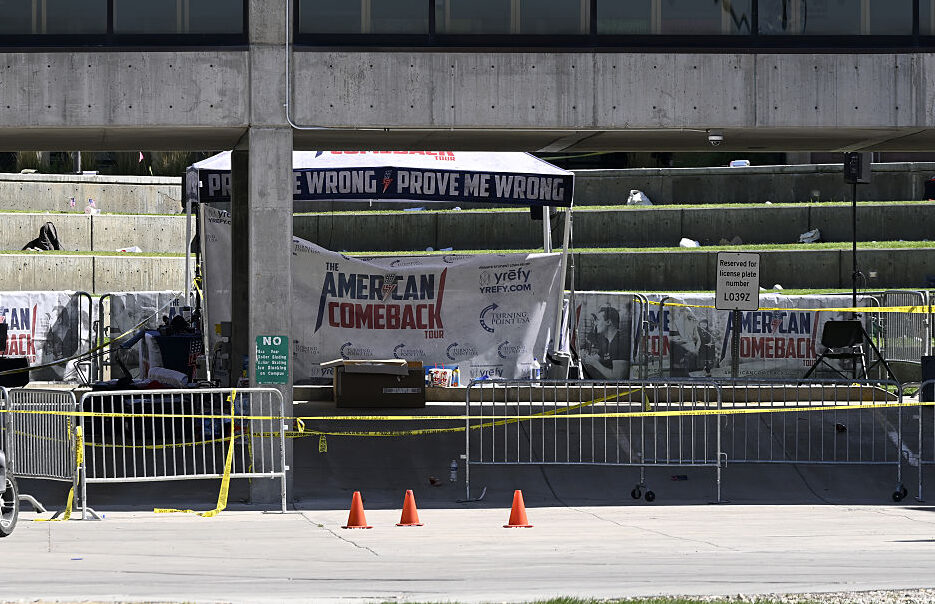
Now, like too many others on all sides of the political spectrum, Kirk’s voice has been silenced. A wife has lost her husband, and two children have lost their father. A family is grieving. And we are left confronting the brutal consequences of a society that has embraced the friend–enemy paradigm — one in which our entire goal becomes the destruction of our opponents rather than the contest of ideas. And as we witness over and over again, when politics becomes about vanquishing opponents instead of wrestling with them, violence follows.
It is a good time for a reminder of the well-worn but always urgent Jewish teaching that every person is created b’tzelem Elohim, in the image of God. The Mishnah in Sanhedrin (4:5) teaches that one who destroys a single life is considered to have destroyed an entire world, and one who saves a single life is considered to have saved an entire world. This is not just rhetoric — it is a framework for how we reckon with tragedy, insisting that every life carries infinite value and that every loss tears at the fabric of creation.
The danger is not disagreement itself but when difference hardens into exclusion, when argument threatens to become annihilation. Jewish community, and democratic community, can only survive when we practice the “discipline of pluralism” — choosing to argue passionately, listen generously and remain bound to one another even when consensus is impossible. Whether Kirk himself represented this disciplined and energetic pluralism should not dissuade us from the hard task of doing so ourselves.
In our work with students at Hillel, we see the hunger for this kind of pluralism. It requires courage to stay in hard conversations, humility to hear voices that unsettle us and discipline to resist the satisfactions of outrage. And it is from students who engage in robust yet civil debate — even and especially with those with whom they strongly disagree — that we continue to learn what is possible.
Rabbi Benjamin Berger is Hillel International’s senior vice president of Jewish education, community and culture.