Opinion
DATA DIVE
The price of Jewish literacy




 Add EJP on Google
In Short
A new report puts hard numbers on the day school affordability crisis.
For years, some of the most prominent voices in American Jewish life — Bret Stephens, Bari Weiss, Dan Senor — have been making the same argument: the most powerful response to antisemitism and assimilation isn’t defensive. It’s generative.
Fund Jewish day schools. Make them affordable to middle-class families. Charge tuition at Catholic school levels.
The argument is compelling and the urgency is real. What has been missing is the math.
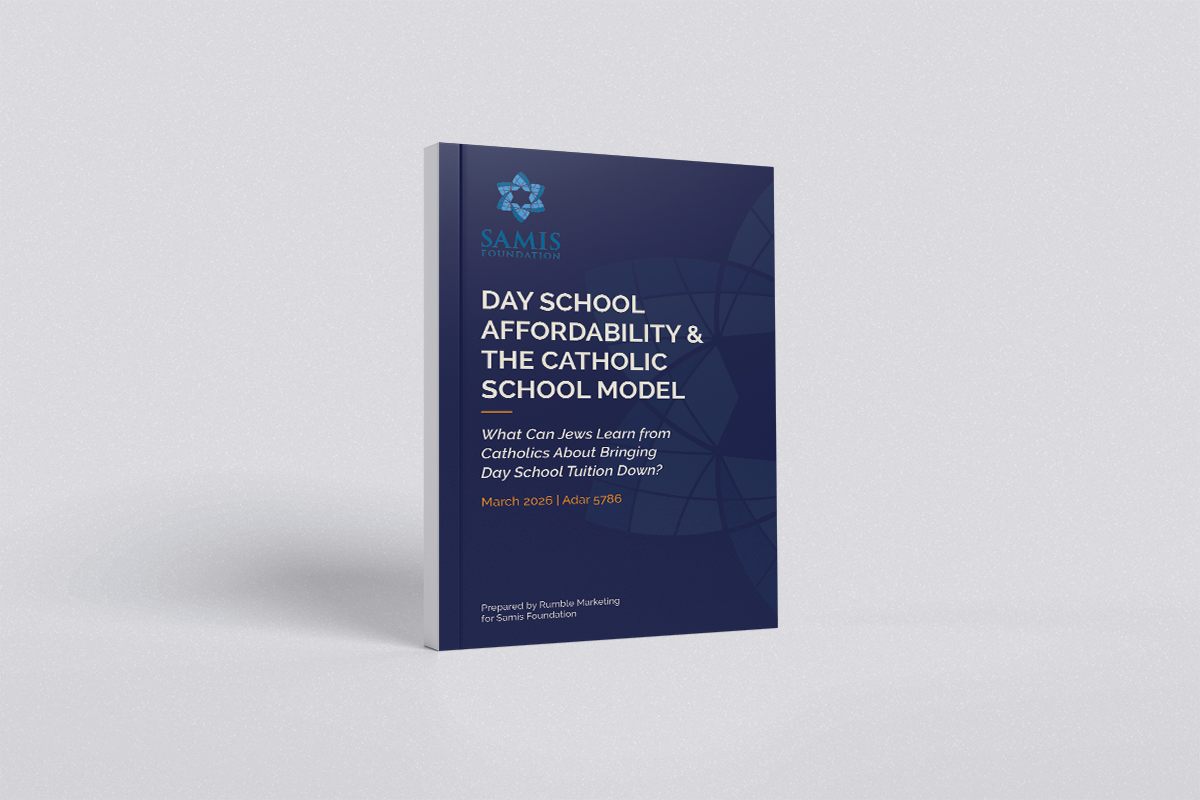
This month, the Samis Foundation released “Day School Affordability and the Catholic School Model,” a rigorous structural and financial comparison of Catholic and Jewish day school economics produced for a philanthropic audience. The report is dense with data and includes school-by-school tuition tables across five major metropolitan areas, side-by-side comparisons of funding models, cost driver analysis and endowment modeling. The result is a road map of what Catholic-parity tuition would actually require — and what it would actually cost.
The dual curriculum
One of the key findings is that the tuition gap is driven by a set of structural cost factors unique to Jewish day schools — spanning labor, security, enrollment and institutional structure — each documented in detail with data most philanthropists have not seen assembled in one place. Chief among them is the dual curriculum.
The dual curriculum is well understood in broad strokes. What is less understood is how different it is from Catholic schools where religious instruction typically amounts to one class period daily, plus one or two masses per week. The report finds that the impact on costs is stark: “Where a 4th-grade Catholic class needs one teacher, a Jewish class needs two. This structural requirement effectively doubles instructional headcount per student.”
Security adds another layer. Average annual security expenditures surged by 124% since 2022, according to the report, a fixed liability for Jewish schools with no Catholic school equivalent. Detailed tables demonstrate differences in average enrollment and show the impact on cost to educate per student, as well as tracing benefits Catholic schools receive from indirect subsidies by being affiliated with the parish.
These structural differences are not problems to be solved by running leaner. The dual curriculum is the entire value proposition of Jewish day school education and the engine of Jewish literacy, identity and continuity. Security, too, is not optional. These and other structural cost drivers are unambiguous. The question is not whether schools should do less, it is whether the philanthropic community is prepared to do more.
The Catholic model
The Catholic school funding model includes the Parish Subsidy, a formal mechanism through which a portion of contributions to the parish are explicitly earmarked for supporting Catholic schools. “Catholic parishes in cities nationwide operate under the expectation that they will support Catholic schools… socializing the cost of education across the entire Catholic community — including empty-nesters and families without children.”
The report makes clear that the Parish Subsidy is not simply a check from the Diocese. It is a layered system of direct support for operating costs, cost-benefits from shared facilities and administration, access to below-market building costs through the use of church facilities, and a tuition structure that converts part of the tuition obligation into a tax-deductible charitable contribution. Catholic school tuition is suppressed by multiple factors, not just one, all of which contribute to the tuition gap. “Where the Catholic model compounds subsidies, eliminates redundant overhead and generates tax benefits for parents, the Jewish day school model loses all three.”
The tables mapping current tuition rates, school by school, across Chicago, New York, Boston, Los Angeles and Seattle are among the most useful data the Jewish philanthropic community has had on this question. In Chicago, the most affordable Catholic K-8 school in the dataset, St. Barnabas, publishes tuition at $6,800, while the most affordable Jewish day school K-8, Hillel Torah, publishes tuition at $22,950, more than three times as much.
At the high school level, the report shows that the gap persists: For example, St. Ignatius College Prep lists tuition at $24,300, while Rochelle Zell Jewish High School lists $37,400 — a $13,000 premium. As the report’s extensive tables show across all five cities with multiple schools cited in every market, this gap is not a Chicago anomaly. It is the norm.
Where it’s actually working
In addition to a clear picture of tuition gaps and structural cost drivers, we get a road map for how to close them. It identifies two models that are demonstrably closing the gap: the Samis Foundation Day School Affordability Initiative (DSA) in Seattle and the Crown Family Philanthropies Tuition Accessibility Partnership (TAP) in Chicago. Both cap family tuition at a percentage of adjusted gross income. Both function, in practice, as a community-wide guarantor — the closest thing the Jewish day school world has to a Parish Subsidy.
As a result, although published tuition gaps in these cities remain high, the actual costs families are paying are significantly lower. The next frontier is creating a system where Jewish day schools can publish tuition that matches Catholic schools from the outset, because eye-watering sticker prices may be keeping otherwise interested families away, even when financial aid is available. That is where major philanthropy comes in.
Think generationally
The endowment modeling in the report’s final section is where the conversation has to go next. It breaks down target costs to educate and illuminates how much philanthropy it would take to make published tuition attainable for every student, with additional aid for families that need it. This is the Catholic school model: one in which schools look affordable to middle and upper-middle income families from the start, and everyone who needs additional help gets it.
The numbers cited in the endowment modeling section are sobering.
“A Jewish day school with 400 students would need to drive its cost to educate down to $30,000 and establish a $177.7 million endowment to reach Catholic school tuition parity. At the more realistic cost to educate of $35,000 per student, the required endowment rises to approximately $555,556 per student, or $222.2 million.”
These are numbers comparable to the endowment of a small American college, and will not be attained through annual giving campaigns or incremental foundation grants. They require philanthropists to think in terms of generational, institution-building capital — the same ambition that built Jewish hospitals, federations and community centers in the twentieth century.
The voices calling for change have been right all along. Making Jewish day school tuition comparable to Catholic school tuition is not a fantasy but a matter of measurable math. Endowments are the key. What we need to scale them is generational philanthropic ambition of the kind that built the institutions that define American Jewish life. The community that built those institutions can build this one, too.
Deanne Weiss Etsekson is a member of the Samis Foundation Board of Trustees, past president of the board of Northwest Yeshiva High School in Seattle and current president of AJC Seattle.