Opinion
CONSTRUCTIVE CRITICISM
Rethinking how we critique Hillel and its educators




 Add EJP on Google
In Short
The issues raised in a recent 'Commentary' article are serious and deserve discussion, but Jewish tradition demands a more considerate, internal debate
Jewish tradition offers a demanding framework for how we speak to one another when the issues before us are serious and emotionally charged. The mitzvah of tokhe?ah — rebuke — asks us to offer clear feedback on wrongdoings while also attending to the dignity of the person we address. It assumes relationship, context and responsibility. The rabbis warn that when rebuke is expressed through embarrassment or exposure — “halbanat panim ba-rabbim” — it no longer strengthens the community. It damages it. Rebuke is meant to build, to clarify and to support growth; to speak without this intention is to step outside the tradition entirely.
A serious critique that must be taken seriously
COURTESY/Northwestern Hillel
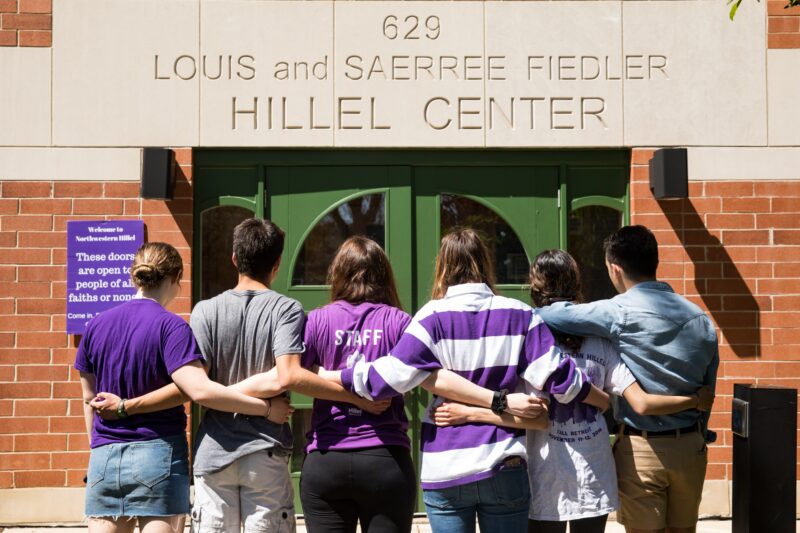
Staff members stand in front of the Northwestern Hillel building, in an undated photograph.
I have held this framework in mind while reading a recent essay in Commentary critiquing Hillel International and, more broadly, the state of Jewish life on campus. The author raises concerns that are significant and deserve genuine engagement. He argues that Jewish institutions have become overly shaped by the norms and expectations of the contemporary university and progressive culture. He worries that a generation of students is encountering a Judaism that is warm and welcoming but not confident, thick or substantive enough to offer depth, coherence and continuity. He suggests that the moment calls for stronger articulation of Jewish purpose and peoplehood — especially in an era marked by rising antisemitism, charged debates around Israel and deep uncertainty about identity.
These concerns matter. They point to the essential claim embedded in Hillel the Elder’s teaching “im ein ani li, mi li” — “If I am not for myself, who will be for me?” It is a teaching that places clarity, loyalty and responsibility for Jewish life at the center of our communal commitments. Many educators and leaders share the author’s view that Jewish institutions must transmit a rich, civilizational Judaism that can anchor young adults who are navigating a turbulent world. Ignoring this critique would be irresponsible.
The educational commitments that shape Hillel
At the same time, campus educators understand something equally important about this generation. Students arrive with uneven Jewish backgrounds, mixed levels of literacy and uncertainty about where they belong. The first step into Jewish life is often relational rather than conceptual. It happens when a student feels seen, met without judgment and accompanied at their pace. Hillel’s educational approach — when practiced at its strongest — is guided not only by openness, but by a sophisticated understanding of how identity is formed and how trust becomes the gateway to depth.
This posture emerges from another of Hillel the Elder’s teachings, the instruction to be like Aaron: “ohev shalom ve-rodef shalom, ohev et ha-briyot u-mekarvan la-Torah” — “loving peace, pursuing peace, loving people and drawing them closer to Torah.” This is not a philosophy of low expectations. It is a deliberate educational method. It begins with the human being in front of you, trusting that belonging can open the door to study and commitment. It recognizes that students who feel respected and understood often become students who can receive the richness of Jewish life.
It is also important to say directly that Hillel is not unaware of the tensions between these two orientations. They are discussed openly across the movement. Professionals wrestle with them daily. Is there room for improvement? Absolutely. Is Hillel examining how to strengthen its educational clarity and Jewish content? Yes. These internal conversations are happening with seriousness. The question is how we participate in that work — from the outside looking in, or from within a tradition of rebuke that aims to strengthen rather than to reduce.
When critique touches individuals rather than institutions
This becomes particularly important when public critique names individual professionals. Institutions can absorb critique; individual educators cannot absorb mischaracterization. And this is where the recent essay touches more delicate ground. Among those mentioned is Rabbi Jessica Lott, whose leadership I know well through years of working with Hillel professionals. Rabbi Jessica, an alumna of our 18×18 Executive Fellowship and now an adjunct faculty member, is not simply one example among many; she is a contemporary embodiment of Hillel’s second teaching. She lives ohev et ha-briyot u-mekarvan la-Torah — first loving people, then bringing them in.
This is not a metaphor. It describes her entire way of working: the relationships she builds, the seriousness with which she meets students’ questions, the confidence she has that genuine care creates openings for Jewish learning. It is present even in the quotes the author uses to critique her — quotes that, in fact, should give her pride. They show an educator rooted in integrity, one who understands that students grow not through pressure but through trust and honest accompaniment.
Highlighting this is not about defending an educator I deeply respect. It is about recognizing what is lost when individuals become the face of a systemic critique. The conversation we need is about institutional direction, educational clarity and the balance between belonging and depth — not about the character or competence of professionals who are doing difficult, thoughtful work every day.
Toward a conversation that strengthens
The critiques raised in the Commentary essay are real and important. I share many of them. Hillel needs to continue strengthening its Jewish content, sharpening its educational goals and ensuring that being welcoming does not overshadow substance. The moment demands institutions that can speak with clarity about Jewish identity and purpose.
But how we conduct that conversation matters. Rebuke offered from within relationship strengthens community; critique delivered as exposure can weaken it. If we want Hillel to grow, we must engage it from a place that honors both teachings of its namesake: the clarity of “im ein ani li, mi li” and the compassion of “ohev et ha-briyot u-mekarvan la-Torah.” When we hold these two commitments together, our critique becomes more honest, our rebuke becomes more constructive and our discourse becomes more capable of supporting the Jewish future we are all trying to build.
Shuki Taylor is founder and CEO of M²: The Institute for Experiential Jewish Education.