WHAT YOU SHOULD KNOW
Most Americans lean on nonprofits without ever realizing it, survey finds
Courtesy
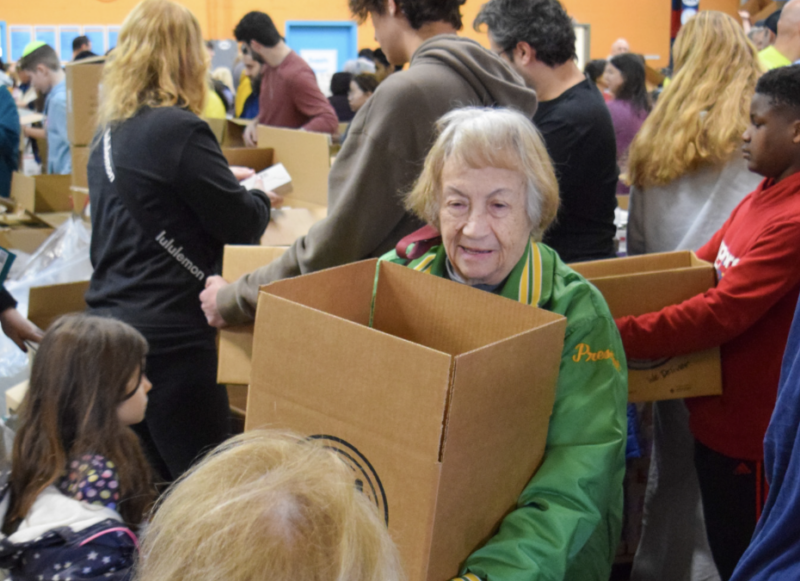
Elderly congregants join young students to pack and deliver food for the needy at an event at Temple Beth Hillel - Beth El in Wynnewood, Pa.




 Add EJP on Google
Even as the vast majority of Americans engage with or depend on a variety of nonprofits, most do not recognize that they are doing so, according to a survey by researchers at Indiana University’s Lilly School of Philanthropy that was released yesterday.
Nearly three-quarters of the nearly 1,800 respondents — 71.9% — reported engaging with at least one service provided by nonprofits, among them enrollment in private universities, receiving food support, visiting museums and attending religious services. However, asked broadly about their use of nonprofit services, just 7.4% of respondents said that they or someone in their immediate family had received or used services from a charitable organization in the past year. That 7.4% represented a 2% increase since the survey was last conducted three years ago.
“That recognition gap matters. It affects not just things like whether they donate, but how they react to events or policies that affect the nonprofit sector as a whole,” Jon Bergdoll, interim director of data and research partnerships at the IU Lilly Family School of Philanthropy and the report’s lead analyst, said in a statement.
Of the services run by nonprofits that respondents had interacted with in the last year, religious services represented the largest segment, at 46%. The next largest segment was respondents who had attended a museum, at 36%.
Compared with three years ago, respondents were also slightly less likely to consider “giving time” or volunteering, as philanthropic — 82% this year, compared to 85% in 2023. Participants were also slightly less likely to consider giving to religious congregations or organizations as philanthropic — a 1.3% decrease — though 64% of respondents still deemed it to be charitable giving. In the broader philanthropic ecosystem, religious institutions are the largest recipient of charitable funds.
Americans do not view nonprofits as the ideal provider of basic needs, instead preferring government involvement. Compared to 2023, fewer respondents said that nonprofits are more effective than the government at providing basic needs, declining from 24.6% to 18.9%.
However, Americans also place significantly more faith in nonprofit organizations to “solve societal or global problems,” as compared to governments, according to the report. Seventy percent of respondents had high or moderate confidence in nonprofits, ranking them third on the list of 11 categories of institutions. The bottom two institutions were Congress and the Supreme Court, with 38.5% and 36.1% of respondents expressing some level of confidence, respectively.
Respondents also expressed preferences about the source and use of charitable funds. Participants viewed small gifts from many donors as more important than big donations from few donors. They also expressed a preference for foundations operating in perpetuity rather than spending down their funds, or sunsetting — consistent with the previous survey.
Twenty-eight percent of participants responded that they believe the nonprofit sector is on the wrong track, compared with 19% of respondents who think it is on the right track. Fifty-four percent of respondents said they didn’t know enough to weigh in.