Opinion
‘Make a friend before you need a friend’




 Add EJP on Google
My friend Reverend Earl Harris, a former Christian pastor and veteran of the Civil Rights movement who comes to our Shabbat services almost weekly, taught me that when it comes to inter-religious collaboration you need to “make a friend before you need a friend.”
The truth of that teaching became clear after the firebombing attack on Pennsylvania Gov. Josh Shapiro’s residence on the first night of Passover this year. The Governor’s Residence is a few blocks from my house and the synagogue where I work in Harrisburg. It was shocking to return from my family’s Passover Seder in Maryland and see the gates of the residence covered in caution tape and the block swarming with police cars.
As soon as the holiday was over, I reached out to other rabbis in town and asked what kind of response was being planned. To my surprise, I found that no plan had been formulated, so I took up the cause myself, convinced that the public needed to see a positive showing of interfaith support in Harrisburg to know that the community would not tolerate violent acts of hatred. Together with another rabbi and the local Jewish federation, we discussed ways that the community could respond to this shocking hate act. Then I began to reach out to my interfaith network.
I am fortunate to have strong relationships with leaders of other Harrisburg faith communities. The Harrisburg community has a long history of interfaith organizing that I inherited, from an interfaith “Freedom Seder” that my congregation hosts annually to a monthly Jewish-Christian Bible study group, as well as multiple interfaith programs and services throughout the year.
Having often participated in these events I had numerous contacts with interfaith clergy and friends that I could reach out to in a crisis. Once we set a date and a time for a solidarity march to condemn acts of hatred, I sent out requests to faith leaders in town to partner with me and the Jewish community in the event. Within a few days, I had a robust response from leaders across faith traditions, ready to march with us.
It wasn’t uncomplicated, of course. There were security issues to think of, a fear that is all too common for Jews these days. Might someone who heard about the march try to attack us? This was not an unreasonable fear, given that we were responding to exactly one such antisemitic attack. Fortunately, the Harrisburg police department agreed to accompany the march, attending to our security concerns.
But there were other issues, as well. One dear friend, an organizer in the Black community who I met at a Black Lives Matter rally, expressed concern that we would gather a large march to respond to an act of violence against a prominent, privileged member of our community when we had not done so after incidents of gun violence that affect poor and underprivileged community members. Gun violence in Harrisburg is disproportionately high and the need to organize and end it is urgent. My friend told me that he could not participate in the rally as I described it because it so heavily centered on Gov. Shapiro over needy people who so often go unnoticed.
I appreciated his perspective, and it helped me reframe the message of the rally. We called it, “Hate Has No Home in Harrisburg,” and, at the rally, we spoke about the need to end violence of all kinds, not just this firebombing but gun violence as well.
In the end, my friend, the organizer, did attend the march. He told me later that he thought of all the times Jewish leaders had shown up to events when he needed us, and he wanted to show support for us in return. Moved by his commitment, I vowed to continue to raise awareness about gun violence in our community and to continue to show up when he needed me.
Another issue was the political overtones of the firebombing. Upon arrest, the attacker made a comment that connected his actions to the Palestinian cause. There are diverse opinions about the war in Israel and Gaza among our interfaith partners, and I worried that some might not show up out of sympathy for Palestinians suffering in Gaza. That proved not to be the case. Christian and Muslim friends of various political stripes showed up because they cared about their Jewish friends over and above any politics. Some marchers wore or carried Israeli flags, with no incident.
In the end we had over 200 people at the last-minute march, singing songs of peace as they walked from our Beth El Temple building towards the Governor’s Residence. Outside the residence, leaders from across faith traditions — Jewish, Muslim, Protestant, Catholic, Bahai and more — shared prayers for peace.
This has been a time of intense division in the world, and in our country in particular. Jews feel especially isolated with the rise of antisemitism, including violent incidents like the attack on Governor Shapiro’s official residence. These circumstances raise our suspicions and fears, causing us to turn inward, away from anyone we don’t know well.
But this turning away is a self-fulfilling prophecy. When we isolate ourselves, we are more likely to fear and mistrust others.
In these circumstances, it is helpful to have “made a friend before you need a friend” — to have friends in other faith groups that we trust enough to talk through the difficult issues, to navigate through the tricky parts. These friendships can help us dispel some of the suspicion and fear, release some of the anger, and stay strong through the hard times.
As the event concluded I walked next to other marchers who expressed grateful surprise at the power of the event. Jewish participants expressed relief at seeing people from other faith communities standing by their side, dispelling some of their fear through solidarity. Participants from other faiths expressed gratitude for the opportunity to do something, to take effective action for goodness and love in a world where hate seems to run rampant.
Sadly, in the last few months we have seen additional acts of ignorance and hatred in our region. At a Halloween parade in York, Pa., Catholic school children marched beside a cemetery-like float with gates reading “Arbeit macht frei,” “Work makes you free.” The creator was apparently unaware that this was the sign that hung above the gates to the Auschwitz concentration camp. The Harrisburg Diocese, an ally of the Jewish community that regularly sends us holiday greetings, immediately condemned the float and initiated discussions to improve Holocaust education in Catholic schools. At another Halloween parade in Mechanicsburg, Pa., a KKK representative handed out hate literature alongside candy. Christian and Jewish clergy there immediately planned a “Hate Has No Home Here” event that drew hundreds.
As frightening as each of these events were, the robust interfaith responses by clergy felt even more powerful. By turning these painful moments into opportunities for education and community building, we are creating a more connected and healed world. I feel lucky to be part of this work.
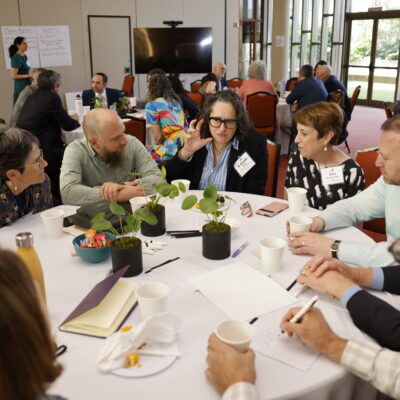
Inspired to strengthen my interfaith friendships, I recently joined with a pastor friend in town to create a group called “The Peace Circle.” The purpose is to heal divisions by sharing honestly and listening compassionately. Bearing witness to one another’s struggles helps to reduce any animosity or suspicion that has been building between our communities. Together with a few clergy and leaders from various faith communities, we gather without any agenda, just an invitation to speak what is on our hearts.
This monthly group has been an important “safe space” for me in these dark days, a space that gives me some comfort and the courage to forge ahead. We have witnessed one another in tears and laughter, sharing stories both personal and global. We return each time to our central purpose: mutual support. In this space I am forming deep bonds, strengthening friendships that I know will be there for me when I need them most, just as I will be there for them when they need me.
Rabbi Ariana Capptauber serves as the rabbi of Beth El Temple in Harrisburg, Pa., where she lives with her husband and two children. Ordained by JTS, she is an alumnus of the Clergy Leadership Incubator, a two-year leadership fellowship for rabbis directed by Rabbi Sid Schwarz, and is a contributor to CLI’s Spiritual Innovation Blog.