Opinion
TIMELESS AND TIMELY
Keeping everyone at the table: Pesach and the hard conversations ahead




 Add EJP on Google
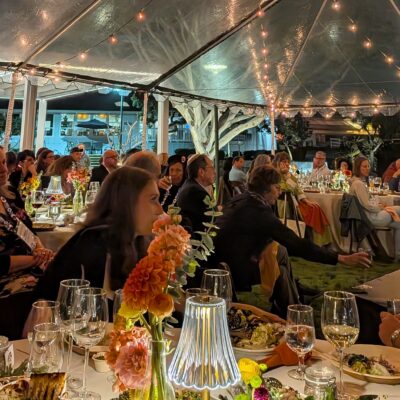
In at least one respect, Pesach is the Thanksgiving of the Jewish calendar: for many families, it is the holiday when dreaded fault-line conversations surface around a table crowded with opinions (and often a bit too much wine). At their best, both holidays bring us together to eat and to tell the stories that shaped us. At their worst, they devolve into scenes of tension and polarization.
This is not only a challenge of 2026, though as we once again contemplate Pesach during a time of war, it feels particularly acute. The particulars change from generation to generation, but one of the key underlying dynamics at a family table like the Seder is perennial: the moment when people who share love and history nevertheless arrive with differences, some seemingly unbridgeable.

halbergman/Getty Images
Illustrative. An American Jewish family at the Passover Seder table. The Seder leader holds up the middle matzah before breaking it. halbergman/Getty Images
Often, but not always, that dynamic is felt most sharply when younger adults return home with perspectives that unsettle existing assumptions and beliefs. For many Jewish families, Israel is where the fault lines feel sharpest. A child comes home from college and says they are campaigning for a DSA candidate or joined Jewish Voice for Peace or avoided Hillel because it has an Israeli flag displayed. In these choices, there’s a risk that a parent hears not only politics, but rejection — of the family’s story, of Jewish peoplehood, of solidarity in a time of threat.
The Haggadah anticipates this — not in the language of Israel or Zionism, of course, but in the deeper language of transmission of values, history and faith. It assumes that the story it is telling will not be received uniformly or easily.
Some will lean in with curiosity and mastery. Others will need simplicity, patience, or encouragement. And others will push back, distancing themselves from the collective “we” altogether.
The Seder does not imagine a seamless handoff from one generation to the next. It anticipates the anxiety of that handoff and requires us to rehearse it anyway — to imagine ourselves, k’eilu, as if we are participants rather than distant observers.
This comes into sharp focus in the Haggadah’s passage about The Four Sons. This is not merely a list of personality types. It is a guide to raising and educating our children, even those questioning the values we hold most precious.
Let’s quickly review the four children. The wise child seeks elaboration. The simple child requires clarity. The child who does not know how to ask depends on the adult to initiate the conversation. And the child who distances himself poses the question that haunts every Seder table facing generational or ideological difference: “What does this ritual mean to you?”
This child, described as the rasha (the wicked one), is the questioner that the Haggadah seems most worried about: not the child who doesn’t know enough, but the child who uses the operative “you” to indicate his own distancing, stepping back from the collective “we.”
It’s in that context that we encounter the Haggadah’s famously harsh instruction: hakheh et shinav — “blunt [the rasha’s] teeth.” The phrase has long unsettled readers, and for good reason. The plain sense of the phrase resists easy softening: On its surface, it suggests rebuke, even aggression, in response to a child who has distanced himself from the collective story; read narrowly, it can sound like the tradition is telling us to shut the conversation down.
But that is not what actually happens in the Haggadah.
The rasha is neither removed from the table nor ignored. He is addressed directly, inside the shared ritual space of the Seder.
The point is not punishment, but interruption. Something is being blunted, but it’s not the child’s capacity to question. What is being interrupted is the escalation that turns questioning into mutual defensiveness and withdrawal. The Haggadah refuses to let that dynamic take over, because it knows what comes next: rupture. In the stark language of the Haggadah, the risk is a child who is irredeemable.
In other words, the Haggadah treats this not primarily as intellectual dissent, but as relational disruption. The child is no longer asking how the story works, but whether it is his story at all. And that is when the work of transmission changes. It is no longer mainly about giving the “right” explanation. It becomes the more fragile task of holding a boundary without losing the relationship.
At that point, you can almost feel two instincts pulling in opposite directions. One is to defend the story: to tighten boundaries, insist on loyalty and protect continuity when things feel threatened. The other is to stay curious about the encounter itself: to remain present to uncomfortable questions, tolerate uncertainty and trust that relationship is the only real pathway to transmission. Both instincts usually come from care. Both are often fueled by fear of loss. But they do not lead to the same future.
Several recent studies highlight this dynamic and confirm what many Jewish educators and campus professionals are seeing firsthand: a growing number of young Jews are hesitant to claim the label “Zionist,” even while maintaining real emotional attachment to Israel, to Israeli friends and family and to the Jewish story of return and sovereignty. The gap, in other words, is not always one of connection, but of language and what certain words have come to signal socially and politically in a particular moment. If we treat the label as the litmus test, we may miss the deeper truth: that the relationship is still there, even if the vocabulary has shifted.
The worst mistake we can make is to let certain words or positions become the price of admission to the table. If we insist that young people argue their way back into our preferred language before we grant them a seat at the table, we should not be surprised when they stop coming to the table altogether.
The Haggadah’s wisdom is that it refuses to do this. It keeps even the alienated voice within the conversation, because it understands that the story cannot be transmitted to those who have been pushed outside it.
The Seder opens with an invitation: Kol dichfin yeitei v’yechol. All who are hungry, come and eat. That invitation is offered before the story is told, before its meaning is explained and before its boundaries are defended. In placing the invitation first, the Haggadah offers an essential insight into our moment: belonging precedes agreement; presence comes before persuasion.
Our task is not to ensure that the story is never questioned, but to make certain that there remains a table at which it can still be told.
Rabbi Ben Berger is the senior vice president of Jewish education, community and culture at Hillel International.