Opinion
TURN OFF AUTOPILOT
Jewish worship: It’s time for some creative disruption




 Add EJP on Google
As a pulpit cantor and rabbi who has served a synagogue community for a dozen years, I rarely have an opportunity to experience Shabbat services beyond my own sanctuary. This year, however, was an unusually travel-heavy year for family simchas, so I had the pleasure of seeing three other synagogues in action: a Reform temple in Washington state, a Conservative synagogue in Arizona and a Sephardic temple close to our own congregation in Los Angeles.
It’s both exciting and uncanny, interesting and unnerving, to watch a familiar script with different players and radical diversions from what I am accustomed to. The melodies that I have never heard. The prayers that they skipped. The way they navigated the b’nei mitzvah ceremonies. The announcements. The kiddush. I returned to my community each time with a pocketful of ideas that I am eager to try. It is not that the way our community does Shabbat is broken; rather, stagnancy breeds boredom.
Courtesy
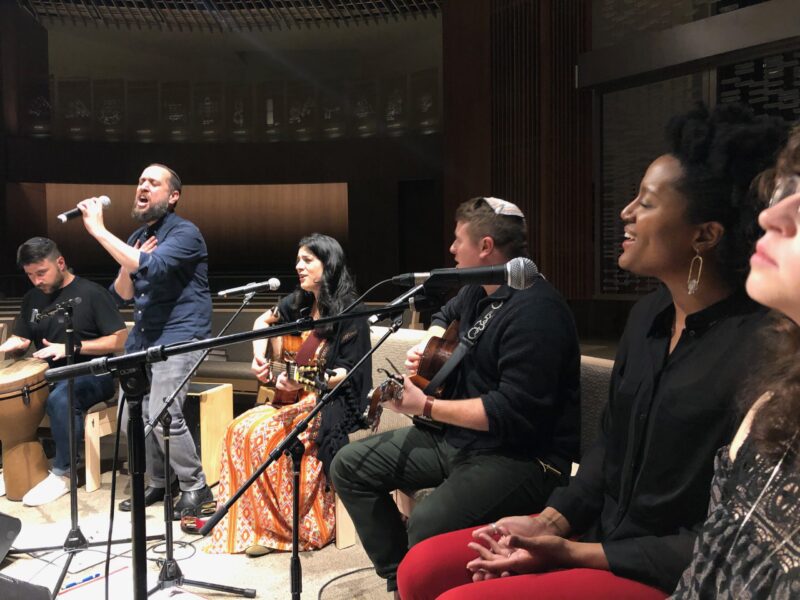
Rabbi Yosef Goldman (standing) leads a melave malka with (from left) Rabbi Sammy Rosenbaum, Chava Mirel, Rabbi Noah Diamondstein, Ayo Awosika and Eliana Light at a previous Kol Tefilla Conference.
Jewish customs have a way of getting stuck. The longer we have been doing something a given way, the less likely we are to examine how ritually effective it is. We lean on the power of precedent — sometimes calling it “tradition” — rather than the power of disruption. But we need disruption in our spiritual lives. We need to turn off the autopilot mode in services so as to reawaken our intentions and insert some fun in our prayer experiences.
For the past eight years, my home synagogue, Temple Beth Am in Los Angeles, has hosted Kol Tefilla, a radically heimish shabbaton and conference focused on innovative tefillah experiences. Our team of Rabbis Adam Kligfeld and Rebecca Schatz, with the partnership of Cantor Michelle Stone, has brought this to life year after year. We have been pleased to partner with United Synagogue of Conservative Judaism; the Clergy Leadership Incubator rabbical fellowship program; the Cantors Assembly; the Rabbinical Assembly; Yeshivat Hadar; the Jewish Studio Project and other institutions to offer a weekend for clergy and lay leaders who want to disrupt their tefillah mindset. Against the backdrop of our traditional Conservative landscape, we delved into new content, form and melodies, all guided by the instruction of remarkable teachers from across Jewish genres. Our upcoming Kol Tefilla shabbaton, featuring Rabbi Elie Kaunfer, CEO of Yeshivat Hadar, and musicians of the Zamru ensemble from the Fuchsberg Center in Jerusalem, will take place in early January 2026 at Temple Beth Am in Los Angeles. (Early bird registration ends Nov. 28.)
The exquisite tunes brought to us by the musicians who have served in residence at Kol Tefilla pervade our services year-round. That includes the music of Rabbi Josh Warshawsky, Nava Tehila, Chava Mirel, Rabbi Deborah Sacks-Mintz, Eliana Light and more. Beth Am has also experimented with new modalities that have infused our prayer life and transformed our approaches to both traditional and radical tefillah offerings. “Hama’alot,” the Renewal-inspired Shabbat morning service that we showcase each shabbaton as a cornerstone example of the tefillah approach at TBA, is now also the modality we use for Yom Kippur Musaf. Most of all, we’ve created a beautiful braid of leadership that pervades the tefillah landscape at Beth Am: clergy, lay leaders and congregants working jointly to produce experiences that meet a variety of spiritual needs.
Had we just experienced the transformative impact of the shabbaton on our own hosting institution, dayeinu. But after each conference, we hear from attendees that they returned to their home communities to implement material and methodological changes inspired by Kol Tefilla. Each year we have heard some version of the following: a new monthly service initiated at a synagogue across the country; how a melody from our musician-in-residence is now a staple of Kabbalat Shabbat; an attendee applying to rabbinical school; or a lay leader who found their inspiration to get more deeply involved in synagogue life after attending Kol Tefilla. The common thread is change, both big and bold as well as small but powerful. More and more congregations are daring to do tefillah differently through better design.
Those of us who craft prayer experiences are the ones most likely to be invested in the forms of prayer that we were exposed to early in life. We trained to be clergy because we liked what we experienced. But it is becoming increasingly clear that the rationale “Because we’ve always done it that way” is no longer defensible. At Kol Tefilla, our scholars and musicians challenge participants to rethink every contour of tefillah. The conference is a launchpad for renewal, sending participants back home asking, “What’s next?” for their prayer experiences.
This Elul, I spent some time in chevruta with my teacher, Rabbi Vanessa Ochs. We spoke about the turn of the 21st century as an inflection point in disruption, the beginning of a long era of “unprecedented times.”
For millennia, Jews almost exclusively designed ritual and prayer experiences with deep, traceable roots, declaring that each tradition was the next link in the chain. With the onset of globalization and the 24-hour news cycle, ritual has quickly evolved to be responsive and real-time, often uprooting precedent. Laptops next to the seder plate during the COVID-19 pandemic. Tables for the missing hostages popping up in homes and synagogue lobbies. Prayers published overnight and spread through social media. We haven’t developed an allergy to tradition but rather a hunger for rituals and prayers that resonate in the present.
Over the past decade, Kol Tefilla has been a showcase and a workshop for this real-time, ritual mindset. We are excited to welcome returning and first-time participants alike, dreaming about the things tefillah could be and do for each of us.
Rabbi Cantor Hillary Chorny is the cantor at Temple Beth Am in Los Angeles. Her forthcoming book, to be published by the Rabbinical Assembly, is Minding the Ritual Gap, exploring ritual through the lens of design thinking. She is a contributor to the “Spiritual Innovation Blog” of the Clergy Leadership Incubator, a two-year rabbinic fellowship program directed by Rabbi Sid Schwarz.