WHAT YOU SHOULD KNOW
In l’affaire Macklemore, Jewish leaders find they’re damned if they do; damned if they don’t
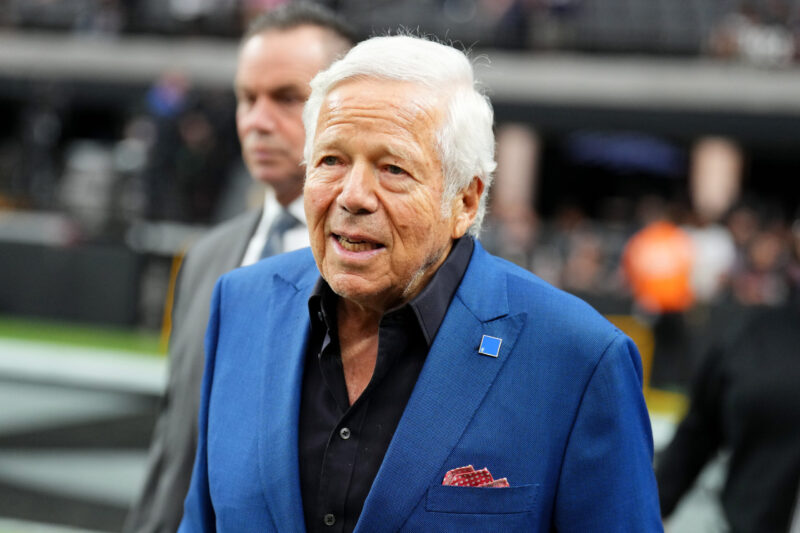
Chris Unger/Getty Images
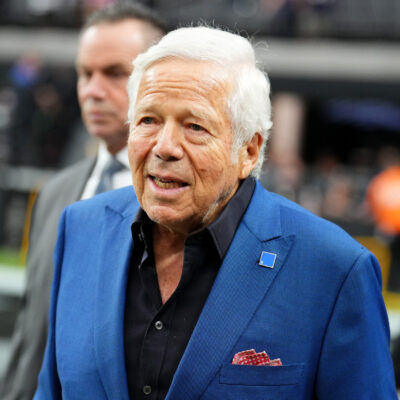
New England Patriots owner Robert Kraft looks on prior to a game against the Las Vegas Raiders at Allegiant Stadium on Oct. 15, 2023 in Las Vegas.




 Add EJP on Google
In response to onstage rants accusing Israel of committing genocide and apartheid, Macklemore was dropped yesterday as the opening act for Ed Sheeran after venue owners — notably including New England Patriots owner Robert Kraft — refused to allow the rapper to take the stage.
To many Jewish groups, particularly those who had been calling for his removal, this constituted a form of justice: A performer making unfounded allegations against the only Jewish state in front of massive audiences was held to account and faced repercussions for his actions. David triumphs over Goliath.
“Freedom of speech is not freedom from responsibility,” the Israeli-American Council said in a statement. “Anyone who chooses to turn an 80,000-person concert into a vehicle for advancing a one-sided political agenda must stand behind that choice. A concert stage is not a platform for anti-Israel and antisemitic propaganda.”
Yet immediately, the headlines and articles about the development indicated that the issue was not Macklemore’s anti-Israel sentiments but his support for Palestinians. Add to that the fact that the main figure involved, Kraft, is a billionaire owner of multiple sports franchises with personal ties to President Donald Trump.
In Rolling Stone, which broke the story, the headline was, “Macklemore Dropped From Ed Sheeran Tour After Onstage ‘Free Palestine’ Statements.” In The New York Times, it was, “Macklemore Dropped From Ed Sheeran Tour After ‘Free Palestine’ Remarks.” In The Washington Post, it was, “Macklemore dropped from Ed Sheeran tour after pro-Palestine comments.”
And thus, the David vs. Goliath dynamic is reversed, and a martyr is born, albeit one whose life is intact and whose fame has only grown. (Indeed, a glimpse at Google Search Trends shows that the word “Macklmore” has been searched for more in the United States this month than at any time in a decade.)
Surely there are those for whom “Free Palestine” is inherently anti-Israel, but to most Jewish Americans, the majority of whom support a two-state solution, the issue is not the calls for a Palestinian state but the allegations — opposed by much of the Jewish community — of genocide and apartheid and support for a protest movement that is widely believed to have antisemitic elements.
There is, in this incident, the added element that this is not Macklemore’s first run-in with the Jewish community. In 2014, during a performance of his hit “Thrift Shop,” a jaunty tune about being fashionable while stingy, the rapper donned a black suit, white shirt, fake beard and large hooked nose, which was widely seen as an antisemitic caricature. Following an outcry, Macklemore said the costume selection was unintentional but recognized how it could be construed as an antisemitic stereotype.
The latest kerfuffle highlights the Catch-22 of such incidents. On the one hand, there is an eminent need by Jewish groups and leaders to respond to figures whom they see as threatening or hurting the Jewish community. And yet, exercising that right also feeds into an antisemitic narrative of Jewish control and of persecution for supporting a disadvantaged group. Damned if you do; damned if you don’t.