WHAT YOU SHOULD KNOW
Israel again goes into ‘war mode,’ wondering how long this one will last
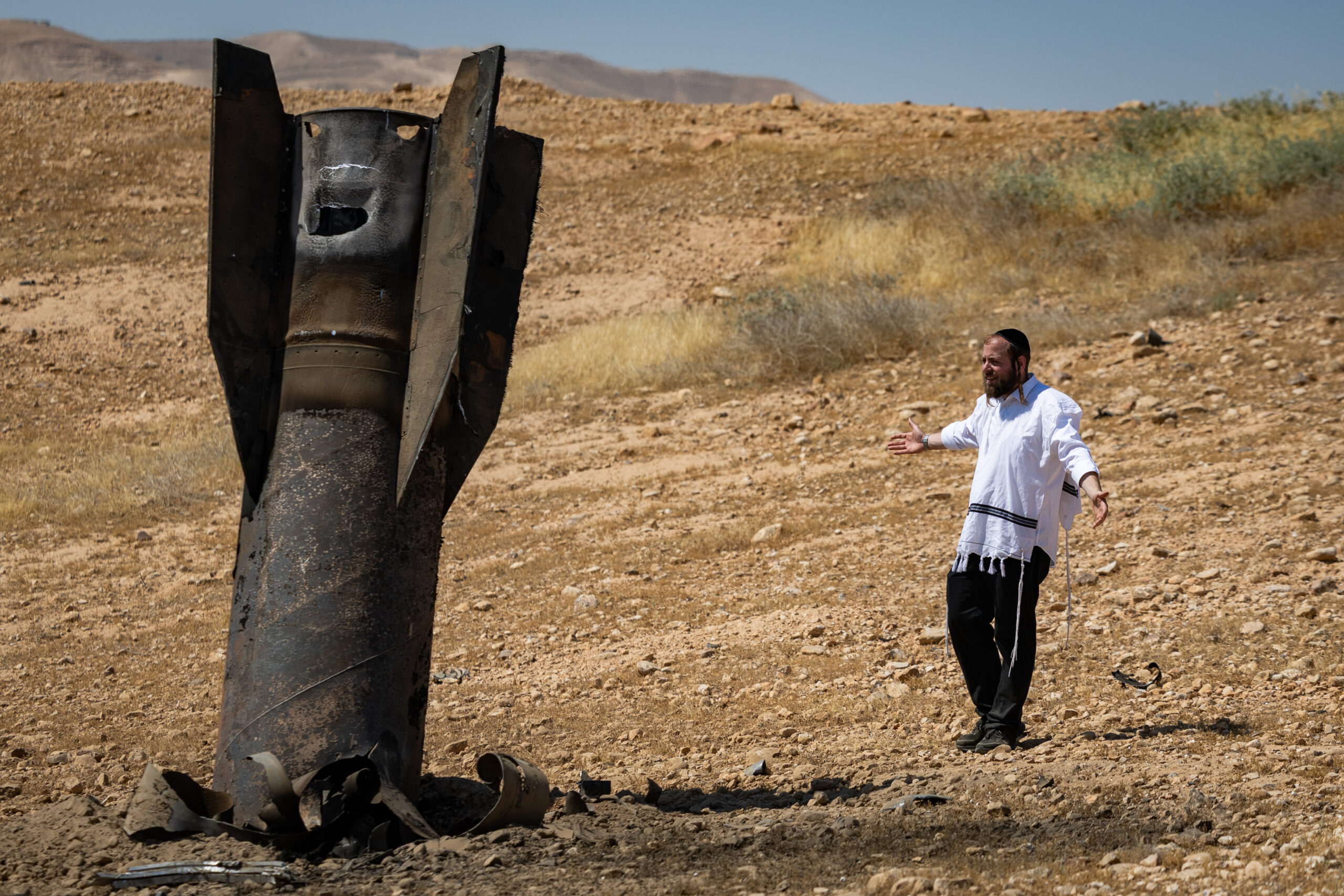
Chaim Goldberg/Flash90
Part of an Iranian ballistic missile is seen in the desert near Vered Yeriho in the West Bank after being fired toward Israel from Iran on June 8, 2026.




 Add EJP on Google
Like an unfortunately well-oiled machine, the State of Israel entered “war mode” on Sunday night and Monday morning as Iran fired waves of ballistic missiles at the country’s North and Center, sending millions of people rushing to bomb shelters — provided they had one they could reach in time.
The waves of ballistic missiles have mostly been intercepted as of Monday afternoon, save for one that caused no injuries but damaged buildings in a West Bank settlement.
Iran said that it launched the missiles — the first such attacks since a ceasefire went into effect two months ago — in retaliation for Israel’s strikes earlier in the day on a Hezbollah headquarters in the Dahiyeh neighborhood of Beirut, which was in response to rocket fire by the Iran-backed terror group. The war between Israel and Hezbollah has been gaining intensity in recent weeks as the terror group exploited Israel’s weakness to fiber optic-controlled drones, killing and wounding many soldiers. Israel, in turn, has taken control of larger swathes of southern Lebanon to drive back the terror group.
For the past two months, only the residents of Israel’s northernmost communities have faced regular attacks, and now nearly the entire country is again hearing the air raid sirens and notifications of the military’s Home Front Command app. (This time around, there’s a new, jauntier tune telling people that it is safe to leave their shelters.)
After the first barrage on Sunday night, the Education Ministry and IDF Home Front Command ordered all educational institutions closed until further notice. Hospitals across the country entered “emergency mode,” releasing non-critical patients home and moving the rest to protected areas — generally underground parking garages that can be converted to hospital rooms.
“Beilinson’s teams have begun transferring hundreds of patients to the underground facility,” a spokesperson for the central Israeli hospital said in a statement. “The experience that we have obtained in recent years for handling extreme situations and complicated events allows the hospital to quickly and safely move from routine to crisis.”
Unlike in previous rounds, Israel’s main travel hub, Ben Gurion Airport, has remained open for now, even as missiles fired both by Iran’s proxy, the Yemeni Houthis, and by Iran itself have forced travelers to take cover in the airport’s shelters.
“Following a situational assessment that was held by Transportation Minister [Miri Regev], Ben Gurion Airport is operating as normal,” the airport said. “We recommended that the traveling public update itself with its airline and track developments through official media channels.”
Israeli businesses have also remained open — a source of frustration for Israeli parents, who are yet again stuck juggling work and childcare.
Perhaps most curiously, Israeli citizens have discovered that while they are grappling with the realities of war, their politicians are back to business as usual. The Knesset today is primarily dealing not with war-related issues — committee hearings on national security, schools or support for businesses — but instead on whether the parliament should revoke the immunity of a Knesset member, Tali Gotliv, who faces criminal prosecution for allegedly exposing the identity of a secret Shin Bet security officer. The parliament is also debating a contentious bill that would establish an alternative commission to investigate the Oct. 7 terror attacks, instead of a standard independent state commission of inquiry.
But for Israelis — and everyone else in the region — the main question on their mind is how long this round of fighting will last. Is this a brief tit-for-tat or the start of a new round of all-out, multifront war?
The Israeli military has stressed that it is prepared to fight for as long as necessary and expects the current round to last several days. “The IDF is ready for continued activity on all fronts against whoever threatens the State of Israel,” the military said this morning.
President Donald Trump, meanwhile, has expressed his desire for the round of fighting to come to a swift end and allow American and Iranian negotiators to work out a lasting ceasefire.
“I am going to call Bibi right now and tell him not to retaliate. Each of them had their fun. Israel had its strike and Iran had its strike. We don’t need another one,” Trump told Axios last night after the first barrage.