WHAT YOU SHOULD KNOW
With Iran war looming, Miami confab looks to chart a course forward for American Jewry

selimaksan/Getty Images




 Add EJP on Google
Jews around the world gathered yesterday to listen to the Book of Esther: a tale of two Diaspora Jews who, from very different positions of leadership, not only responded to a lethal antisemitic threat to their community with commitment, strategic thinking and self-sacrifice, but also rallied their fellow Jews to action and established communal traditions that continue to bring us together.
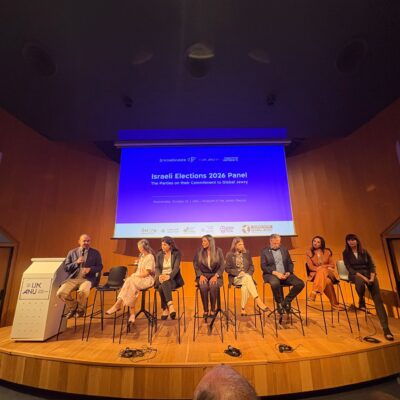
A different Jewish gathering is commencing today in Miami, taking place in the shadow of the war in the Middle East and rampant antisemitism challenging Jewish communities around the world. But like the protagonists of the Purim story, the organizers are dedicated to ensuring the security and continuity of their Diaspora community — in this case, American Jewry — and see an opportunity for wider grassroots collaboration.
“I think everybody agrees that American Jewry is in a state of crisis, challenge, decline — there’s been a lot of talk about that and a lot of writing,” Gidi Grinstein, founder and president of the think tank Reut USA, said in a recent phone call with eJewishPhilanthropy. “To [emerge] out of this crisis requires creating communal knowledge. Nobody’s an expert about the future; people are experts about specific lanes, they’re experts about specific topics, but not about the future. So the purpose of this conference is to extract, elicit and inspire people to share their insights.”
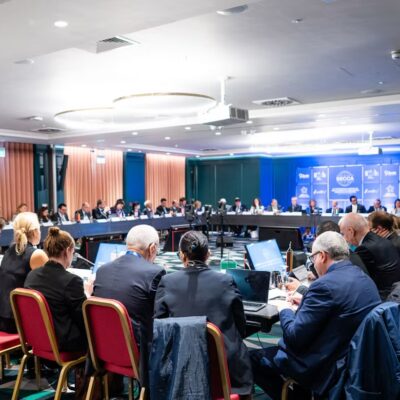
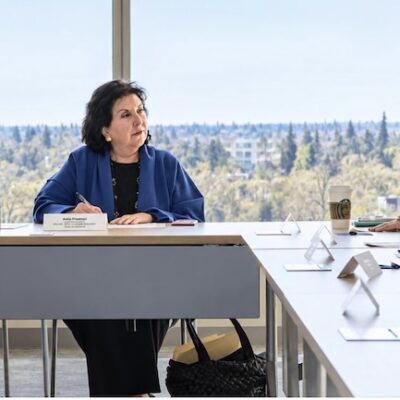
Around 100 lay leaders, professionals, scholars, journalists, philanthropists, entrepreneurs and activists of varied denominational and political stripes are expected to attend AJ2026, one in a series of confabs being organized by Reut USA to discuss the condition and direction of American Jewry alongside America’s 250th anniversary. Today’s event is taking place in partnership with the Weitzman National Museum of American Jewish History and the Greater Miami Jewish Federation, as well as eJP, which is serving as a media partner for the conference.
“A central theme of AJ2026 is the ‘national security’ of American Jewry, as a golden age may be ending. In the new era, the polarization and radicalization of American society and the turning of Israel into a wedge issue of American politics are an existential threat to American Jewry,” Grinstein said. “Therefore, strengthening a moderate American center is the primary challenge of our community. The vicious attacks on Israel are coming from the extremes. A strong center is good for America, for American Jewry and also for U.S.-Israel relations.”
While the growing war in the Middle East will loom over the conference, Grinstein said that the discussions are separate from the current conflict.
“The war against Iran is existential for Israel, consequential for the Middle East and may also affect the stature of Israel in the U.S., particularly if it continues without a decisive victory,” Grinstein said. “That being said, AJ2026 is a conference of American Jews about the long-term wellbeing and security of American Jewry. Most of the topics on our agenda, like education, leadership, institutional renewal, contribution to the U.S. or participation in America’s 250th celebrations, are not affected by the current conflict, and most Israeli participants are also Americans.”
Building on Reut USA’s AJ2025 conference in New York in July, in which the attendees helped develop an “11-point agenda” for the next decade of American Jewry renewal, today’s gathering is meant to take that admittedly ambitious goal forward.
“If there was no deep record of the discussions of AJ2025, the conversation of AJ2026 would start from the same place, right? A blank slate,” said Grinstein. A series of essays generated by AJ2025 (some of which were co-published in eJP over the summer), and an 11-point agenda built on 11 major topics that came out of the conference, are serving as a springboard “to make sure that the starting point for this conversation is much higher than in July,” he said.
“The theory of impact here is called ‘ecosystem intervention,’” he continued. “We’re trying to nudge the ecosystem, which consists of hundreds and hundreds of Jewish organizations, thousands of lay leaders and professionals and philanthropists and activists and entrepreneurs and so on. The way you nudge the ecosystem is you convene people, you offer a vision, you model successes — you do all these things that are like a catalyst, that are moving the ecosystem. And this is the logic of this conference, and that’s why it’s so important for us to get so many people, to give so many people the opportunity to share their insights.”
Grinstein is based in New York but is originally from Israel, and said that his experience leading civil society efforts there informs his vision and passion for this project.
“Now the paradox is that in Israel, all this civic energy, which comes from a horizontal civil society, meets a political system which is effectively vertical. So there is a mismatch of translating all these ideas that come from the civic space into the political system, right? This is a structural problem in Israel,” he said.
“Meanwhile, in America, American Jewry is flat. There’s no prime minister, there’s no president [of the entire Jewish community]… It’s a flat system, a flat network of communities, so you would expect that there would be many more of these civic mobility organizations and initiatives among American Jewry compared to Israel. So I was kind of struck by the absence of the dialogue, by the fact that there is no real grassroots civic mobilization and engagement and conversation about the future of American Jewry, by American Jews,” Grinstein said.
“I just saw the gap, and I said, like, why not? Why not do it here in the same way, with very diverse engagement, very inclusive; nobody has a monopoly on the future, there’s no silver bullet, which is another key idea of this conference. There is no silver bullet that will shape the future of American Jewry. It will be a mix of a lot of initiatives.”