What you should know
What Ken Livingstone’s London can teach Jews living in Zohran Mamdani’s New York
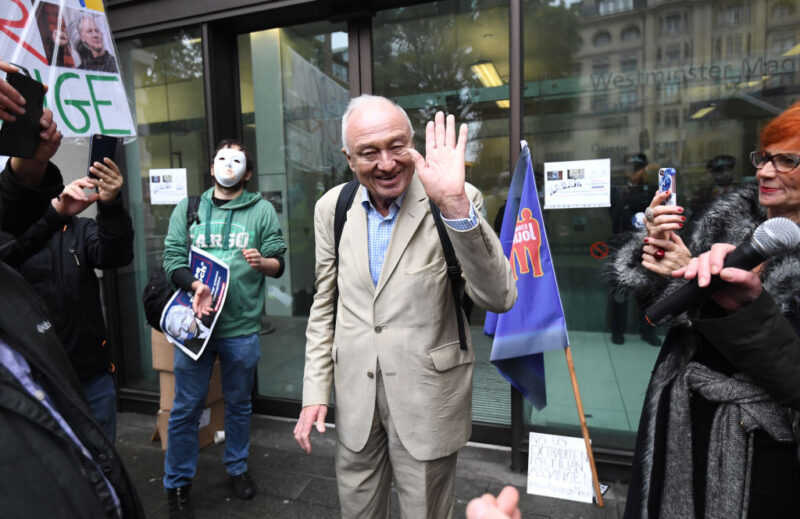
Kirsty O'Connor/PA Images via Getty Images
Former Mayor of London Ken Livingstone waves outside Westminster Magistrates' Court in London where Wikileaks founder Julian Assange is due to appear for a case management hearing relating to his extradition to the United States over allegations that he conspired to break into a classified Pentagon computer, on Oct. 21, 2019.




 Add EJP on Google
The city with the largest Jewish population in the world elected Democrat Zohran Mamdani as its mayor last night, following an election that deeply divided the Jewish community and is poised to continue to influence Jewish communal politics and priorities into the future.
Mamdani, a democratic socialist, was staunchly opposed throughout his campaign by the mainstream Jewish communal world over his support for the boycott, divestment and sanctions movement against Israel and his refusal to disavow calls to “globalize the intifada,” among other things. This included leading rabbis breaking from historical norms to endorse his main opponent, former New York Gov. Andrew Cuomo, from the pulpit. And now, that same mainstream Jewish communal world will have to learn to work with and against Mamdani, who received less than a third of the Jewish vote, compared to 60% that went to Cuomo, according to exit polls.
“As we have done for over a century, we will continue to work across every level of government to ensure that our city remains a place where our Jewish community, and all communities, feel safe and respected,” the UJA-Federation of New York, Jewish Community Relations Council of New York, the New York/New Jersey branch of the Anti-Defamation League, the New York office of the American Jewish Committee and and the New York Board of Rabbis, wrote in a joint statement.
“Our agenda remains clear. We will hold all elected officials, including Mayor-elect Mamdani, fully accountable for ensuring that New York remains a place where Jewish life and support for Israel are protected and can thrive. We will continue to confront, without hesitation, the alarming rise in antisemitism and hate crimes, and loudly call out any rhetoric or actions that delegitimize Israel or excuse antisemitism,” the organizations wrote.
This was echoed by many national and local Jewish organizations, who reiterated their concerns but also called for Mamdani to come through on his campaign promises of ensuring the dignity and safety of all New Yorkers, including Jewish ones. Others took a more combative posture, such as the Anti-Defamation League, which launched a “Mamdani Monitor” to track and monitor the incoming mayor’s policies and personnel appointments. Read Jewish Insider’s coverage of that here.
In his victory speech, Mamdani vowed to “build a city hall that stands steadfast alongside Jewish New Yorkers and does not waver in the fight against the scourge of antisemitism.”
Going forward, the Jewish community will face a far more complicated relationship with New York City leadership than it is used to. Suffice it to say that the new mayor will likely not be attending the “Israel on Fifth” parade next spring. Yet Jewish leaders will have to cooperate with the incoming administration in order to ensure the community is secured and receives access to municipal resources, while also pushing back against Mamdani’s more troubling proposals and initiatives, particularly those related to Israel, such as a plan to reassess Cornell University and the Israeli Technion’s joint campus on Roosevelt Island.
This will be a delicate line to balance. There are precedents for this, however, which the New York Jewish community — and American Jewish community writ large — can turn to for a roadmap, particularly in Europe, where anti-Zionist sentiments have been far more common for years. Arieh Kovler, a London-born political consultant, noted the similarities between Mamdani and former London Mayor Ken Livingstone, who came from the progressive wing of the Labour Party and who held anti-Israel views and was repeatedly accused of antisemitism.
“In most of Jewish history, leaders have not been our friends, and we’ve had to work with them,” Kovler told eJewishPhilanthropy.
This can be through direct negotiations and engagement, but it can also be done through proxies, Kovler noted. After Livingstone made antisemitic comments to a Jewish journalist — comparing him to a Nazi — large British organizations officially boycotted the London mayor. However, this left the area of Jewish advocacy open to the fringes of the community.
“If mainstream organizations don’t [engage with the mayor], someone else will,” Kovler said. “If you leave a vacuum, people can create their own organizations.”
To maintain the boycott while still ensuring that the mainstream Jewish voice was heard, a new organization, the London Jewish Forum, was created. The forum acted as a go-between for the local Jewish community and the mayor’s office, Kovler said.
Ultimately, while this period was complicated and challenging, the London Jewish community made it through. “Ken Livingstone was not a friend of the Jews,” Kovler said. “But Jewish life did not end. Organizations still got funding. Israel events still happened. And we came out the end of it. The Jews did not flee London.”