Opinion
WORD TO THE WISE
What every Jewish nonprofit leader needs to know about AI




 Add EJP on Google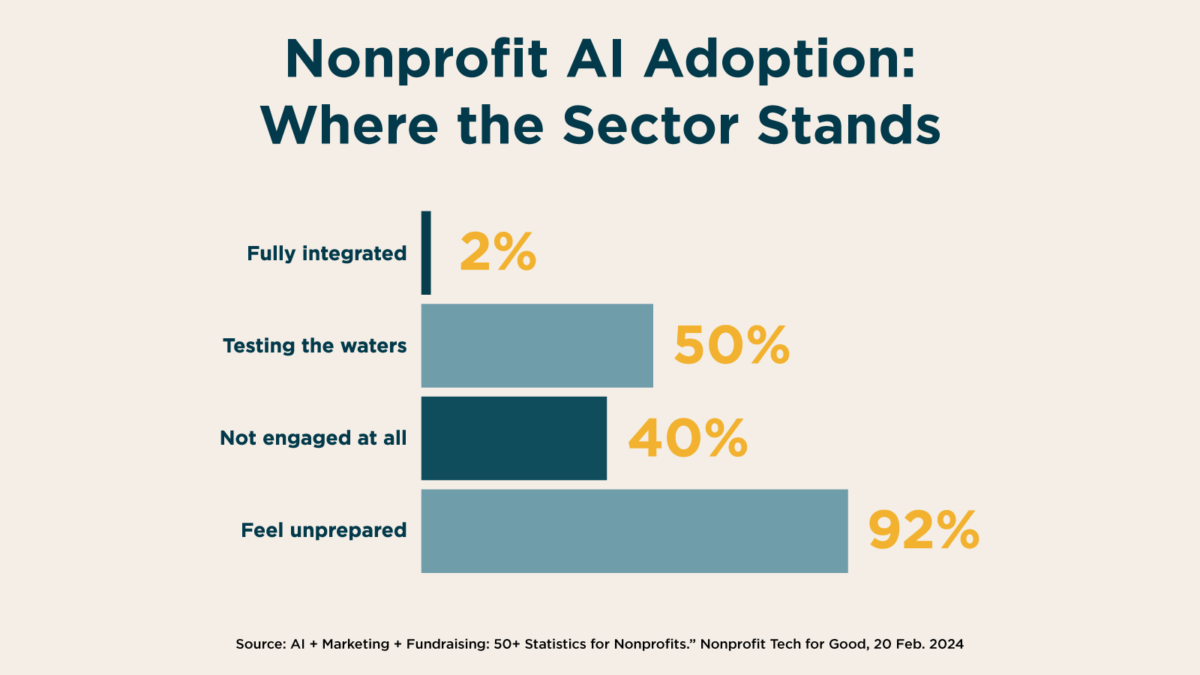
Most nonprofit leaders recognize the importance of AI, but according to a 2024 report only 2% of nonprofit leaders say that AI is fully integrated in their organization. Meanwhile, 40% say they are not engaged at all, and 92% report feeling unprepared. When asked why, leaders often cite urgent priorities like fundraising, strategic planning and staffing. Fair enough. But while leaders are focused on other things, many staffers are experimenting with AI tools on their own. If you think this is a universal good, think again. Here’s why.
AI is a communications wizard, but only in skilled hands
AI tools can make everyday communications lightning fast. Work that used to take hours or days now takes minutes.
The problem is that AI-generated text can sound really good while still being absolutely meaningless. When someone doesn’t really know the core story behind any given communication, AI won’t fill in the blanks. Instead, it’ll confidently invent prose and details that sound plausible, but fall apart upon examination.
What many leaders miss is that even if you understand these pitfalls, many of your staff don’t. Which is why you end up tearing your hair out when they send you copy that sounds like it was written by a soulless robot. Because it was.
AI-built visuals are still not ready for prime time
The hype around ChatGPT’s image generation capabilities has been intense — and the improvements have been remarkable — but even the latest versions of AI-generated visuals are still unusable for most branded content.
AI-generated images are very tempting when budgets are tight, because they are cheap and fast. But they are also obviously AI-generated. This matters because people donate to a mission they believe in deeply, often based on a personal connection and sense of authenticity. When it’s clear that a robot created the visuals, the emotional connection to donors is compromised.
When you sound like everyone else, you’re invisible
AI can make almost anyone’s writing sound smoother and more professional, but it can also make it sound like everyone else. That’s the kiss of death for fundraising.
Great nonprofit stories are grounded in your unique mission and voice. Used incorrectly, AI tools sand down that uniqueness, turning communication into cliche.
This is why AI alone won’t turn your 22-year-old marketing intern into a social media star. Stars are people who understand strategy and know how to communicate, whether they have AI help or not. For them, AI is a game-changer no nonprofit can afford to ignore.
Jewish knowledge is your nonprofit superpower — and AI can help
AI gives your team instant access to a vast library of sources, from Torah and Talmud to modern thinkers. It dramatically shortens the time it takes to find a reference, weave in a story or quote, and connect your communications to Jewish values.
Try this: Ask ChatGPT to act like Rabbi Jonathan Sacks z”l and draft a dvar Torah on the upcoming parsha. You’ll never look at AI the same way again.
But this power carries risks. Beyond knowing how to use AI, nonprofit teams need the Jewish fluency to fact-check the output. As Sarah Wolkenfeld recently argued in eJewishPhilanthropy, Jewish day schools are only just beginning to build this literacy among teachers. It will take years for that fluency to reach the nonprofit world. Which is exactly why organizations shouldn’t wait: Training your teams now in responsible use of AI is essential.
The worst AI rollout plan
If you don’t have an organization-wide AI policy, then unfortunately your policy is for your people to wing it. And that can go wrong in more ways than you think:
Has a staffer ever used the free version of ChatGPT to write a thank-you email to a donor? Bad news: Now that donor’s name and gift amount belongs to ChatGPT.
What if your team creates a new logo with AI? Sounds great, until you realize the logo doesn’t work in most real-world design applications and the image files are useless. And if they built that logo in the free version of Midjourney, you don’t even own the rights to it.
If your team is really sharp, they might produce a research report using Deep Research. But unless you check, some part of it may be completely made up.
These are not hypothetical doom scenarios. They are real-life examples we have seen in working with nonprofit clients. This does not mean you should give up on AI. It does mean that in order to realize the full promise of AI, leaders need to invest in clear policies, standardized training and at least some oversight.
AI implications for your ‘people plan’
AI goes way beyond tools, it’s a shift in how work gets done. That means it’s time to think differently about your team.
Some roles will need new skills. Some tasks that used to take 80% of someone’s time may now take 40%, freeing that person to focus on higher-value or entirely new work. That doesn’t mean you can — or should — start cutting staff now. But it does mean every new hire needs to be looked at strategically.
It also has implications that go beyond hiring. This includes beefing up training and developing a people plan that gives high-performing staff a chance to grow into new opportunities.
With all the challenges the Jewish world is facing, Jewish nonprofits cannot afford to be in the 92% who say they are unprepared for AI. Take steps now, and very quickly the efficiencies of AI will free up time for teams to develop new, bolder initiatives and do meaningful work they didn’t have time to do before. That’s the goal: a mission-driven team, empowered to build lasting impact and carry the organization’s purpose forward into the future.
Carol Schiller is the founder of Rumble Marketing, a brand marketing and strategic communications firm that works with leading companies like Boeing, Microsoft and Starbucks, and offers AI workshops and consulting to Jewish nonprofits. She also teaches in the graduate school of communications at the University of Washington.