WHAT YOU SHOULD KNOW
What do Americans Jews need in order to make aliyah?
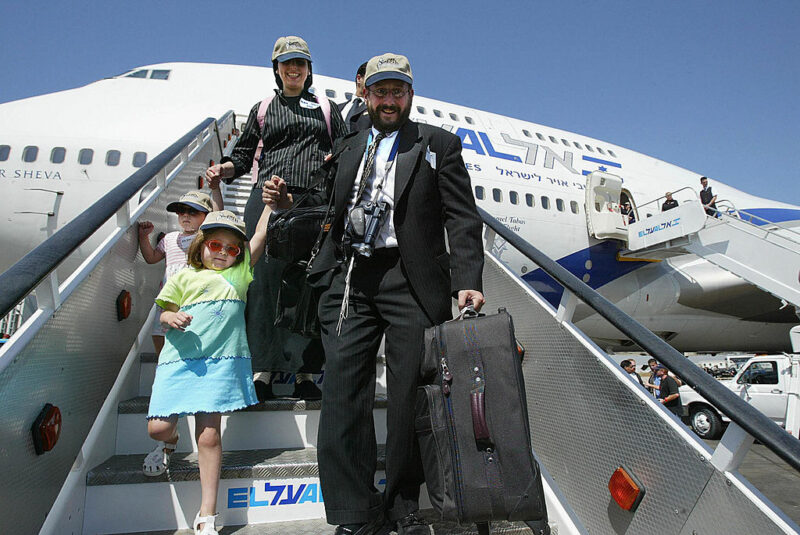
Yoav Lemmer/AFP via Getty Images
Illustrative. A Jewish family arrives at Ben Gurion International airport in Lod on July 14, 2004, as part of a program organized by Nefesh B'Nefesh.




 Add EJP on Google
There is a conversation unfolding this week about aliyah, taking place in the digital shmoozing grounds where Modern Orthodox, Haredi and Hasidic figures mix and mingle and address their online constituencies. On another level, though, it is a conversation that captures different perspectives on what it means, as Jewish individuals and as Jewish communities, to need something — and it offers an opportunity to reflect on how the community prioritizes those needs and who carries the burden of meeting them.
“Growing up, I had a hard time wrapping my head around the halacha that if a wealthy person who’s accustomed to eating steak suddenly loses everything, the mitzvah of tzedakah can mean providing him steak,” Hasidic journalist Jake Turx, who has lived in multiple major Orthodox communities in the U.S., wrote in a post on X yesterday. “The immature child in me rebelled against that idea. Why couldn’t the rich suffer for once? Let the poor person eat steak for once, and let the former millionaire discover hard bread.”
“It was only as I got older and actually met wealthy people who had fallen on hard times that I began to appreciate the profound wisdom of Chazal [the Sages],” he continued, “[b]ecause what looks from the outside like luxury isn’t always experienced by the person as luxury. There is such a thing as dignity, continuity and preserving a person’s basic sense of self.”
This post was part of Turx’s defense of the idea that one of the keys to a “mass aliyah” of American Jewry’s religious right would be facilitating the replication of communities such as those in Lakewood, N.J., or Boca Raton, Fla., dropping like a ready-made Third Temple from the sky.
“We need entire communities built by us, for us, and with our own capital, so that we can transplant not just individual families, but entire ecosystems,” he wrote on Tuesday.
American olim responded. “Israel is not an Amazon package,” Orthodox activist Shoshana Keats Jaskoll, who lives in Beit Shemesh, said in a video posted on Facebook. “We don’t deliver you what you want when you want it in the color you want it in the style you want it… If that’s what you’re looking for, stay where you’re at, and don’t come here.”
In Israel, “you have to deal with life as it is,” she continued, “and you have to deal with rockets, and you have to deal with terror, and you have to deal with all the things that come with a new country born under fire and raised under fire. And you also get all the positives.”
“If you want to come and be part of the Jewish People’s story; if you want to come and build with us; if you want to come and make it better — you are always welcome,” she said.
American Israeli educator and author Rabbi Uri Pilichowski wrote on Instagram yesterday that he believes the answer “lies somewhere in the middle”:
“In Mitzpe Yericho, our Anglo community of roughly seventy plus families among six hundred keeps enough American texture, American-style food, minyanim, English shiurim, while ensuring the next generations become Israeli. Our children speak perfect Hebrew and excellent English. They see themselves as Israelis, not American-Israelis. First-generation olim hold what they need of the old world; the second and third generations root fully in the new one. That balance works.”
He also references Rabbi Mark Wildes, who lives in Manhattan and wrote in The Times of Israel this week that while Israel “should remove practical obstacles” for olim, “aliyah is called ‘aliyah’ for a reason.”
“You go up, and going up requires sacrifice,” Wildes wrote. “Israel cannot first become Manhattan with better weather before we agree to live there.”
This may be a conversation among Orthodox Jews of various stripes, their American origin in common, but their perspectives have analogs in the American Jewish community in general. Like Turx, there are those who openly express love for Israel and identify aliyah as a worthy aspiration, but insist on doing it on their terms or not at all. There are those like Keats Jaskoll with a “take it or leave it because it’s worth it” mentality, encouraging people to embrace Israel’s rough edges and, in doing so, take the risk to shape it into the country they dream it could be — something unique to the Jewish People and, in that sense, a better home than America could ever be. And there are those like Pilichowski whose ideal allows for finding comfort in the familiar while striving to build a future that is distinctly new and stronger for it.
The challenge to our institutions, in Israel and the Diaspora, is how to address the needs of these constituencies as they themselves perceive them — or is there a point at which you say, “Sorry, we don’t have steak today, but you’re welcome to try the schnitzel”?