Opinion
JDAIM 2026
Want to take inclusion from principle to practice? The JCC movement shows what’s possible




 Add EJP on Google
The Jewish community’s ability to build a vibrant and successful future depends directly on its commitment to inclusion. We are far beyond a point where it is acceptable for inclusion to be “nice to have.” In some organizations, as Matan’s executive director has previously written in eJewishPhilanthropy, disability inclusion is treated as a “specialized niche” and considered outside of their scope of work. The reality is, whether intended or not, all organizations are doing the work of inclusion. The question is really whether they are doing it well and with intention. When we design our community with inclusion at its core, we strengthen the fabric of Judaism itself and create a place where everyone can participate, contribute and feel at home.
A recent study conducted by Matan found that people with disabilities and their families participate in Jewish communal life at far lower rates than at secular counterparts. The report reveals a striking mismatch: While most Jewish organizations and communities describe inclusion as a core value, far fewer have the necessary systems, training or policies to put that value into practice. The report found that these Jewish organizations lag behind comparable secular institutions and suggested that a significant source of this problem is inclusion work that relies on a single role or person, creating bottlenecks, siloing the work and preventing systemic change.
JCC Association
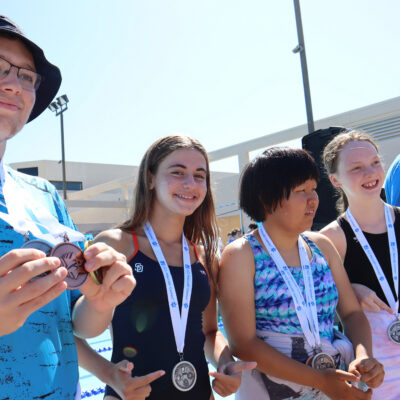
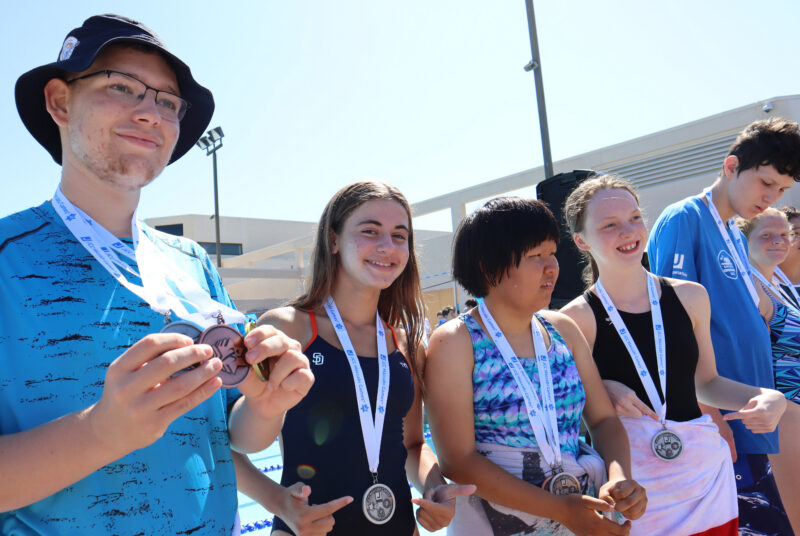
Maccabi Access athletes.
As the largest platform for Jewish engagement in North America, with nearly 150 JCCs and JCC Camps serving 1.5 million people weekly, the JCC movement has spent several years addressing these structural barriers. What we’ve learned is simple: inclusion is possible when shared, systematized and woven into the fabric of an entire movement, not maintained by a sole person or department.
As a first step, the JCC Association developed its Eight Guiding Principles on Inclusion. Rooted in Jewish text and values, they define the ways inclusion touches all aspects of work throughout the movement, from how people are greeted at JCCs to the educational programs offered to how we respect and uplift our professionals. The principles ground the movement’s inclusion work and promote common language among JCC professionals. Shared in multiple formats — plain text, webinars and artistic prints — to provide access for all, they themselves model inclusive practices. Many North American JCCs use the artwork to showcase their commitment to the values of inclusion and, in some cases, it serves as a milestone marker after staff members have completed inclusion training.
The original eight-part online series that introduced each principle has evolved into a quarterly Inclusion Peer Community gathering of nearly 200 inclusion professionals and colleagues. Interested in deepening their understanding of inclusion topics, they explore inclusion training at camp, relationship and sex education for adults with disabilities, vocational education programming, among other subjects. Last November, 15 members of the movement’s Inclusion Peer Community met at JCCs of North America Professional Conference, networking and learning together in person for the first time.
A recent peer community session explored an often-overlooked barrier to inclusion: fundraising. Inclusion work is frequently deprioritized because many falsely believe it is resource-intensive but non-revenue-generating. Scott Ehrlich, CEO of the Posnack JCC in Fort Lauderdale, is among the JCC movement leaders disproving that notion: his JCC has raised more than $3 million for inclusion initiatives in only the last two years.
“Fundraising for inclusion,” Ehrlich noted, “is a core value for all JCCs. It’s about providing the highest quality programming for the disability population and building a community where every person belongs.” The session sought to equip inclusion professionals with tools and confidence to participate actively in fundraising, advocate for their program needs and collaborate effectively with development teams so their work can continue to grow.
Most recently, the Inclusion Peer Community joined with the Fitness and Aquatics Peer Communities for an introduction to adaptive fitness, highlighting success stories and partner organizations supporting JCCs in launching adaptive programs. More than 40 professionals attended, and many are planning such initiatives.
Internal partnerships are a cornerstone of JCC Association’s inclusion work, and last month, together with our Sheva Center, which promotes excellence in early childhood Jewish education, we co-hosted the second annual JCC Movement Early Childhood Inclusion Summit. Once again, we welcomed more than 100 participants to explore topics to support and advance inclusion in JCCs’ early childhood centers. We also are working to recenter inclusion work to, as one participant aptly said, “shift from child centered to imagining an ecosystem where all needs are connected and prioritized.” This summit is part of a multi-year effort to develop the Sheva Framework 2.0, in which inclusion will be a fundamental pillar, offering Sheva professionals best practices to augment their inclusion endeavors.
Besides training others to lead inclusion work locally, JCC Maccabi Access offers us an unparalleled, annual opportunity to work directly with people with disabilities and their families. Three JCC CEOs — Todd Rockoff of the Tucson JCC, Scott Ehrlich of the Posnack JCC in Fort Lauderdale and Betzy Lynch of the Lawrence Family JCC in San Diego — recognized an important sector of our community was missing out on the magic of JCC Maccabi, the largest Jewish youth sports event in the world and one of the most significant Jewish peoplehood projects of our time. What began as a pilot in 2022 for seven athletes with intellectual and developmental disabilities and their families has since more than tripled in size, with 22 athletes representing 11 JCC communities, and stands as an essential part of the Games. JCC Maccabi Access consistently receives enthusiastic feedback from participants, particularly around the program’s Jewish impact.
JCC Association endeavors to provide training and resources, so all JCC professionals see themselves as inclusion professionals, creating consistency and advancing collective responsibility. To make inclusion a true pillar throughout the movement and beyond, each of us must do our part.
Inclusion professionals throughout the Jewish world are doing incredible work in this arena. However, as one of the Eight Guiding Principles says, we do not finish; rather, we must always strive to become more inclusive. Now is the time for Jewish communal organizations to see that this responsibility belongs to us all, and we must adopt it widely throughout our ecosystem.
With centralized leadership and shared language, frameworks and responsibility, we all can expand inclusion efforts and empower each other to join in this vitally important work. Let us be explicit in our commitment to inclusion and awaken a legion of professionals eager and ready to act. The JCC movement demonstrates what becomes possible when inclusion is a practice, not a principle — and it is time for our broader Jewish community to follow suit.
Sierra Weiss is the director of inclusion and JCC Maccabi Access at JCC Association of North America.