Opinion
SACRED WORK
Disability inclusion is ‘outside our scope’? Think again




 Add EJP on Google
In Short
When an organizations ensures that its services are accessible to people with diverse needs, everyone benefits
A few months ago, a colleague told me about a conversation with a major Jewish organization. When asked how they were addressing disability inclusion, the staff member replied: “Oh, we don’t really do disability.” The comment wasn’t meant to be dismissive or unkind; it simply reflected a widespread misconception that disability is a specialized niche, separate from the “core” work of Jewish life.
Here’s the truth, though: if your mission involves education, social justice, poverty alleviation, community building or Jewish engagement, then you already do disability. You just may not realize it.

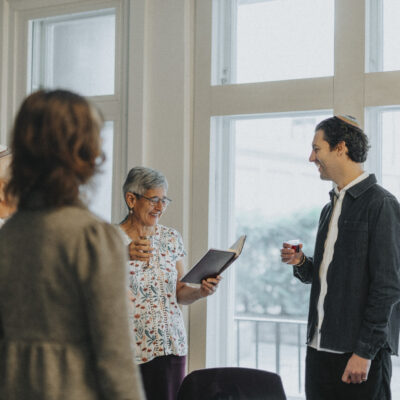
Evelyn Hockstein/For The Washington Post via Getty Images
Illustrative. Batya Sperling Milner, who is blind, practices reading Torah with her aunt, Rachel Milner Gillers, and her friend Hannah Jaffee, during a rehearsal for her Bat-Mitzvah at Ohev Shalom synagogue in Washington, DC.
Disability is much broader than many people imagine. It includes visible things, like mobility or physical disabilities and invisible ones, like mental health conditions, neurodivergence, learning disabilities, chronic illness and more. It includes people whose disabilities are congenital or acquired over time. And it includes people you already know: your students, your congregants, your volunteers, your co-workers and your loved ones.
When organizations treat disability as “outside their scope,” they overlook a vast part of the community. One in five people in the United States lives with a disability. That means disability cuts across every demographic: age, race, gender, income and faith. It also intersects with nearly every other social justice priority.
Consider poverty: People with disabilities are more likely to live below the poverty line, often because of barriers to employment, health care and transportation. Think about mental health: Stigma and lack of access to care affect individuals and families across our synagogues and schools. Even our work to combat antisemitism and strengthen Jewish identity depends on inclusion — because a community that only caters to some of its members is inherently a weaker community.
In Jewish life, we often talk about tikkun olam, repairing the world. But we cannot repair a world that we don’t see in its entirety. Disability inclusion isn’t an “add-on” or a box to check; it’s a lens that makes our work more effective, compassionate and just.
The “curb-cut effect” is real. Curb cuts — the little ramps leading onto sidewalks at crosswalks — were originally designed for people using wheelchairs. But how many times have you rolled a stroller or a suitcase over those curb cuts, or walked with an older individual who preferred to avoid the step up? How often have you checked the captions of a speech, television show or webinar — not because you have hearing loss, but because you could process the information more easily seeing the words? How much do you listen to audiobooks, originally intended for people with vision impairments, because you prefer listening over reading? These are just a few of the things that we mean when we say accessibility benefits everyone.
Because in the end, inclusion isn’t about “them.” It’s about “us.”
When a synagogue ensures that its services are accessible to people with diverse needs, everyone benefits from clearer communication, better design and a more thoughtful experience. When a school learns to support students with different learning profiles, every child benefits from teachers who understand how to engage learners in multi-modal ways. When a communal program considers physical, emotional and cognitive access from the start, it strengthens connection and participation across the board.
Judaism teaches the principle of kavod habriyot, honoring the dignity of every human being. That means inclusion isn’t specialized work. It is sacred work.
If your organization says, “We don’t do disability,” I urge you to look again. You do. Disability is part of every human story, and therefore part of every Jewish story. The question is not whether we “do” disability, but whether we choose to see it, honor it and build a community where everyone truly belongs.
Meredith Englander Polsky is the executive director of Matan.