Opinion
DISHONORABLE MENTION
NYC plaques honoring antisemitic war criminals are an abomination




 Add EJP on Google
As International Holocaust Remembrance Day approaches next week, New York City Mayor Zohran Mamdani, City Council Speaker Julie Menin and Comptroller Mark Levine have a golden opportunity to join together and put an end to the memorialization of two odious French World War II war criminals on the sidewalks of lower Manhattan. The continued presence there of two plaques honoring the leaders of the Hitler-allied Vichy government is an abomination that constitutes an egregious insult to and desecration of the memory of the victims of the Holocaust.
I first raised the alarm on this issue four years ago, but to no avail. Given the dramatic upsurge in global and domestic antisemitism, it is even more urgent now than it was then to consign these plaques to a trash can.
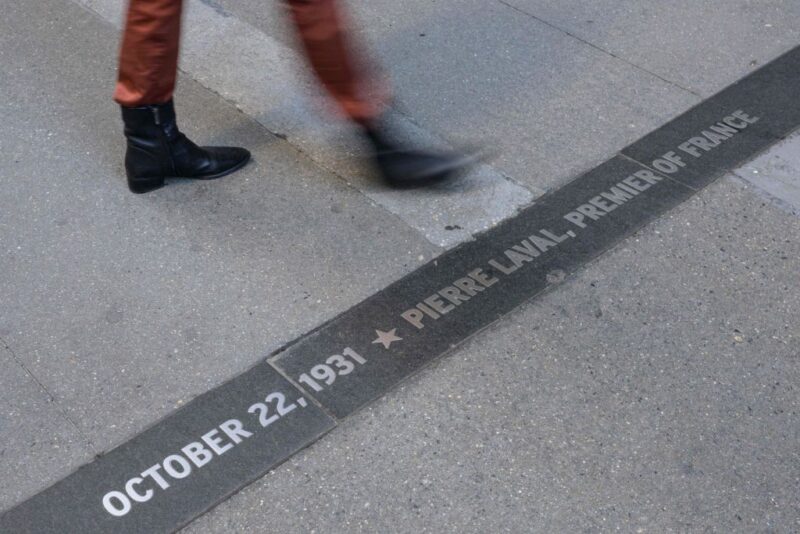
Angela Weiss/AFP via Getty Images
A person walks over the memorial in the "Canyon of Heroes" for former French Prime Minister Pierre Laval, in New York City on Jan. 27, 2023.
Addressing the Park Avenue Synagogue congregation last Friday evening, Menin described how her mother and grandmother survived the Holocaust in Hungary. She also spoke of the critical importance of Holocaust education.
She recounted that in 2024, as a member of the New York City Council, she read in a survey that 34% of young people believed that the Holocaust was a myth or exaggerated. In order to “eradicate that point of view,” she said, she “launched a program that is now universal where we’re bringing every 8th grade public school student [in New York City] to the Museum of Jewish Heritage in Battery Park City to go to the Holocaust exhibition, to see the artifacts, to hear the story, to see with their own eyes.”
“We know that education is the antidote to antisemitism and ensuring that the next generation learns about the lessons of the Holocaust is of paramount importance,” she said.
Speaker Menin is right, of course. But as we mark International Holocaust Remembrance Day on Jan. 27, the 81st anniversary of the liberation of the Nazi death camp Auschwitz-Birkenau, we must also confront the repugnant reality that every day, thousands of New Yorkers pass by granite markers bearing the names of two antisemites who were willingly and enthusiastically complicit in the perpetration of the Holocaust.
Marshal Philippe Pétain and Pierre Laval were, respectively, the French chief of state and the head of the Vichy regime from 1940 until 1944. They oversaw and were responsible for the promulgation of draconian antisemitic laws and enabled the deportation of thousands of Jews from France to Nazi death camps in German-occupied Poland. On their watch, approximately 77,000 Jews living in France were murdered during the Holocaust, and yet black granite markers engraved with their names are on prominent display on Broadway’s so-called Canyon of Heroes in lower Manhattan. Both were tried and convicted to death by French courts in 1945; Laval was duly executed, while Pétain’s sentence was commuted to life imprisonment.
The Laval and Pétain plaques are two of 206 such markers embedded in the sidewalks between Battery Park and Chambers Street to commemorate individuals and groups that had been celebrated with ticker-tape parades in New York City as far back as 1886. In October 1931, Laval, then the prime minister of France, and Pétain, the French army’s commander-in-chief at the end of World War I, starred in two such parades. Admittedly, that was before their descent into permanent ignominy during World War II, but the extent of their notoriety was fully known when the plaques were first installed in 2004.
Laval and Pétain were unabashed antisemites who targeted Jews under their control for persecution, oppression, and death. Laval told German and other correspondents at a news conference in September 1942 that he intended to continue deporting alien Jews — that is, refugees and other Jews who did not hold French citizenship — from France. “No man and nothing,” Laval declared, “can sway me from my determination to rid France of alien Jews and send them back where they came from.” On another occasion in 1942, Laval referred to these foreign Jews as déchets, that is, garbage waste.
According to a New York Times article from Sept. 6, 1942, “Pierre Laval’s anti-Semitic measures in unoccupied France had aroused violent opposition to his regime. Anti-Jewish measures in the unoccupied zone are said to have aroused ‘violent opposition’ at Nice, Marseille and Lyon, where the population formed protective cordons around intended victims, shouting abuse at the police.”
To be sure, the Laval plaque is the more egregious of the two, but Pétain is not far behind as an antisemite and persecutor of Jews. He, too, is reviled in France by everyone other than far right extremists and neo-fascist ideologues. A draft of the Vichy government’s first Law on the Status of the Jews (Statut des Juifs) of October 1940, which defined who was Jewish and which excluded Jews from large segments of French public life, included Pétain’s handwritten notations making the law ever more repressive. In July 1942, he told members of his government that he considered the distinction between French and foreign Jews to be “fair and would be understood by opinion.
In 2018, Francis Kalifat, president of the Representative Council of French Jewish Organizations, said of Pétain that in 1945 “he was an incarnation of national shame, which makes him ineligible for any tribute.” The same holds true for Laval. Except that New York City politicians and bureaucrats, while self-righteously precluding slaveholders, racists, misogynists and homophobes from any form of positive recognition, seem willing to give Nazis and Nazi collaborators a pass.
Four years ago, I urged Mayor Eric Adams “to take a fresh, hard look at the obscenity of heroizing two antisemitic Nazi collaborators on the streets of New York City” and expressed the hope that he would have these markers removed without further delay, but nothing happened.
On Jan. 27, 2023, then-Manhattan Borough President Mark Levine marked International Holocaust Remembrance Day by holding a press conference on Broadway alongside one of the offending markers.
“Removing the plaques is not a whitewashing of history,” he explained on that occasion. “Rather, it is a refusal to continue to honor two people who made the choice to embody the worst of humanity.”
At the same press conference, Gideon Taylor, the executive vice president and CEO of the Jewish Community Relations Council of New York, said: “In a world where young people often know little about the Holocaust and antisemitism is on the rise, plaques honoring Nazi sympathizers have no place. Removing them … would be a teaching moment for our youth as part of our common struggle to combat hate in New York City.”
Again, nothing happened. The two plaques remain as monuments not only to Laval and Pétain, but also to the callous indifference of three successive NYC mayors and municipal administrations to the glorification of two men who epitomized evil.
During the primary campaign for last year’s Democratic mayoral nomination, Zohran Mamdani declared that he “condemned the Holocaust.” In a video posted on social media, he said that as a member of the New York State Assembly, he had “voted every year for the Holocaust Remembrance Day Resolution … to honor the more than six million Jewish people murdered by the Nazis. I have repeatedly supported allocating millions of dollars in the state budget for Holocaust survivors.”
Fair enough. I am prepared to take him at his word. As mayor, Mamdani can now demonstrate affirmatively that he is genuinely committed to honor the memory of the more than six million Jewish people murdered by the Nazis.
As the son of two survivors of the Nazi camps of Auschwitz and Bergen-Belsen, I call on Mamdani, Menin and Levine to join forces and take the necessary steps to permanently and publicly rid the lower Manhattan sidewalks of these two plaques.
If they do, they will significantly advance the cause of Holocaust remembrance. Anything less, on the other hand, would signal to the young people of whom Menin spoke at Park Avenue Synagogue last weekend that the oft-expressed repudiation of Nazis, Nazi collaborators and Nazi ideology is hollow — that Holocaust education is an anachronism that can be ignored without consequences.
I am also calling on New York City’s rabbis across the ideological and denominational spectrum — as well as members of the Christian and Muslim clergy, for that matter — to deliver sermons and write letters on this issue, which touches upon neither the International Holocaust Remembrance Alliance definition of antisemitism nor the Israeli-Palestinian conflict and thus is entirely nonpolitical and uncontroversial.
The launching of such a broad-based initiative strikes me as the appropriate and honorable way to observe this year’s International Holocaust Remembrance Day.
Menachem Z. Rosensaft is adjunct professor of law at Cornell Law School, lecturer-in-law at Columbia Law School and general counsel emeritus of the World Jewish Congress. He is the author, most recently, of Burning Psalms: Confronting Adonai after Auschwitz (Ben Yehuda Press, 2025).