Opinion
A COMMUNAL FRONTIER
Investing in Jewish life at work




 Add EJP on Google
Throughout the Jewish world in North America, we have built up resources to support Jewish life: curricula for Hebrew schools, speaker series for synagogues, professional networks for employees across communal institutions, even program ideas for young adult Shabbat dinners. There is a gap, however, between the efforts and the resources for Jews trying to build vibrant Jewish life in the workplace, as more and more young Jews are doing these days. You have Jews building sukkahs at corporate offices to coordinate Sukkot meals, those writing and/or giving weekly divrei Torah, many leading local volunteering opportunities, bringing in speakers like Ahmed al Ahmed, the hero of the Bondi Beach attack in Sydney, Australia, and running company-wide events sharing diverse personal Jewish stories — all creating a deeper sense of Jewish identity and belonging, and also giving non-Jews an opportunity to learn about and have a more positive view of Jews.
Over the past year, Clal’s Jewish@Work research has surfaced a consistent and striking finding: Jewish professionals, especially those leading employee resource groups (ERGs), are often improvising programming, searching endlessly for trusted speakers and carrying responsibility for promoting safety and belonging largely on their own. There are now over 180 Jewish ERGs at various companies, including Bloomberg, Deloitte, Netflix, Bank of America, Visa and universities like Harvard and Columbia University Medical Center, with 46% of that growth since Oct. 7, 2023. The leaders of these groups care deeply about building meaningful Jewish life at work, but they are doing so with far too little support; the commitment is there, but the infrastructure is not.

Adobe Stock
Illustrative.
That’s why we at Clal built the Jewish@Work Resource Portal. It is a hub to offer real-world support with three core components: resources to navigate being Jewish in the workplace (including Kosher food vendors), event templates and a speakers bureau. It features over 100 resources, ranging from mental health support to holiday programming ideas, antisemitism speakers and comedians. The portal will add more features to continue to meet the needs of Jewish employees across the country.
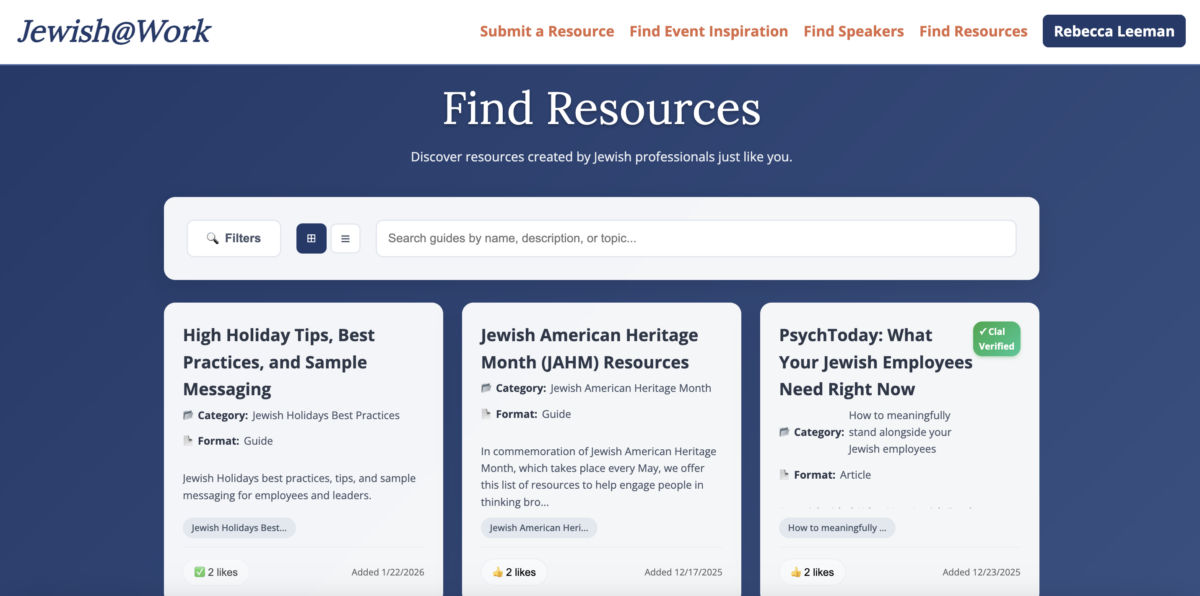
Since launching in January, more than 140 Jewish ERG leaders and Jewish professionals signed up — not in response to a flashy marketing campaign, but because they feel the need deeply and now have support for their work. As one early user put it: “I’m usually ChatGPT-ing what kind of event I can do for each holiday. It’s hard when you don’t have such a resource, so I’m making it up on the fly.” That improvisation is unsustainable, especially for volunteer leaders balancing demanding jobs alongside communal responsibility.
Jewish professionals are not only looking for content; they are looking for coherence. They want to know they are not alone, that there is a field around them and that someone is paying attention to the lived reality of being Jewish at work. The shared platform and community features makes good programming easier, offering the ability to see what others are planning, react to ideas and learn from the centralized resources like funding opportunities, coaching, legal services and mental health support.
These Jewish leaders — operating in a less visible and more under-resourced arena compared to those in communal learning, fertility or Shabbat programming — are advocating for accommodations, responding thoughtfully in moments of crisis and bringing Jewish values into professional environments. They are also serving a very broad Jewish community with different backgrounds and levels of experience. In fact, 44% of people in these Jewish networks are not involved in any other Jewish organization — it’s the only Jewish thing they do.
The early feedback on the Jewish@Work portal underscores how hungry the field is for support that is practical, well-designed and peer-informed.
Leaders need the support to move from reactive to strategic action and to feel more connected. Being Jewish is hard enough in the workplace these days, let alone being Jewish and taking on what is essentially a second part-time job as an ERG leader. Even more so, though, it can be lonely. Our portal does two critically important things: it makes Jewish ERG leaders’ work significantly easier, and it gives them opportunities to connect with, learn from, and share with one another. When Jewish professionals have access to shared tools and trusted colleagues, they can spend less time scrambling and more time building cultures of belonging.
We must invest not only in programs but in the platforms that support those programs at scale. And we must recognize Jewish professionals as full participants in Jewish life who are building meaningful communities in their workplaces.
The launch of Jewish@Work is one step towards investing in this vision of meeting Jewish people where they are at. We hope to see our community expand its support even more for this new and growing setting for Jewish life.
Rebecca Leeman is the chief of staff at Clal – The National Jewish Center for Learning and Leadership, where she leads the Jewish@Work initiative. She previously had a career in people analytics and organizational consulting at Bridgewater and PwC.