WHAT YOU SHOULD KNOW
How do we protect worshippers and keep synagogues welcoming spaces?

John Lamparski/Getty Images
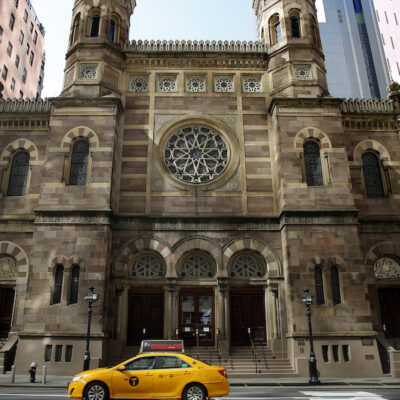
New York City's Central Synagogue, one of the largest Reform synagogues in the United States.




 Add EJP on Google
When a man stood up from among the congregation at Friday night services at Central Synagogue, a prominent Reform congregation in Midtown Manhattan, and abruptly stormed the bima screaming, it sparked fresh conversation within the Jewish community about how to respond to an increasing number of threats and attacks and the rising cost of that response.
Identified as Larry Montes, 46, of the Bronx, the suspect managed to strike a 63-year-old congregant to the floor and headbutt a police officer who was working a paid security detail at the synagogue before being removed from the premises. According to transcripts of Montes’ arraignment released by the Manhattan District Attorney’s Office, he referred to the congregants as “swine” and “fake Jews” during the incident and admitted to his crime and its religious motivation after his arrest. He was charged with two counts of assault as a hate crime and one count of criminal mischief as a hate crime.
In early August, the New York City Police Department reported that hate crimes in the city had increased by 9.4% in the first seven months of 2026, with hate crimes against Jewish people making up over half of confirmed hate crimes even as crime in New York City reached a historic low. And in the United States more broadly, recent attacks — including the incident at Central Synagogue, the stabbing of a Jewish man outside The Jewish Center on Manhattan’s Upper West Side in July, the vehicle-ramming and shooting attack on Temple Israel in West Bloomfield, Mich., and the January arson at Beth Israel Congregation in Jackson, Miss. — have kept the community on high alert.
In March, shortly after the attack in West Bloomfield, Mitchell Silber, executive director of the Community Security Initiative, warned that American Jewry might be approaching a “tipping point,” telling the Jewish Telegraphic Agency that Jewish institutions may now need additional layers of protection: specifically, multiple armed guards outside entrances and increased security screening prior to entry. “We’ve gone to a new level, where really what’s required to secure a Jewish institution in the US starts to look like almost a Europeanization of security,” he said.
The cost of increased threats to the Jewish community is not only monetary, say American community leaders, but can also come at the expense of the welcoming environment synagogues and Jewish communal spaces strive to offer.
“We will not answer fear by retreating behind locked doors,” Rabbi Rick Jacobs, president of the Union for Reform Judaism, said in a statement released in response to Friday’s incident at Central Synagogue. “Our welcoming communities are where we find our strength and our purpose. We will keep our doors open, keep our arms open, and keep insisting that Jewish life be proud and unafraid.”
Jacobs told eJP that this posture reflects a near-consensus within the movement, even as individual congregants vary in how vulnerable they feel.
“We’ve been trying to balance it for a number of years, and people are individuals, and they have their own sense of what they feel they can do. Some people may just feel too vulnerable,” he said. “We’re not going to close up shop and wait till things are calmer… It’s important that we do the dual act of securing our communities and also finding places of joy, belonging and resilience, and those have to always go together.”
“Europeanized” security measures won’t necessarily translate into an increased sense of safety for congregants. Research published this year in the Journal of Modern Jewish Studies found that both threats and security measures can contribute to feelings of insecurity among congregants in European Jewish communities. While the researchers found CCTV universally accepted, for instance, armed guards raise concerns about spurring an escalation in attack methods, reinforcing stereotypes of Jews as weak and/or alienating worshipers.
Heightened security has become one of “the largest budget items” for synagogues and other Jewish institutions in America, Jacobs told eJP, but the goal of making congregants and visitors feel genuinely welcome is equally important, he said. “The key thing is to be very serious about security, and at the very same time, make sure that we are also able to express a clear sense of welcome.”
Central Synagogue, like many synagogues in New York City, already looks “like a fortress” from the outside, said Richard Priem, CEO of the nonprofit Community Security Service. He pointed out the posted guards, the frequent police presence and the investments already made in the facility’s physical security. He also noted that one way to strike a balance between the necessary security and a welcoming environment could be by using trained community volunteers to screen those who enter: as members of the community themselves, they could quickly clear those who belong and focus attention only on anyone who seems out of place rather than subjecting every visitor to the same scrutiny, Priem said. (CSS, which fields over 2,000 active volunteers in more than 150 synagogues in the U.S., does not have a trained volunteer presence at Central Synagogue.)
Priem credited Central Synagogue’s security team for intervening quickly on Friday and praised the Community Security Initiative — a joint program of the UJA-Federation of New York and JCRC-NY, which has been coordinating with the synagogue — for its work in the incident’s aftermath.
“But the fact that the Jewish community needs security — that is shameful to begin with,” he said. “That is something that we should not accept as the new normal.”