WHAT YOU SHOULD KNOW
Full of uncertainy and threat of war, Israelis wrap up their first full workweek since February
Yonatan Sindel/Flash90
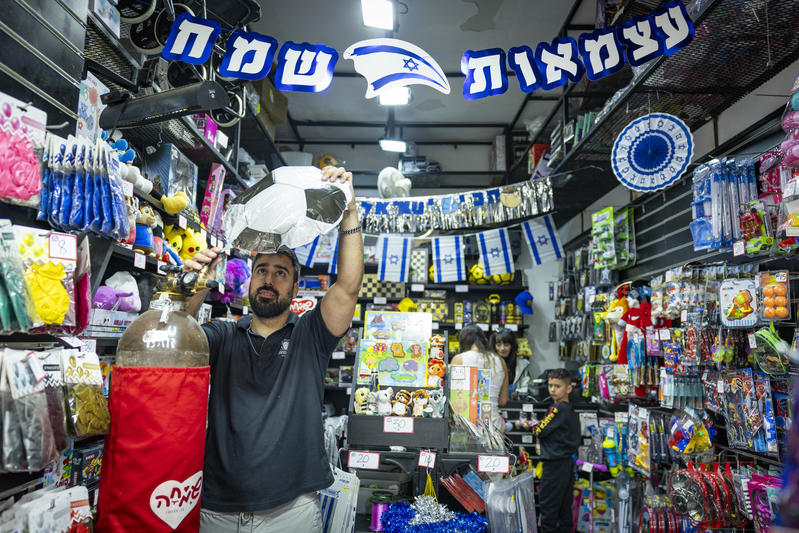
A man fills a helium balloon beneath a large sign reading 'Happy Independence Day' at Mahane Yehuda Market in Jerusalem on April 13, 2026.




 Add EJP on Google
The barbecue or the bomb shelter?
As Israelis look ahead to next week’s back-to-back national holidays, Memorial Day and Independence Day, that question seems to sum up the anxious place Israelis find themselves.
For most Israelis, whose workweek runs Sunday to Thursday, this week marked an uneasy return to normalcy, following the end of Passover last week and as the fragile truce with Iran holds. Residents of the North were not as lucky, as the fighting with the terror group Hezbollah has persisted, with Israeli communities along the border being targeted repeatedly as Israeli forces conquered Hezbollah-aligned villages in southern Lebanon, even as Lebanese and Israeli officials discuss a ceasefire.
Children across the country had their first full week of school in more than a month and a half — a welcome respite for many Israeli parents who have been juggling work, childcare, frequent runs to bomb shelters and, in many cases, at least one spouse’s reserve military duty.
That routine will again be disrupted next week with the country’s back-to-back Memorial Day, Yom HaZikaron, which begins on Monday night, and Independence Day, Yom HaAtzmaut, which begins Tuesday night. But as fighting in Lebanon continues and the war with Iran threatens to resume, Israelis are left wondering if next week they will be running to barbecues or bomb shelters.
Most Israelis remain deeply skeptical of the current pause in fighting and even more wary of a long-term deal, according to a survey by the Tel Aviv-based Institute for National Security Studies that was released this week. The snap poll found that 61% of the public oppose the ceasefire with Iran in its current form, and 73% said they expect active fighting to resume within the year.
Beyond the immediate security situation, a broader sense of systemic instability continues to challenge Israeli civil society. Many nonprofit executives are currently recalibrating their financial projections to account for the historic strength of the New Israeli Shekel against the U.S. dollar — the denomination in which most donations are made. As the barrages of Iranian missiles at central Israel have waned, Ben Gurion Airport has begun seeing international carriers return, allowing more Israelis to travel abroad — including nonprofit figures — and foreign visitors to arrive. A resumption of fighting could again see the skies close.
In any case, the country will again mark its national holidays differently this year. For the third year in a row, the annual flyover show of Israeli Air Force fighter jets and other aircraft that normally traverses the country will not take place. Instead, pilots are expected to remain either on base or close to base, ready for the war with Iran to resume at a moment’s notice. The local and national ceremonies for both Yom HaZikaron and Yom HaAtzmaut, which are staples of the Israeli cultural, social and political calendar, are being held in smaller configurations, virtually or are not being held at all in light of the Israel Defense Forces’ Home Front Command’s safety restrictions.
Cities across the country are only allowing bereaved families and local officials to attend Yom HaZikaron ceremonies and are canceling the massive street parties that they normally hold for Yom HaAtzmaut due to military restrictions on large gatherings. Many national ceremonies have been prerecorded and will not feature live audiences.
President Donald Trump, who was originally slated to arrive for Independence Day to accept the Israel Prize for Lifetime Special Contribution — the first non-Israeli citizen to ever be awarded the honor — will not be arriving to accept the prize at the televised state ceremony. However, Argentine President Javier Milei will light an honorary torch at the national Yom HaAtzmaut ceremony, alongside 11 Israelis who were selected from across many sectors of Israeli society. Among them, venture capitalist and philanthropist Gili Raanan is being honored for driving economic resilience through his $300 million VC fund to prevent a wartime talent drain and for his philanthropy in establishing a post-trauma department at Tel Aviv Sourasky Medical Center, also known as Ichilov Hospital.
Managing Editor Judah Ari Gross contributed to this report.