Opinion
VIEW FROM THE FIELD
For tomorrow’s rabbinate, we must up our game




 Add EJP on Google
After more than 50 years teaching and mentoring those pursuing the rabbinate, the Atra report struck a chord with me. Despite renewed interest in Jewish study and service, I have observed many deeply committed and very talented Jews find themselves almost allergic to rabbinical school: I have seen them not start, not finish or upon finishing feel profoundly alienated from their education. It is clear that this has brought about a crisis in the recruitment and training of rabbis.
To address this crisis, we must begin by focusing on the very best and brightest of our young Jews.
Emily Glick
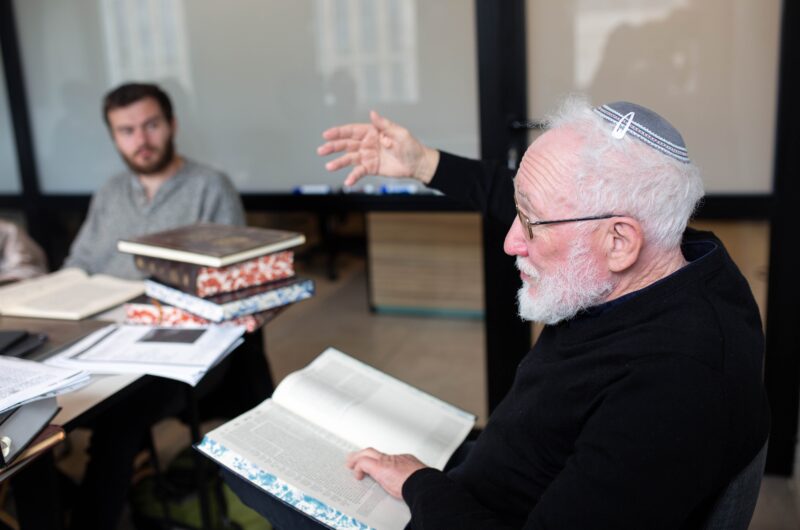
Rabbi Daniel Landes (right) and Aron Wander, a student in Yashrut's Semikhah Initiative.
At Yashrut, we have offered the very best and brightest an intentionally demanding pipeline into the rabbinate, including, though not exclusively, a rabbinic program of our own. Yashrut is dedicated to the rigorous study of Talmudic and other Jewish legal texts and brings together students in part-time, online and in-person learning grounded in intellectual seriousness and sensitivity to the human condition. Today, our students, alumni and ordainees represent a wide array of professional and academic paths, many serving as professional and lay Jewish educators in prayer communities, day schools, Hillels, rabbinic training programs and beyond.
This is what we have observed as the causes of alienation from entering and being part of the rabbinate:
First, today’s best students are profoundly a-ideological and a-denominational. They are not interested in ideology, yet they find rabbinical schools deeply immersed in it, with unspoken but very present dogma in both denominational and renewal models of education. They do not experience this discourse as either spiritual or intellectual. Alongside this rejection, they quickly grow bored with a professional-school atmosphere filled with excessive bureaucracy and failed visionaries.
Second, even the most talented students face the crushing recognition that after all their considerable years of education, they still will not emerge with any real mastery of the classics: Talmud, commentaries and codes. Recently, a brilliant new graduate of a rabbinical school confessed to me: “I feel that I am condemned to depending on anthologies, translations or articles. A terminal beginner.” They complain of dullness of mind and of spirit.
Third, teachers are at a remove from the students. There is no sense of real collaborative learning; instead, there is top-down instruction based on well-worn faculty notes.
And finally, many find themselves in serious debt from all that education, and in the end they have no choice but to pay the piper.
The above perils lead to a hidden imposter syndrome that afflicts the truly talented. They are taught to look, talk and walk like rabbis, but they know deep down that they are lacking.
Our experiment, Yashrut 501(c)(3), Amutat Yashrut, has no fixed location, no bureaucracy and no recruiters. In place of modern civil service-style written tests, our students have old-school, one-on-one probing discussion examinations. We ask for no tuition except for the currency of complete dedication to profound study of core Talmudic and legal texts. We have no introductory courses. All our students are thrown into this study. We have been able to attract outstanding women and men of all types of backgrounds to this study.
We have graduated more than 90 students from our Classic Talmud pipeline, and more than 50 have additionally received our semicha. Many have gone on from our pipeline to other rabbinic programs of all types. Our students come from top-tier schools, and 25% either have or are working on their doctorates. Thirty-four of our students are currently in or have graduated from seminaries of other denominations. We have expanded our enrollment, but we still have a waiting list of strongly qualified applicants who are yearning for the joy of exertion and accomplishment that this rewarding form of study provides through the lens of yashrut, the ideal of moral integrity.
At Yashrut, we have learned that our rabbinic pipelines and schools should be magnetic centers for the mastery of learning and of service. Our rabbinic future is luminescent; all we need is to improve our game.
Rabbi Daniel Landes is the founder and rosh hayeshiva of Yashrut.