WHAT YOU SHOULD KNOW
Deadly Sydney attack keeps Jewish community focused on security
George Chan/Getty Images
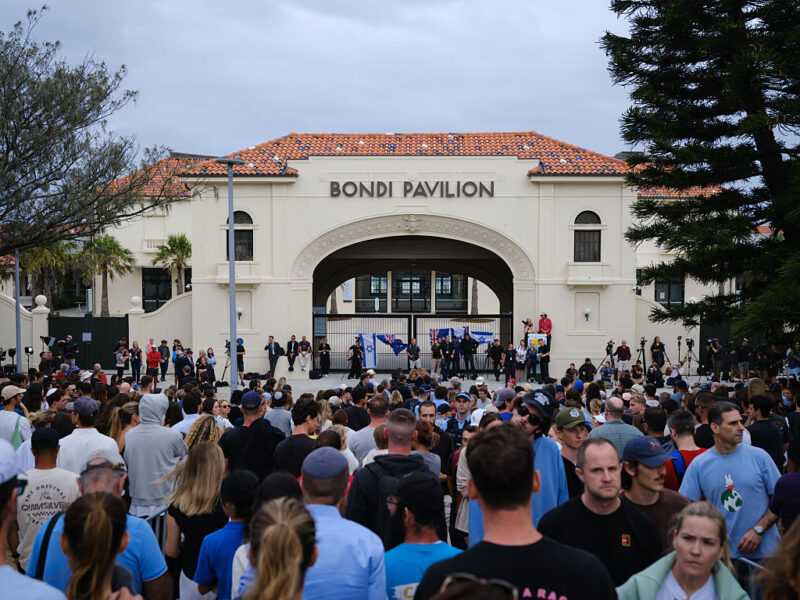
Members of the public lay flowers at a memorial at Bondi Pavilion in the wake of an antisemitic terror attack at Bondi Beach in Sydney, Australia, the day before, on Dec. 15, 2025.




 Add EJP on Google
What began as a moment of joy and faith and community and public acceptance turned into a bloodbath as two gunmen opened fire on the masses gathered yesterday for a Chabad-led hanukkiah lighting at Bondi Beach in Sydney, Australia. At least 15 people, including a child, were killed, and scores more were injured.
In the short time since yesterday’s terror attack — the deadliest antisemitic attack since the Oct. 7 massacre — much has been said and written on the subject, with a particular, deserved focus on the fact that the shooting came after two years of violent antisemitic incidents in Australia, including an arson attack on a Melbourne synagogue, when members were inside, one year ago. The writing for this deadly attack was on the wall, as Marina Rosenberg, senior vice president for international affairs at the Anti-Defamation League, wrote yesterday in an opinion piece for eJewishPhilanthropy. See below.
Since the Oct. 7 attacks, security and combating antisemitism have been top Jewish communal priorities. With the ending of the war in Gaza — or at least a pivot to a less active form of conflict in the Strip — there were hopes that the Jewish community could shift to other priorities, which have been struggling to garner support for the past two years.
Yesterday’s attack makes that far less likely. This summer, Eric Fingerhut, the president and CEO of the Jewish Federations of North America, estimated that the American Jewish community spends more than three-quarters of a billion dollars annually on communal security. Even as the Jewish community pushes for increased government funding, these major financial outlays on security do not appear to be leaving us shortly.
The attack also serves as a reminder of the American Jewish community’s own security concerns. Earlier this year, the FBI cut ties with the Anti-Defamation League, one of the top organizations tracking antisemitism and extremism in the United States. For some Jewish organizations, government security grants remain a source of concern in light of certain prohibitions against supporting illegal migrants and maintaining diversity, equity and inclusion programs. These requirements have caused many Jewish groups to reconsider applying for nonprofit security grant programs, even as national organizations encourage them to do so.
The Jewish communal world’s response to the attacks has been overwhelming: outpourings of support for Australian Jewry, condemnations for the terrorists and the atmosphere that has made these kinds of attacks more common, offers to help in whatever way possible, vows to hold yet more public candle-lighting events around the world as a sign of both solidarity and defiance.
While those candle-lighting events have indeed still been held, Jewish security services have called for increased vigilance at them. In a joint initiative, the Jewish Federations of North America, ADL, Secure Community Network, Community Security Service and Community Security Initiative of New York issued a new eight-point security guideline for communal events. This includes coordination with law enforcement, only sharing event details with registrants and reinforcing security teams, both professionals and volunteers.
Many Jewish leaders hailed the actions of Ahmed al-Ahmed, a 43-year-old Muslim father of two who barehandedly tackled one of the gunmen, likely preventing an even higher death toll. Investor Bill Ackman has even offered al-Ahmed a cash reward for his actions.
On multiple levels, the Sydney also attack demonstrated — yet again — the Jewish People’s interconnectedness. For one, while the investigation into the attack and the terrorists’ specific motivations is ongoing, previous antisemitic incidents in Australia have been found to have been directed by Iran against the local Jewish community as part of its war with Israel. The victims and survivors also had connections to Jews and Jewish communities around the world, making an attack that in some cases happened on the other side of the world feel intensely personal. Many Jewish communal professionals — this reporter included — know Arsen Ostrovsky, a pro-Israel attorney and activist, who recently moved back to Australia after living in Israel for 13 years to head the advocacy group Australia Israel & Jewish Affairs Council and whose head was grazed by a bullet during the attack. Ostrovsky’s wife, who is the sister of UJA-Federation of New York’s scholar-in-residence, Rabbi Menachem Creditor, and their two young daughters also attended the event, but were not injured.Jewish organizations and communities around the world have also embraced the nation of “kol yisrael arevim zeh la’zeh” — all of Israel is responsible for one another — sending assistance to Sydney and to the Chabad movement that hosted the event. In the field of mental health, a team of trauma experts from Hadassah Hospital in Jerusalem made contact with the Forum of Jewish Therapists in Australia in order to train local psychologists, social workers and therapists in the latest psychotrauma treatment, a field in which Israel is a world leader.