Q&A
Beth Oppenheim, incoming CEO of embattled HIAS: ‘This is an opportunity for us to showcase that we have survived’
Oppenheim steps into the role as the group handles an internal financial crisis, federal funding cuts and skyrocketing demands amid a national crackdown on immigration
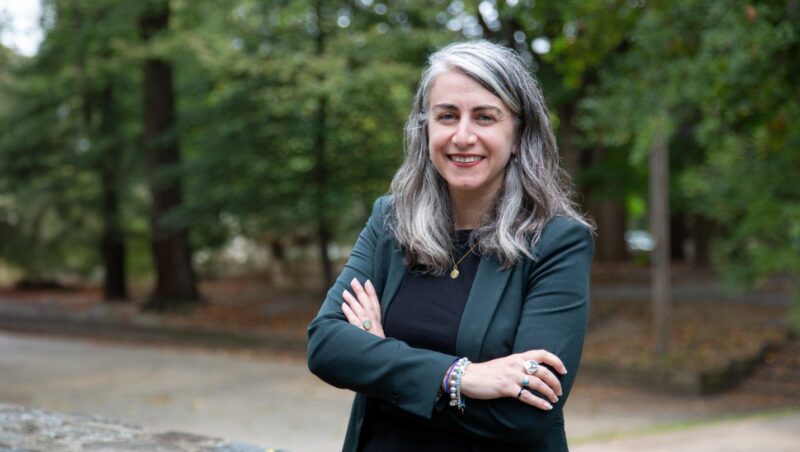
courtesy/hias
Beth Oppenheim, the incoming CEO of HIAS




 Add EJP on Google
After a decade during which HIAS’ refugee resettlement work boomed, the last two years have posed a major challenge to the immigration advocacy group. First, a budget discrepancy forced the group to cut 20% of its staff between February 2024 and January 2025. Then, after President Donald Trump took office for the second time in January and slashed refugee and foreign aid, canceling contracts with HIAS, the agency laid off hundreds of staff members and shuttered many of its international offices.
The White House has cracked down on immigration, visa programs and asylum claims. This has left many would-be immigrants and refugees in limbo overseas, and those already in the United States who believed that they had legal status face deportation. Over 60,000 people are currently in U.S. immigration detention. This is the landscape that Beth Oppenheim will now navigate, having been named CEO of HIAS earlier this month.
Oppenheim steps into the shoes of Mark Hetfield, the face of the agency for over 12 years, who served as both president and CEO but stepped down as CEO in December 2024, while retaining the title president — a legal and policy advisor position that reports to Oppenheim.
The CEO position is a dream job for Oppenheim, who has worked at HIAS for two years, serving as interim CEO for the past seven months. She comes with a tailor-made background for the organization formerly known as the Hebrew Immigrant Aid Society, having studied both Hebrew and Judaic studies and global affairs, with over 23 years’ experience in refugee resettlement and international development at agencies including Voice for Refuge Action Fund and Church World Service.
Oppenheim sat down with eJewishPhilanthropy for a series of interviews to discuss her goals for the organization as well as how HIAS is navigating these tumultuous times in the immigration sector.
The interviews have been combined and edited for length and clarity.
Jay Deitcher: Tell me about your vision for HIAS.
Beth Oppenheim: One of the things that I really want to bring as a vision to this organization is [ensuring it’s] an organization that’s able to be nimble in tough moments, because we’re not able to predict the future. We’re not even able to predict the next day sometimes.
It has been an organization that has adapted throughout its 120-plus-year history, and that’s really the reality of being a legacy organization. You go through a lot of different changes, both internally and externally.
This is an opportunity for us to showcase the fact that we have survived, and we have adapted to the world around us, and we’ve kept our Jewish values and our Jewish history at the forefront of that adaptation.
Being a woman and the first woman [CEO of HIAS], part of [my vision] is being able to lift up young leadership and young female leadership throughout both the organization and the [nonprofit] space. That’s very important to me—to be seen as a mentor for people who are working in a pretty unprecedented environment. We want people to continue to go into careers that put social justice at the forefront, and this is a really hard time for that.
JD: How are you weighing funding right now, when it comes to depending on government and philanthropy?
BO: It’s the ultimate question for every leader of an NGO at this moment.
One of the things that I worked a lot with interim CEO David Weiss [who held the position after Hetfield stepped down] on when he was here at HIAS from October 2024 to April 2025, he and I focused on looking at different revenue models, different operational models, to make sure that the organization was able to respond quickly to the Trump cuts. We knew cuts would come. We just didn’t know the extent.
One of the things that we were thinking through was, how do you create an operating model where you’re still doing good and you’re actually able to be nimble and not dependent on any one funder? It’s not even so much about the U.S. government, just that you don’t want to ever be dependent on any one funder.
What we’ve done, and what I’ve done over the last seven months, was to work with the entire staff to think through how we do that creatively. How do we build out our relationships with the Jewish community to make sure that we have a good mix of individual funders, private philanthropy, making sure that people understand the extent to which that the cuts have impacted HIAS?
JD: What are you excited about with this new position?
BO: I really do thrive on building teams, thinking creatively to do more with less, being able to strengthen the leaders that we have within the organization.
[Prior to the interview] you asked [HIAS’ media representative] if we were still providing legal services to immigrants [who were in or at risk to be taken into ICE custody]. The answer is yes, and one of the things that I am excited about is thinking through the ways in which we can expand our social services that we provide alongside those legal services.
We have offices in New York and in Silver Spring[, Md.] that do holistic models of legal services. You come in for a green card application or an actualization application or an asylum application, and you also gain access to a whole community of organizations and people who are willing to support you and who have services that can help fill some of the gaps that you might be experiencing.
JD: How much is your imprint overseas right now?
BO: We’ve been able to, I guess, salvage 10 country offices, including the United States, so that is significantly smaller than it was nine, 10, 11 months ago, and one of the ways in which we’re trying to refocus those efforts is to focus on depth rather than breadth. So instead of having so many country offices open in a lot of different places, really focusing on making sure that we are providing key, quality, in-depth services to folks who need it, engaging with the Jewish community where applicable and able to do that strategically in the countries where we remain.
JD: How is HIAS supporting people who are facing arrest and deportation?
BO: Focusing on [Immigration and Customs Enforcement] itself is the salacious part. What is the reality is that terrorizing immigrant communities is what’s happening in cities all over the country, but has been happening, not just with this new sort of empowerment of this particular arm of the government.
Where we’re trying to engage with our constituents, which we see as the American Jewish community and others, is trying to help them understand what’s happening. It’s overwhelming. It’s unclear what kind of criteria are being used to determine whether someone gets swept up in an ICE raid or not, and what protection they are allowed under the law. We partner with a lot of legal service agencies to provide an understanding of what are the different types of legal services that people usually seek if they’re an asylum seeker here in the United States.
The second is on accompaniment. It basically refers to community members making sure that people who are going to their appointments with immigration officers feel safe. They have someone who can come with them if they need language support if they need that. We’re calling it accompaniment, but that’s not really a HIAS term. It’s just a community organizing term. And so our community engagement folks have been working with other grassroots organizations to see what communities are in need of accompaniment, how we might be able to partner. And if we’re not able to provide that, at least provide the opportunity for our community members to understand what that is, so that if they want to get involved at the local level, they can, since HIAS is not able to do that in every community across the country, nor is really any organization.
The last piece is making sure that we are speaking out when we feel that we’re seeing things that are anathema to our identity. You and I are speaking on [Oct.] 27th, which is the anniversary of the Pittsburgh [Tree of Life synagogue] shooting [where 11 people were murdered]. It does not go unnoticed that a lot of places of worship, places of education, are conflated with the great replacement theory, that Jews are responsible for bringing illegal immigrants into this country. [The convicted Tree of Life shooter said he was motivated by HIAS’ refugee work.] It’s really problematic. It’s terrible. One of the things that we’re specifically doing is making sure that we’re speaking out on how that has affected us well beyond just the average organization taking some heat for supporting people who are not politically popular, but it has resulted in real violence, and that’s something that we can’t forget as an organization.
JD: Your background is in global affairs and Judaic studies. How are you bringing that into the position? For one thing, whenever we write about HIAS, we almost inevitably receive emails saying HIAS is not a Jewish organization. How important is that interlocking of Judaic and global passion in you and in this organization?
BO: It isn’t news to me. I have heard it both from reporters but also from constituents and people who work with me.
For me, it’s extremely important. I started out my career in a Jewish organization. My first job ever was at Avodah, which is a social justice organization, and then I moved more into the global space because I wanted experience working overseas to start understanding how the work I’ve done on the U.S. side was really manifesting overseas and how I might be able to change that.
Being Jewish has been a formative piece of who I am. I went to Jewish day school for my entire life, studied Judaic studies in college and bring the sensibility of the fact that these values are what have motivated me. My hope is that they motivate another generation of Jews to continue to remember that we do have the obligation not only to think about our Jewish identity and to think about the core pieces of what make us who we are, but what we’ve learned from our experience being displaced, being persecuted against.
JD: How do you respond to detractors who say HIAS is not a Jewish organization as it now primarily helps non-Jewish immigrants?
BO: I’d like to say that I wouldn’t necessarily consider that person who says that a detractor, but more someone who hasn’t necessarily been brought along on the journey that HIAS has been on for the last 20 or 30 years, and that obviously includes Mark’s tenure, but also just the fact that our world has changed.
As a uniquely Jewish organization, we’re serving the most displaced people, which at many points in our history were also Jews. We had this unique ability to not only advocate for Jews who needed assistance, but to learn from what we provided [Jews] in order to help other people who found themselves in similar situations of being persecuted. Right now, displaced people around the world are at an all-time high. The UNHCR statistics from this past year is at 120 million worldwide.
Again, I wouldn’t call [the person who said that] a HIAS detractor. We, like any organization, could do a better job of bringing people along [to show] how the identities of displaced people have changed, why that’s been the case and the fact that we are still helping Jews. That’s a pretty big misconception. We have helped thousands of Jewish Ukrainians extremely recently, including both in Europe as well as here in the United States.
JD: How is working at HIAS different from working at Church World Service?
BO: I have wanted to work at HIAS pretty much my whole career. If you look at my resume, you’ve got the global and the Jewish, and you’re like, ‘Oh, that totally makes sense to sit here talking to you as the CEO of the organization.’
It feels like the culmination of a lot of parts of who I am. My grandfather was resettled by HIAS in the early ‘40s from West Germany, and I feel like that unique refugee story is resonant for people at HIAS in a way that may or may not have been at CWS. Both organizations [are] incredibly meaningful and important to me, but this one has always had a special place in my heart and to be in this position at this time, I’m very humbled by that.
Related News

MAGICAL EXPERIENCE
Shefa launches psychedelics retreat for Jewish professionals suffering burnout

EXCLUSIVE
Detroit-based philanthropists Nancy, James Grosfeld donate $8M to renovate JDC’s Israel campus
HIGHER EDUCATION
As Jewish donors reconsider academia, Jan Koum doubles down, endowing Israel studies at Stanford

EXIT INTERVIEW
Elizabeth Sokolsky, longtime EVP of Birthright Israel, to retire next year
ADVANCING A VISION
N.Y. federation donates $1M toward building shared-society center named for peace activist killed on 10/7