WHAT YOU SHOULD KNOW
Birthright participants are far more engaged; their peers are losing ties to Judaism, study finds
Courtesy/Birthright Israel
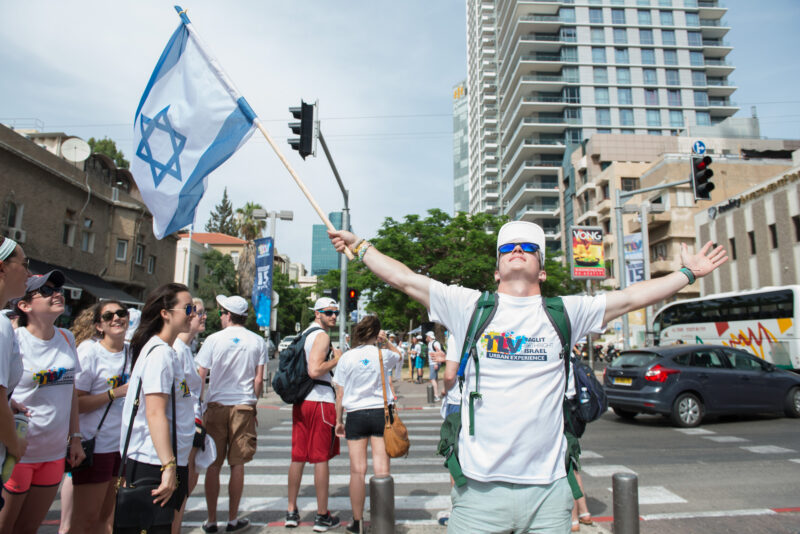
Birthright Israel participants are seen in Tel Aviv.




 Add EJP on Google
A new study of Birthright Israel participants indicates that in the wake of the Oct. 7 terror attacks, the free 10-day trip to Israel is performing a markedly different function for the Jewish community than it did in the past. Instead of serving as an entry point for young Jewish adults into the Jewish world, the trips today are attracting far more engaged participants, deepening their Jewish identities and ties to Israel, according to the report from Brandeis University.
“Brandeis University has released an alarming finding: Jewish connections among young Jews are declining at an unprecedented rate. But the good news is that with philanthropic investment, we can prevent decline and inspire growth,” Elias Saratovsky, president and CEO of Birthright Israel Foundation, said in a statement. “We are at a crossroads. If our community does nothing, we risk losing the younger generation. But if we invest in an effective intervention — Birthright Israel — we can win them back. Birthright Israel works, and the entire Jewish community must support it. Our future depends on it.”
“A Summer Of Uncertainty: The Impact on Birthright Israel’s Summer 2025 Cohort,” which was released today, examines the participants in last summer’s 10-day trips, comparing them to both the previous year’s participants and to those who attended trips in the summer of 2023, before the Oct. 7 attacks. The study found that the 2025 and 2024 participants were far more engaged, Jewishly educated and politically conservative than those in 2023. “October 7 continues to shape American Jewry in numerous ways, and the 2025 Birthright Israel trips illustrate that,” wrote the report’s authors, Leonard Saxe, Graham Wright, Micha Rieser, Shahar Hecht and Samantha Shortall.
More than half of the summer 2025 participants — 53% — said they were “very connected” to Israel before the trip, compared to the 29% who said so in 2023. Similarly, the share of participants who said they were “a little” or “not at all” connected to Israel decreased from 32% in 2023 to 18% in 2024 and 2025.
Nearly twice as many attended Jewish day schools post-Oct. 7 (40% and 38%) than pre-Oct. 7 (23%); accordingly, the share of participants who attended “supplementary” Jewish schools declined post-Oct. 7. More than three times as many identified as Orthodox in 2024 and 2025 (22% and 17%, respectively) than in 2023 (5%).
One of the most dramatic shifts was in the political affiliations of participants. In 2023, most participants — 57% — identified as liberal, while 24% said they were “moderate” and 20% said “conservative.” Post-Oct. 7, the number of conservative participants roughly doubled to 37% in 2024 and 42% in 2025.
The study — which was largely funded by Birthright Israel — found that the trips were particularly influential for liberal participants, deepening their connections to Israel. Meanwhile, among liberal nonparticipants — people who expressed interest in a trip but decided not to attend one — the level of connection to Israel decreased over the same period, from 31% saying they had a connection to 23%. The degree of connection to Israel did not change dramatically for conservative and “moderate” participants and nonparticipants, the study found.
Liberal participants were also more likely to say that being Jewish was “extremely important to their identity” — with 48% saying so after the trip, compared to 29% before the trip — while there was no change on the issue among nonparticipants.
“During the last several months of the war, young Jews who applied to Birthright but did not go became more disconnected from their own Jewish identity, and those who identified as politically liberal became less connected to Israel. Never before in our research on Birthright have we seen such notable declines among nonparticipants,” the authors wrote.
The summer 2025 participants overwhelmingly rated their experience as positive, despite having to be evacuated from Israel due to the war with Iran. Most participants rated being part of a Jewish group, hearing from Israelis about their wartime experience and experiencing Shabbat in Israel as the most meaningful aspects of their trip.
“Brandeis University has released an alarming finding: Jewish connections among young Jews are declining at an unprecedented rate. But the good news is that with philanthropic investment, we can prevent decline and inspire growth,” Elias Saratovsky, president and CEO of Birthright Israel Foundation, said in a statement. “We are at a crossroads. If our community does nothing, we risk losing the younger generation. But if we invest in an effective intervention — Birthright Israel — we can win them back. Birthright Israel works, and the entire Jewish community must support it. Our future depends on it.”