Opinion
ISRAELIS NEED YOU
When the headlines move on, but the missiles don’t




 Add EJP on Google
In the United States, the war with Iran is largely experienced through headlines, analysis and social media commentary. We debate the strategy. We speculate about geopolitics. We refresh news feeds to see what might happen next.
But for millions of Israelis, the crisis is not theoretical. It is daily life.
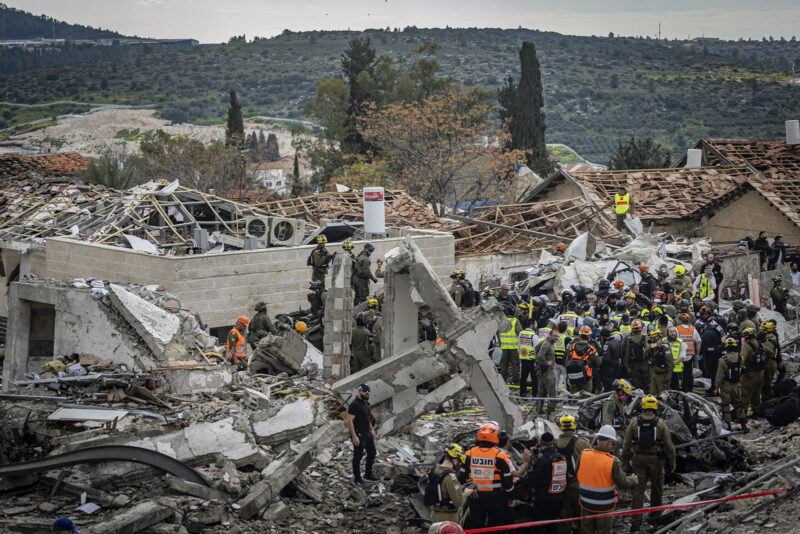
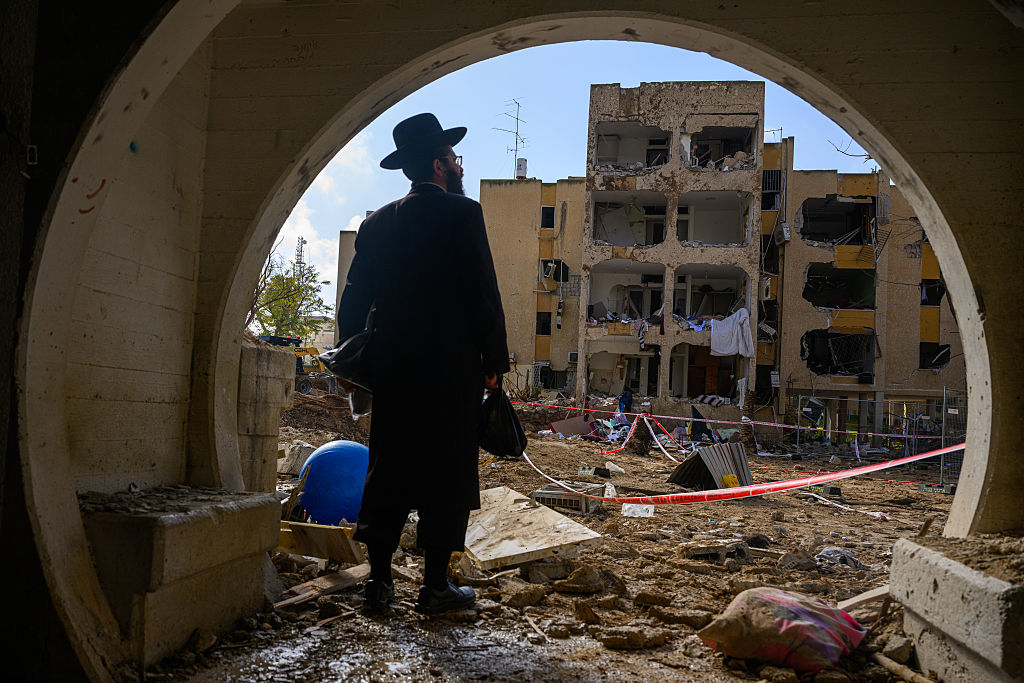
Israeli security and rescue forces operate at the scene where a ballistic missile fired from Iran struck Beit Shemesh, central Israel, causing extensive destruction and killing at least eight people, March 1, 2026. Photo by Yonatan Sindel/Flash90
Since the latest wave of Iranian missile attacks began, sirens have sounded incessantly across Israel. Entire neighborhoods have been damaged. Thousands of Israelis are currently living outside their homes. Schools have closed; families are sleeping in hotels; and parents are trying to reassure children who wake up night after night — often multiple times per night — to the sound of air-raid alerts.
Yet for many in the American Jewish community, the scale of this severe disruption is not fully visible. Even among deeply engaged supporters of Israel, the conversation frequently centers on strategy rather than the human toll unfolding inside Israeli homes.
Recently, I met a woman in Beit Shemesh who had lived in the same home for 45 years. Her husband, who suffers from dementia, depends on familiar surroundings and routine. When a missile struck just a few hundred meters away, their house was destroyed. Today, they are living in a hotel room.
She told me something I have not been able to forget. On Oct. 7, 2023, she watched television images of families from Kibbutz Be’eri being evacuated to hotels. She could never have imagined that 2 1/2 years later, she would be walking into a hotel room for that reason herself.
This is what the current moment feels like in Israel. Just when many people thought the worst might be behind them, a new wave of crisis has arrived.
Across the country, families are confronting similar upheaval. Children are separated from their schools and communities. Nearly one-third of evacuees are under age 18. Many elderly Israelis — roughly 11% of those displaced — suddenly find themselves removed from the routines and support systems that allow them to function. And the psychological toll is immense.
At The Jewish Agency for Israel, we see these realities up close. For more than two decades, supported by our partners the Jewish federations and Keren Hayesod, our Fund for the Victims of Terror has provided emergency assistance to Israelis in the immediate aftermath of attacks — often within 48 hours. These grants provide a lifeline: immediate financial help and a powerful message that the Jewish people are standing with those who have just experienced the unimaginable.
In response to the current crisis, The Jewish Agency has launched the Roaring Lion Fund, an emergency relief initiative designed to help families affected by Iranian missile attacks. The fund provides immediate financial grants to families who have lost loved ones, been injured, or lost their homes. It also supports long-term emotional resilience programs to help individuals and communities recover from trauma.
The goal is to respond swiftly when lives are suddenly upended. Many Jewish federations across North America, as they have in the past, have responded quickly and generously.
But this moment presents an unusual challenge. In past crises, Jewish donors around the world often called us first. They saw what was happening in Israel and asked, “How can we help?” Today, we often find ourselves making the call instead, explaining that the needs are significant and still growing.
There are many reasons for this. Some people feel exhausted after years of crisis. Others assume that because Israelis are resilient — and they are — the situation must be under control. Still others are simply struggling to understand the scale of what Israelis are experiencing from thousands of miles away.
All of these reactions are human. But the needs on the ground do not disappear because our attention shifts.
If you feel you have already done so much to support Israel since Oct. 7, you are not alone — and your commitment matters deeply. But there are still families today who are beginning the difficult process of rebuilding their lives after a missile strike. There are children who need psychological support after months of sirens. There are elderly people who have suddenly lost the homes they relied on for stability. For them, the crisis is not an abstract geopolitical event. It is immediate and personal.
My favorite line in all of Tanach captures a poignant and fateful conversation between the two most famous Jews living in the time of the ancient Persian Empire. Mordechai tells his niece, Queen Esther, that she has the opportunity to save the Jewish people. However, he makes clear that should she choose to remain silent and not help the Jewish people, they will be saved another way.
Similarly, the people of Israel today are strong. We will get through this challenging period. The only question is: Will world Jewry help us get through it?
The missiles may not dominate every headline. But their consequences are still unfolding in Israeli homes, schools and communities. And the people living through these attacks should never feel that they are facing the challenge alone.
Danyelle Neuman is the chief development officer of the Jewish Agency for Israel.