WHAT YOU SHOULD KNOW
Australian Jewry fumes after terror attack, looking for support, not meddling, as it faces antisemitism
Knesset
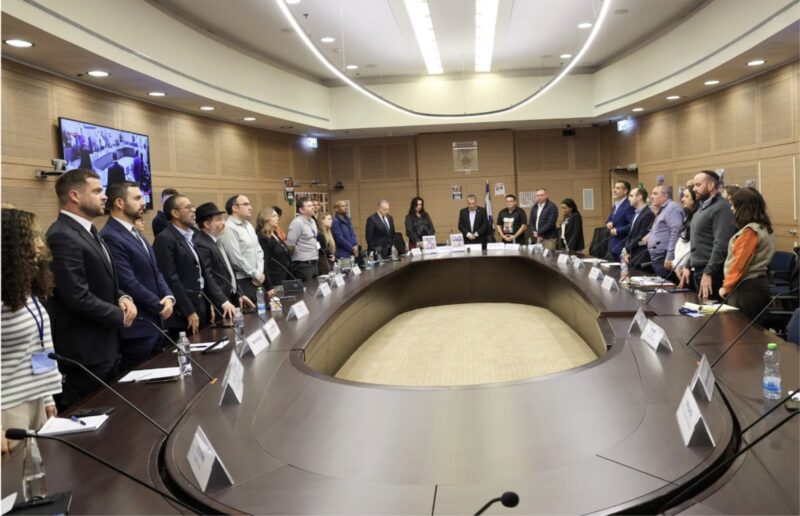
Attendees at a Knesset hearing on the recent terror attack in Sydney, Australia, stand at attention in honor of the victims on Dec. 16, 2025.




 Add EJP on Google
In the wake of Sunday’s terror attack at a community hannukiah-lighting event at Bondi Beach in Sydney, Australia, the local Jewish community finds itself in an increasingly untenable position.
After two years of heightened antisemitism in Australia, including the firebombing of a synagogue with congregants inside, culminating in this week’s deadly attack, the country’s Jewish community has deep, justified grievances with its own government, which has been unable — or unwilling — to protect it over the past two years, or even to embrace it now after its worst-ever tragedy.
In what one local Jewish leader described to eJewishPhilanthropy as “insane” and “completely bizarre,” Australian Prime Minister Anthony Albanese has yet to meet with Jewish survivors of the Bondi Beach attack, even as he has found time to meet with Ahmed al-Ahmed, the Muslim man who disarmed one of the terrorists before being shot multiple times.
For the Australian Jewish community, which has been regularly warning Canberra about the threats it faces, though Sunday’s attack was not surprising, it was infuriating — precisely because the warning signs were both so clear and eminently unheeded. An initial investigation found that there were only two police officers at the Hanukkah event, which had more than 1,000 people in attendance.
Yet the criticism against the Australian government coming from Israel, which has its own issues with Canberra — particularly related to its recent recognition of a Palestinian state — puts the local Jewish community in the position of appearing to have closer loyalties to a foreign government than its own.
These tensions, between the Australian Jewish community’s desire for support from Israel and world Jewry and its need to address antisemitism on its own, were on full display yesterday during a special discussion in the Knesset’s Committee for Immigration, Absorption and Diaspora Affairs.
“Responsibility for the security of Jews living in the Diaspora lies with the governments of the countries in which they reside,” Labor MK Rabbi Gilad Kariv, the committee’s chair, said during the session. “We will ensure that the Knesset does its part in assisting the safety and security of our brothers and sisters overseas. Diaspora Jewry has stood by the State of Israel throughout history and during the Swords of Iron War, and we are committed to standing with Jewish communities in the Diaspora in their time of distress.”
Three representatives from the Australian Jewish community addressed the session: Rabbi Yaakov Lieder, the uncle of Rabbi Eli Schlanger, who was murdered in the attack; Jillian Segal, the government’s special envoy to combat antisemitism; and Rabbi Benjamin Elton, who leads Sydney’s Great Synagogue.
“The federal government in Australia is not doing enough to root out antisemitism. Jews are afraid to live in Australia,” Lieder said, addressing the committee over Zoom in Hebrew.
Lieder called for Israel to recognize those killed and injured in Sunday’s attack as “victims of terror,” which would provide them with Israeli state benefits. He was assured that this would be done soon, under a 2023 government decision that expanded Israel’s definition of “victims of terror” to include non-Israeli Jews killed in antisemitic attacks abroad.
Addressing the committee, Segal said that she was pushing for the immediate implementation of a plan that she had prepared to address antisemitism in Australia, which was presented to the government this summer.
“That is the ‘ask’ now,” she said. “Although [the government] condemns antisemitism — of course, they condemn it — but they will absolutely implement the plan because it has to affect all parts of society. And that is what people are calling for, what the Jewish community is calling for, what I’m calling for, and we expect the government to respond in the affirmative. But we are still waiting.”
Segal added that “if we get a response from the government in the next few days, you’ll be the first to hear.”
Elton reiterated Segal’s call for the Australian government to have a “swift and comprehensive response to [her] antisemitism reports, which has been lacking, and to take responsibility for the protection of Australian Jewish citizens.”
“We are citizens of this country like everyone else, and we are entitled to the protection from our government, and that protection failed on Dec. 14 and now needs to be reinstated,” he said.
Elton rejected the Australian government’s initial response to the attack, of focusing on gun control, which he said is “not where the root of this problem is. The root of the problem is deep-seated antisemitism and violent language, which had its expression in the physically violent attacks that we saw on erev Hanukkah.”
Referring specifically to the Israeli government, Elton said that Australian Jewry needed “moral support” and “proper forms of diplomatic encouragement,” but warned against Israeli officials intervening directly.
“I don’t think we want or need diagnoses from far off of exactly what the problem is and exactly what the solution is, because that is very rarely known by foreign governments. There is the expertise here in Australia, by Jillian Segal and other Jewish communal bodies in the [Australian] states and nationally, who have analyzed the problem and have begun to develop solutions to it,” he said. “I think an encouragement by the Israeli government to have confidence in the Jewish institutions in Australia, to listen to their analyses and to listen to their advice. That would be the most important thing the Israeli government can do.”