WHAT YOU SHOULD KNOW
2.8 million Israelis lack access to healthy food, study finds
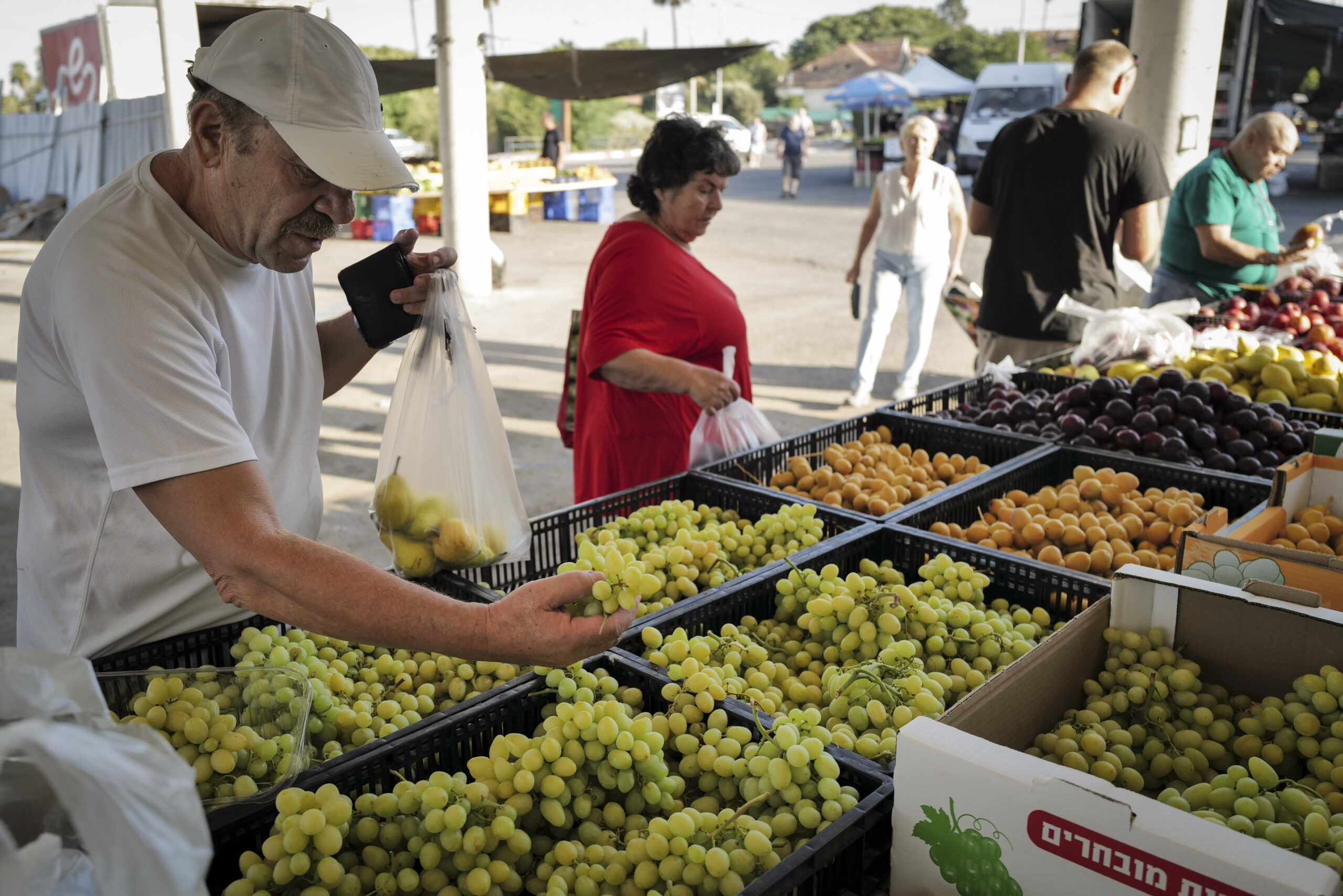
Michael Giladi/ Flash90
People shop for fresh produce at Katsrin's market on Aug. 27, 2024.




 Add EJP on Google
More than a quarter of Israeli households — comprising some 2.8 million people, including roughly 1 million children — did not have regular access to healthy food last year, according to the country’s National Insurance Institute’s annual Food Security Report. This marks a slight improvement over the year before, when more than 30% of households faced so-called “food insecurity,” but remains far higher than in most other developed countries.
The study found that 27.1% of households had “inaccessibility to healthy food” or “inability to afford food that is not damaging to health” in 2024. The issue is particularly acute among Arab Israelis, with 58% of households having some level of “food insecurity” and nearly a quarter having it to a severe extent. A quarter of Haredi households also struggled with the issue, 9.9% of them severely, along with 37% of residents of Jerusalem and 36.7% of residents of northern Israel.
John Gal, a Hebrew University social work professor and a principal researcher at the Taub Center think tank, told eJewishPhilanthropy that in a country like Israel, the issue of “food security” is not about “are people starving or not starving,” but about access to healthy, nourishing food. “Is your child able to eat more than two slices of bread and some chocolate spread?” he said, referring to a cheap Israeli staple.
As demonstrated during the recent government shutdown in the United States, which sent nonprofits scrambling as federal food assistance benefits dried up, philanthropy and civil society can play a role in alleviating issues of hunger and poverty; however, the problem is fundamentally one for the state, with its far greater resources, to address.
This can include greater education to teach people about the importance of healthy eating, as well as addressing specific issues of access to fresh, healthy food for certain populations, such as the elderly and disabled, who are not necessarily able to visit markets regularly.
However, while there are differences between them, the issue of food insecurity is ultimately most closely tied to that of poverty. “One way that you can deal with most cases of food insecurity is making sure that people have more access to resources, that is to say, money,” Gal said.
According to Gal, a leading expert on Israeli welfare policy, these problems long preceded the Oct. 7 terror attacks and the past two years of war, as well as the COVID-19 pandemic.
“Now that hopefully the war has ended, we can go back to [addressing] the problems of poverty and inequality and food insecurity that we had before the virus and before the war. We didn’t deal with them very well then. Now we’ve got to deal with them,” he said.
In addition to the direct issues that this lack of access to healthy food poses to individuals, the National Insurance Institute found that these levels of food insecurity have a significant impact on the wider economy, raising healthcare costs and decreasing productivity.
“Food insecurity is not just a social problem but an economic issue that demands system-wide intervention. Families that cannot afford healthy food are families with a higher rate of disease, missed work and lower academic achievements. Long-term policies in this field will contribute not just to social welfare but to sustainable growth of the market,” Nitza (Kaliner) Kasir, the National Insurance Institute’s deputy director of research and planning, wrote in the report.