WHAT YOU SHOULD KNOW
Universalism vs. particularism: What is the Reform movement fighting about?
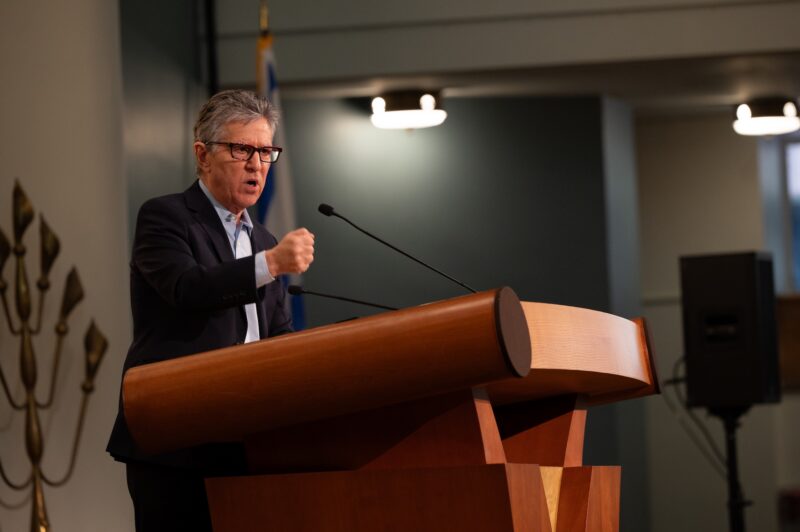
nira dayanim/ejewishphilanthropy
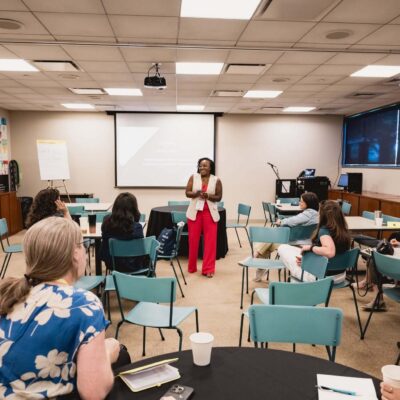
Rabbi Ammiel Hirsch speaks at the Re-Charging Reform Judaism conference at the Stephen Wise Free Synagogue in New York City on May 27, 2026.




 Add EJP on Google
There is a vigorous debate, potentially even a fissure, taking place within the Reform movement around Zionism, whose dividing lines are in some ways eminently clear — Zionism vs. anti-Zionism, universalism vs. particularism — but in others are entirely inscrutable, with the different sides often arguing past each other and employing nomenclature that can be defined in markedly different ways.
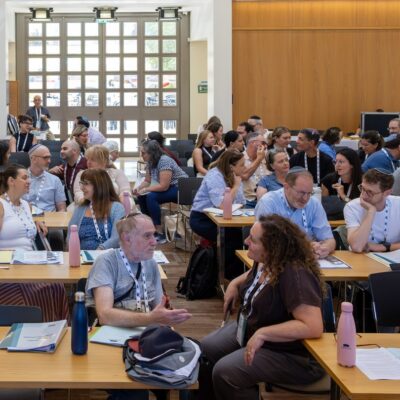
All of that is on display this week at the still-underway Re-Charging Reform Judaism conference at New York City’s Stephen Wise Free Synagogue, which is being spearheaded by the congregation’s senior rabbi, Ammiel Hirsch, who has emerged as one of the Reform movement’s most prominent critics of what he describes as a betrayal of its Zionist commitments.
Hours before Hirsch addressed the conference, the Union for Reform Judaism published a blog post by Rabbis Jonah Dov Pesner and Josh Weinberg, respectively the director of the Religious Action Center of Reform Judaism and the vice president of the URJ for Israel and Reform Zionism, who also serves as executive director of the Association of Reform Zionists of America.
Hirsch’s speech and the blog post by Pesner and Weinberg were, in many ways, remarkably similar. Both stressed the tension between and necessity of universalism and particularism, that Jewry must both care about its members and about everyone else.
“We carry those tensions with us. We carry them because we believe the alternative – a Judaism that abandons either its particularist love for our people or its universalist commitment to human dignity – is not Judaism at all,” Pesner and Weinberg wrote.
“Judaism is a blend of universalism and particularism,” Hirsch declared in his speech.
And yet despite this fundamental agreement, the argument appears to center around a matter of balance and degrees. Both might matter, but which takes precedence: universalism or particularism?
Hirsch appears to favor the latter.
“It is true that we are seeing worrying signs of a narrowing particularism in some quarters of the Jewish world and the Jewish state. … And the hooligans who violently assault Palestinians on the West Bank are a disgrace. It is Israel’s responsibility to thwart them, on pain of imprisonment, and it is our responsibility to say so,” Hirsch said.
“At the same time, while we may convince ourselves that the main problem in the Jewish world is a narrowing particularism — the opposite may constitute an even greater challenge in the Diaspora,” he went on. “A universalism unmoored from particularism is not Jewish universalism. It is just universalism, of the non-Jewish kind.”
Pesner and Weinberg appear to favor the former.
“[Some] tell us, now is not the time for social justice or to concern ourselves with the fate of the Other. Now is not the time for public critique, however nuanced. With antisemitism on the rise, now is the time to circle the wagons, to stand with our people, full stop. We respectfully, but firmly, disagree,” they wrote, detailing their reasons for insisting on a robust commitment to social justice, not despite but because of their commitments to Zionism.
This is a significant and fundamental discussion not only for the Reform movement but for world Jewry in general: What are our commitments to one another? To what extent is Judaism a personal religious matter, and to what extent is it a people that we are duty-bound to support? These are debates that have been taking place within the Reform movement for over a century, but they are also happening in Orthodox spaces as well. (See: Rabbi Joseph B. Soloveitchik and his student, Walter Wurzburger’s, discussions of the Covenant of the Forefathers and the Covenant of Sinai.)
Yet it is more difficult to have those debates when the terms can be understood and interpreted by each side differently.
Even those involved can’t entirely seem to decide if they oppose one another.
Asked about Hirsch’s speech at the Re-Charging conference by eJewishPhilanthropy’s Nira Dayanim, Weinberg struggled to pinpoint the differences between their approaches in concrete terms.
Embracing nuance and rejecting false binaries are eminently worthy goals, but in order for organizations and movements to truly stand for something, they must first articulate it.