Opinion
FIELD NOTES
The promise and perils of pluralism: Lessons from a midsized Hillel and a model for the Jewish future




 Add EJP on Google
In Short
Ask any Hillel professional — pluralism is hard. But it is also essential to the survival of the Jewish people in an increasingly challenging world.
When I was a child, it was hard to get a spot in our synagogue parking lot on the High Holy Days. The space was full to the brim; and since we typically arrived mid-morning for the children’s service, we often parked in the church lot across the street.
Over time, things changed, and getting a spot in the main synagogue lot was less of a challenge. But this year the parking lot was once again full — more than it has been in years. While in part likely attributable to the resurgence of Jewish engagement after the Oct. 7 attacks, the primary reason is that what used to be a parking lot for a building housing one Conservative synagogue is now the lot for a building that is home to four congregations. These smaller congregations did not merge with ours. They have each retained their own unique identities, memberships and, in some cases, clergy. We are not a melting pot of Conservative Jewish practice, but we are collectively better able to financially sustain one beautiful space, with one full parking lot, by finding ways to be together in physical community.
University of Rochester Hillel/Facebook
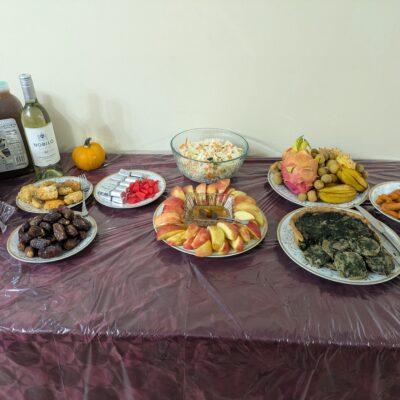
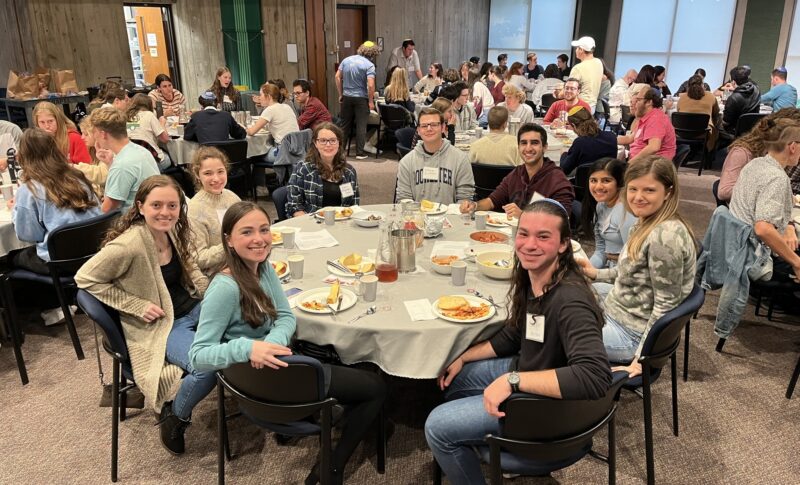
Students eat at a University of Rochester Hillel meal in October 2022.
The Hillel at the University of Rochester underwent a similar experience. On any given Shabbat, there would be separate Reform, Conservative and Orthodox services; but then as populations decreased and shifted, more students preferred to find ways to pray together instead of holding fast to the uniqueness of each movement’s practices.
When I started in my role as the Hillel’s executive director in 2020, one of the things I heard loudest from a core of highly engaged students was that they desired to find better ways to be inclusively together in prayer. At the time, everyone used their own movement prayer book, and the service leader could find themselves calling out the page numbers for two, three or even more siddurim throughout each service. We engaged in a deliberative exploratory process and settled on a siddur that has full Hebrew, transliteration, translation and commentary, all together across two pages. We adopted a siddur that would — as best as we could — ensure everyone could truly pray together as a community, regardless of individual Hebrew literacy, background or preferences.
At long last, we thought we had found a siddur that fit everyone… or did it? We quickly learned that there’s a fine line between one-size-fits-all and one-size-fits-none.
I find the same is true of much of my work as the director of a proudly pluralistic, inclusive Hillel.
There are good reasons the old joke about two Jews, three opinions, continues to resonate. It can be challenging to hold such diversity of opinion – from students, parents, alumni, and community members – about who and what we should be and do. My work can sometimes feel like an endless game of straddling fences. For some, the seder is too long, and for others too short. Some want what they consider a “traditional” Shabbat dinner meal, but others like weekly themes or diversity of menu offerings, and either way, what is traditional to one is foreign to another. For some in our community, we’re too “pro-Israel,” and for others not “pro-Israel” enough. Some want a full Torah reading; some want more Hebrew singing; some want more English readings. Some value having kitniyot (eg, rice, corn, beans) as part of their Passover food practices; others are reluctant to be at a meal where kitniyot options, separately prepared and served, exist. Some want us to welcome all Jewish students irrespective of their views on Israel or Zionism itself, while others say that if we don’t create clear boundaries of belief and practice our organizational tent loses shape and the flaps spill into an open field, adrift in the wind.
I am continually impressed with the thoughtfulness of student feedback. It’s easy to hear their questions as complaints – “Why did you put the sukkah on the cement when I prefer the grass?”; “You don’t put carrots in the chicken soup?” – but ultimately, these are students saying that the Jewish practices of their homes mattered to them, and in the spirit of continuity, they are coming to Hillel to hold on to and recreate moments of Jewish meaning as they’ve always known them. They crave the comforts of what for them is tradition.
It also speaks to the purpose and nature of a Hillel – a dynamic mosaic of “all kinds of Jews, all kinds of Jewish” – where pluralism exists not only in the realm of ritual practice and movement affiliation but also in the arenas of politics, customs, priorities, perspectives on and relationships with Israel, and more. With a Hillel, there is a standing emphasis on Jewish diversity and personal choice. There is an explicit invitation to converse and question, often coupled with implied student expectations that offerings will feel personal and authentic, specifically for and to them. On the individual level, how inspiring — to engage with students who care deeply about the nuances of Jewish choices. On the macro level, it can be challenging to create opportunities for uniqueness and diversity of Jewish practice to shine within a cohesive Jewish space. Yet is the goal of pluralism to even create cohesive space, or is it to create Jewish spaces that, in parallel, welcome and reflect the communal diversity of individual Jewish practices and preferences?
I also wonder where this leaves students coming to us new, just starting their exploration of Jewish identity and tradition. I worry that these students might only get exposed to the practices and preferences of other students with longer organized Jewish engagement, who can better advocate and articulate what they want. It can be challenging, but also really important, to balance the conflicting but known needs of some students with the unknown needs of others, just beginning their search for Jewish meaning and authenticity.
To an extent, it’s a matter of numbers. For example, if our campus Jewish community were larger, we’d be happy to again support parallel minyanim, but on a midsized campus, we must find ways to pray and collaborate across personal preferences. Getting to consensus isn’t easy. I worry that sometimes when two students want strikingly different things and we can only provide one offering, it can come down to who will give up the particular to save the whole. Who will sacrifice their personal ritual preferences, for example, to ensure a full minyan? I struggle with the fairness of that. Should the students most willing to compromise less frequently get the spaces they most desire?
The challenges are daunting, for sure, but the promise of pluralism, thoughtfully pursued and practiced, can be energizing and empowering. We can’t force students to compromise, but we can help them listen, learn and reflect on the beauty of Jewish diversity, and guide conversations towards collective belonging. We can help students learn how to hold fast to what matters most to them, while experiencing what matters most to others – if not in the spirit of personal Jewish practice, then in the spirit of friendship, learning, discovery and community. We can normalize that the only thing truly “traditional” about Judaism is that it’s ever evolving, and how fortunate we are! This, perhaps more than anything, is the story of Jewish life, and we can invite our students to be part of that proudly and affirmatively – together.
Ask any Hillel professional — pluralism is hard. But it is also essential to the survival of the Jewish people in an increasingly challenging world. If the numbers support it, what a luxury to parallel pray. But when the numbers don’t, and for a growing number of communities and campuses, they at some point won’t, we will need to find ways to truly listen, compromise, and build new cohesive traditions together. Midsized and smaller Hillels are examples of this difficult and imperative work, and they serve as models for the future.
When students come of age in pluralistic Jewish spaces, as Hillel offers, they learn to articulate what they most value and need from a Jewish experience. Simultaneously, they learn to listen to their peers and navigate together how to best co-create collaborative Jewish moments of meaning and joy. They learn how to be Jewish with other Jews, and feel the power and strength that comes from being part of an ever-unfolding story of Jewish life, tradition and community.
Joy Getnick, PhD, is the executive director of Hillel at the University of Rochester.