Opinion
BEST PRACTICES
Template thank-you notes undermine donor retention




 Add EJP on Google
The plan for acknowledging end-of-year gifts is just as important as the design of a strategy for end-of-year fundraising, which Avrum Lapin so well described in his Oct. 26 opinion piece (“Results by the numbers: An imperative for end-of-year fundraising”). As Lapin stated, “Year-end campaigns must not only focus on short-term dollars. They must be seen and embraced as a springboard for long-term relationships.”
The first step in building the latter is a well-thought-out donor thank you. It could be a letter, an email, a telephone call or whatever, but I find that donor acknowledgements are frequently template letters that are cold and impersonal. Nonprofit organizations need to recognize that the thank you is a key component of the development process.
denayune/Adobe Stock
A little more than 10 years ago, I published an article in eJewishPhilanthropy titled “Three thank you templates and you’re OUT!” The sad thing is that it appears that not much has changed.
A dramatic example: I spent some time studying at a Jewish institution that, over the course of a year, sent me numerous online requests for donations. My experience with the organization was so terrific that I made a contribution. I was quite excited to be a first-time supporter of the organization, but it clearly did not feel the same way about me. I received a template thank-you note by email. It began with my first and last name — “Dear Deborah Polivy” — obviously taken from a computer-generated form; and the email address from which it was sent belonged to the organization’s development manager, while the note was “signed” by the senior vice president for institutional advancement.
I replied to the email address from which the acknowledgement was sent: “Thank you for your template letter of 12/16/2024.” I had hoped that I might startle the development department into some realization that its acknowledgement was not personal in any way — especially important since I was a first time donor.
The reply must have made the impact that I sought, because I then received another email: “I just left you a voicemail — thank you for your donation.” The author continued. that there was an “issue” with the “tax-receipt” and concluded with the statement, “I would love to hear about your connection to [the institution] and what prompted your year-end donation.”
From the paper trail of countless emails sent to me from this institution throughout the year, it should have been obvious that I had a connection to it of some kind. Had this individual done their homework before sending the template letter, they would have discovered this and might have called, instead of sending emails, and asked me what prompted my year-end donation. That would have been a great way to get to know me as a donor, build a relationship and maybe even create an impetus for continued giving on my part.
Another example: I received a template thank-you letter from an institution with which I had an ongoing relationship. It was in response to a donation I sent in memory of my parents and targeted to a particular program. I had made similar contributions throughout the years. This thank-you note, too, came from one person’s email but was signed by another. No mention was made of my relationship nor that of my parents to the organization, the targeted program — nothing.
When I wrote a return note identifying the gaps in the acknowledgement, I received the following reply: “I work in the office and part of my responsibilities are processing payments, recording donations and sending out the thank-you letters.” In other words, the entire procedure was more or less automated.
Donor retention depends upon personalization. “Donors want to know that you know who they are. Personalization is a vital way to convey that feeling,” explains David A. Mersky of nonprofit consultants Mersky, Jaffe & Associates in his April 2025 blog post, “Retain Your First-Time Donors.”
But don’t limit personalization to just first-time donors. All contributors want to be individually recognized in some way, and this is a key component of donor retention — whether first-time or ongoing, and no matter the size of the gift. I think the issue is that no one is paying attention to the mail, and gifts are recorded and template thank-you notes are sent without any staff analysis. If gift size is the barometer for personalization, then many endowment contributions from long-term donors making small contributions could be lost.
Some people with whom I have spoken tell me that they receive so many gifts, especially at the end of the year, that personalization is just not possible. Nevertheless, it is imperative: it should be considered and implemented as part of the overall development plan. As Mersky observes, there is no lifetime value to “a donor who is one and done,” and while we spend so many resources on acquiring first-time donors, we don’t place a similar amount of attention on retention.
Many years ago, I recommended that development professionals pay attention to a donor’s position on the Donor Lifecycle Map and create tools that can be applied to the personalization process. For example, all first-time donors could be thanked for an “initial gift.” If gift size is important, then it can be used as a mechanism to sort first-time or other donors in terms of additional thank-you tools such as a telephone call.
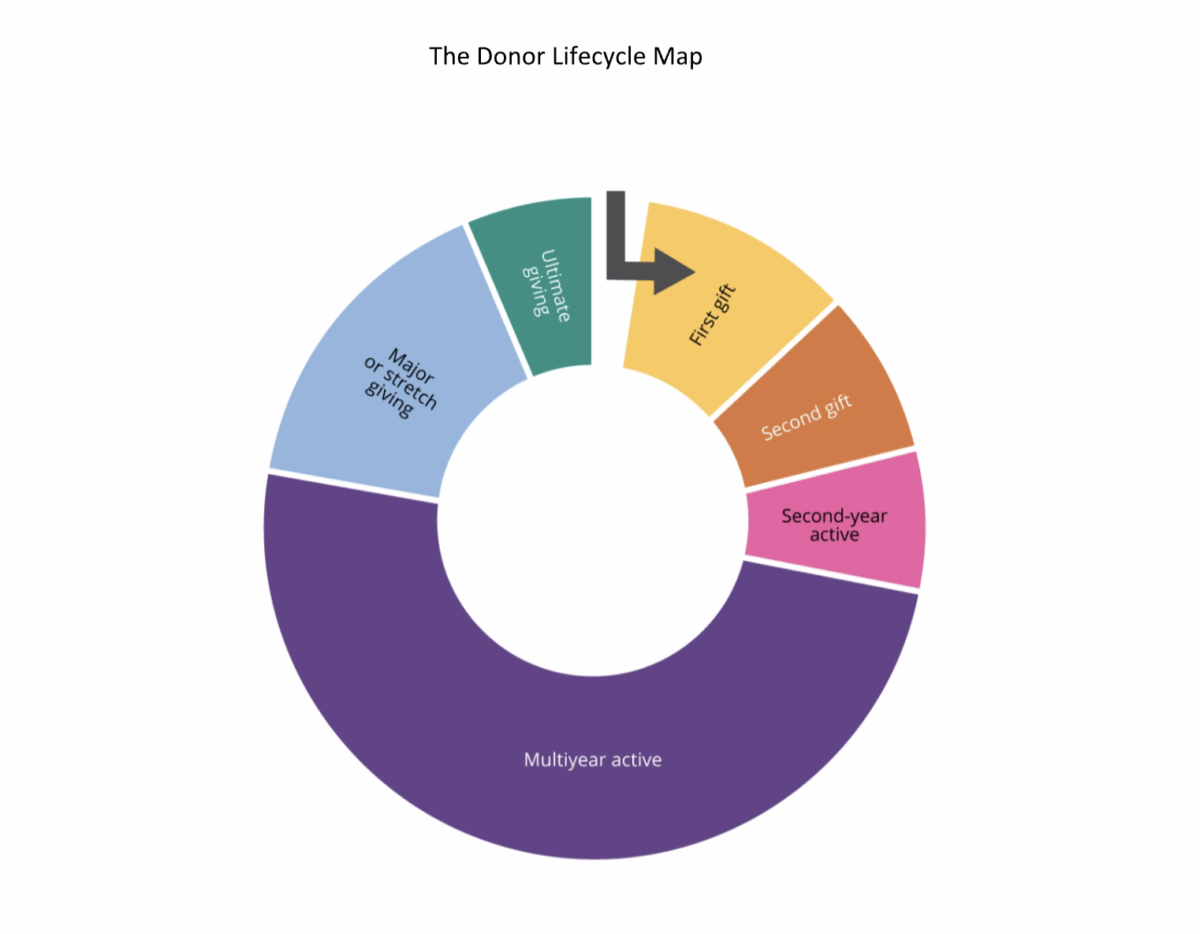
The purpose of the map is to identify where a donor is situated on it and create tools to ensure he progresses over its expanse and is not lost on the journey. The tools could be letters or phone calls using the language mentioned above; donors could be recognized in annual reports or invited to special programs. These are all tools or mechanisms to retain donors, but they have to be well-thought-out as part of the development strategy.
It always helps retention to have a conversation with a donor. It is important to learn why an individual makes an initial gift or increases a contribution from one year to the next; such information helps in formulating subsequent “asks” and maintaining communication with contributors.
Our nonprofit organizations must make donor retention a priority. We must think about how we train our development team and our fundraising priorities. While Lapin recommends using data to personalize and show donors “results by the numbers” — in this case related to impact of a gift — I recommend using giving data — like how and where a donor resides on the Donor Lifecycle Map — to personalize the acknowledgement component of fundraising and thereby add to the “building of long-term connection and commitment.” I, too, believe in “using the right segmentation tools,” but in terms of recognizing the history of the donor’s contribution pattern. While Lapin focuses on the impact of the gift, it is also important to let a donor know that the trajectory of giving is recognized and appreciated.
Donor segmentation among first-time donors, second-year donors, ongoing contributors and those who make a major gift, no matter how that is defined for each organization, can be reflected in the thank-you method. Mersky suggests making “a welcome thank you call to each new donor within 48 hours of receiving their gift”; such a call was certainly missing in my first example. A major gift also deserves an acknowledgement telephone call or a personalized thank-you note within a very short amount of time, and continuing donors need to be recognized as such — “thank you for your ongoing support” is a phrase that honors the long term giving history of a contributor. Again, it’s all about personalization.
Finally, returning to that first template letter signed by the senior vice president for institutional advancement: They are responsible for communication that comes out of their development office, especially when they are presented as the signatory, and it should never be a template letter or email, ever.
Deborah Kaplan Polivy is the author of The Time for Endowment Building is Now: Why and How to Secure Your Organization’s Future (Rowman & Littlefield, 2020) and Donor Cultivation and the Donor Lifecycle Map: A New Framework for Fundraising (Wiley, 2014), as well as numerous articles that have appeared in eJewishPhilanthropy.