Opinion
MODEL OF CHANGE
More than financially sensible: How a shared campus helps Jewish life flourish in Greater Boston




 Add EJP on Google
In Short
A new case study shows the key steps and strategies that led to a shared campus among a group of Jewish organizations in Greater Boston.
Spend a few minutes scanning headlines about the nonprofit sector and a familiar narrative emerges: consolidation, contraction, survival. Mergers are framed as inevitable. Collaboration is often reactive. Too frequently, institutions come together only when a crisis leaves them no other choice.
But what if we flipped the script?
Courtesy
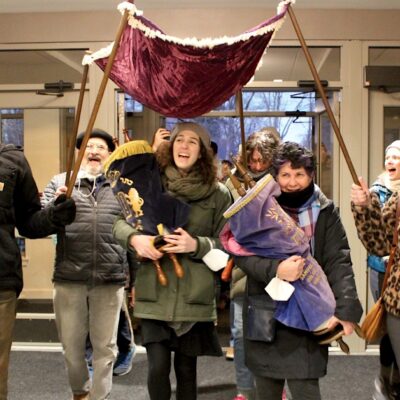
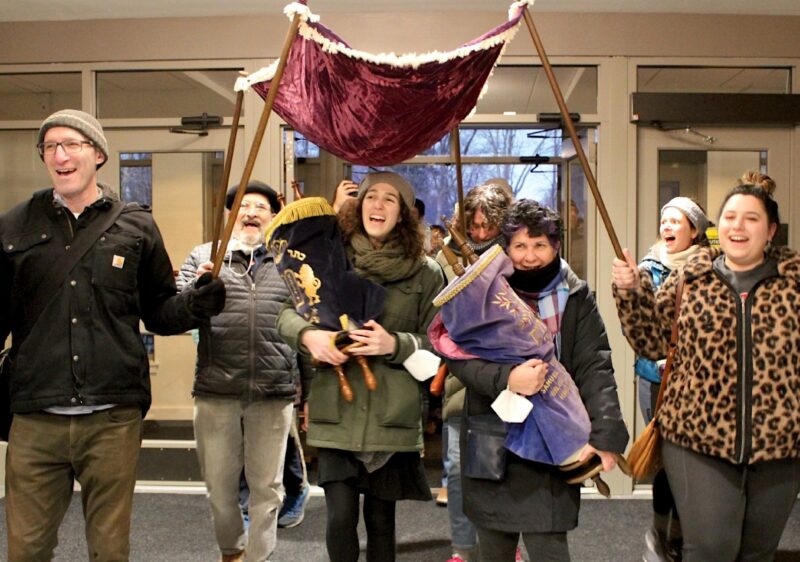
Hebrew College faculty and students accompany the Torah scrolls to their new collaborative campus home on Washington Street in Newton, Mass., January 2023.
In Greater Boston, our organizations — Hebrew College, Temple Reyim, the Jewish Women’s Archive and Mayyim Hayyim, along with a network of other partners — embarked on a bold experiment. Instead of only asking how our organizations could thrive financially (a worthwhile question in and of itself), we asked a more generative question: What would it look like for Jewish life to truly flourish through partnership, proximity and collaboration?
The answer is a “shared campus” — not simply to house offices, but to activate an ecosystem of multidimensional learning, creativity and connection; one where organic interactions between rabbis, students, artists and activists cross-pollinate new ideas, and where organizations that serve different needs can offer a more integrated model for Jewish vitality.
Our shared campus is described in a case study authored by Susan Wolf Ditkoff, a former partner at the Bridgespan Group. Offering a road map for how mission-driven collaboration can happen before crisis dictates the terms, the case study details a process that unfolds in four stages: dreaming, exploring, aligning and launching — DEAL. The acronym may be pithy, but the work was anything but simple. What we learned is that building a collaborative ecosystem requires the right mix of imagination and discipline.
Dreaming: Start with vision, not logistics
Too many collaborations begin with spreadsheets. Ours began with a question: What is “the big why?”
In the dreaming phase, we resisted the instinct to focus on square footage and instead invited stakeholders to imagine a campus alive with new encounters — where clergy, artists, educators and seekers might cross paths and how institutions could maintain distinct identities while amplifying collective impact. This was not window dressing. Through town halls, focus groups and countless conversations, our vision was stress-tested, shaped and ultimately owned by the community. That early investment in shared purpose paid off: it built trust, generated momentum, and helped unlock $15 million in philanthropic support for Hebrew College’s “Branching Out, Building Together” capital campaign.
Exploring: Get honest about what partnership requires
If dreaming was expansive, exploring was clarifying. In this phase of the process, we named our nonnegotiables. Independence mattered — governance, culture and brand would remain intact. But so did the opportunity to share: space, services and, importantly, proximity. These conversations required candor. What would make this partnership worth it? What would break it?
As clarity emerged, so did ambition. The campus expanded to include additional national organizations like Keshet and later the Jewish Studio Project. The vision evolved from co-location to ecosystem — not just shared space, but shared possibility.
Aligning: Build the systems that make trust durable
None of this was quick. Board members and staff invested deeply in designing governance structures, operational systems and shared services that could sustain collaboration beyond any individual leader. The payoff is already clear. A centralized administrative team — handling reception, security, communications and IT — has strengthened professionalism across the campus while freeing leaders to focus on mission. What might once have been duplicative is now shared — and stronger.
Launching: Let proximity do its work
And then, the real test: opening the doors. When the campus launched in January 2023, not everything could be planned, and that was the point. The goal was not just to execute a model, but to activate a culture.
What followed underscores the power of proximity. New collaborations emerged organically. Take The Shul Lunch Coop, for example. What began as a student workaround for the lack of a cafeteria has become a defining feature of campus life: a weekly ritual of shared meals, cultural expression and community-building. It is as much about Torah, learning and connection as it is about food.
This is what an ecosystem looks like in practice: unscripted, relational, generative. There are also measurable gains. Hebrew College alone saved about $100,000 in facilities costs in the first year of the shared campus. But the deeper value is not financial. It is the creation of a dynamic, living commons — one that expands what each institution can offer on its own.
A different model for a different moment
At a time when Jewish communities are asking urgent questions about belonging and relevance, the shared campus offers a compelling alternative to the merger model. It is not about sameness. It is about synergy. The case study points to several conditions that made this possible: early and sustained stakeholder engagement; clarity about what is shared and what remains distinct; serious investment in governance; patience with complexity; and leadership willing to imagine abundance in a sector too often defined by scarcity.
The shared campus serves as a platform where multiple Jewish expressions coexist and cross-pollinate: academic and congregational, spiritual and cultural, traditional and innovative. This cross-pollination is also changing patterns of philanthropic giving. For example, two donors recently gave a generous gift to underwrite internships at Mayyim Hayyim for two Hebrew College rabbinical students. Their gift was designed to strengthen the connection between emerging Jewish leaders and meaningful ritual practice in the broader community. Moreover, it exemplifies a spirit of collaboration that strengthens the ecosystem of Jewish learning and practice as a whole, and can hopefully serve as a model for other donors to give in ways that foster shared leadership and innovation across institutions.
That shift matters — because the future of Jewish life will not be built by any one organization alone.
Build for flourishing, not just survival
In Greater Boston, our question was never simply, “If you build it, will they come?” It was, “What can we build together — and for whom?” The answer is now taking shape: a campus designed not just to house individual organizations, but to connect and cross-pollinate our work in unexpected ways. If the Jewish nonprofit sector is serious about moving beyond survival mode, it would do well to pay attention.
Rabbi Sharon Cohen Anisfeld is the president of Hebrew College.
Rabbi Dan Berman is the senior rabbi of Temple Reyim.
Judith Rosenbaum is the CEO of the Jewish Women’s Archive.
Jordan Namerow is the immediate past president of Mayyim Hayyim’s board of directors.