Opinion
JEWISH LEADERSHIP PIPELINE
How Jewish camp models the leadership our communities need




 Add EJP on Google
In a world that often prizes individuality over interdependence, Jewish camp remains a sacred space where young people live in community, care for one another and see that their actions matter. And this summer, the power of that community came into sharp focus: With an estimated 200,000 young people not only experiencing the joy and belonging of Jewish camp but learning what it means to show up for each other, we saw the positive feedback loop of Jewish camp in action more clearly than ever.
As camps opened in June, war broke out between Israel and Iran. Teen trips were rerouted, and hundreds of Israeli shlichim (emissaries) were suddenly unable to travel as scheduled. Just as summer was beginning, camps across North America faced immediate staffing shortages and logistical disruption.
Courtesy/Foundation for Jewish Camp
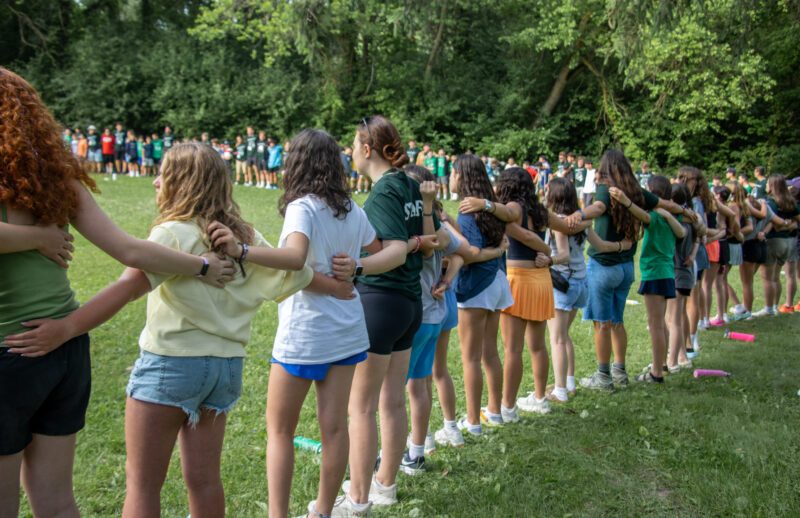
A photo from Summer 2025 at Beber Camp in Mukwonago, Wis.
In response, Foundation for Jewish Camp launched an emergency campaign to help camps adapt. Within 72 hours, more than 1,400 people — from teens to retirees, from Orthodox Jews to people who aren’t Jewish at all — stepped up to help. They offered to volunteer or work at any camp that needed them, not just their own. That’s a big deal for alums loyal to their own camps.
Beyond staffing, FJC also raised more than $2 million so that Jewish camps could build meaningful alternatives to canceled Israel trips for teens this summer. Thanks to that funding, Camp Yavneh in New Hampshire designed an alternate leadership capstone experience at camp; Camp Wise, based in Cleveland, pivoted to a trip to Europe that included a stop at Camp Szarvas, an international Jewish camp in Hungary. Others traveled to Argentina or Costa Rica.
The willingness to volunteer and say Put me in, coach, I can help — the optimism to find meaning in new plans when old ones get scrapped — these are powerful messages to campers. They show rather than tell what it means to be part of a resilient, caring community, and what it looks like to adapt in a world where young people are constantly confronting uncertainty. This kind of response is only possible because these values are woven into the camp experience.
Camp cultivates individual leadership and communal responsibility. Whether it’s cleaning the bunk as part of daily nikayon time or helping to lead Shabbat services, campers take on ownership. Actions as small as cleaning and stacking your plates with your bunkmates send a big message about responsibility and being part of a broader ecosystem. Campers are also encouraged to explore and trusted to lead — just ask the 10-year-olds who host podcasts and radio shows broadcast to their camp communities.
All of this builds the skills campers need to better their own communities: imagination, compassion and teamwork. Even during fierce Maccabiah competitions, campers learn to cheer on their own team but also others. Camp helps young people dial into their emotions, while also instilling the maturity to recognize that at the end of the day, we should all support one another.
Later in the summer, when devastating floods hit camps in Texas, the same ethic we saw during the war resurfaced. Though the affected camps weren’t Jewish, our network responded quickly, promoting fundraising efforts and offering support. The lesson was loud and clear: Caring for others is part of who we are — even when it’s not our immediate circle or no one asks us to.
The people who stepped up and reached out to help this summer are products of this ethos of Jewish camp. Jewish communities are, in a way, a product of Jewish camp as well: Data from Leading Edge suggests that Jewish camp is where many Jewish professionals get their start, with camp alums more connected to their community as adults and more likely to get involved.
I’m living proof of that impact. My journey started as a Jewish camper, nervous and excited, clutching my duffel bag full of bug spray and possibility. Over the years, I went from camper to counselor, from camp director to the newly appointed CEO of Foundation for Jewish Camp.
For me, camp was the first place I felt a deep sense of belonging, where my Jewishness was celebrated through music, ritual, values and community. It was a stark contrast from my childhood growing up as the only Jewish kid in my class. And I’m not alone: A recent study from Stanford University and BeWell found that summer camp is the No. 1 community space where Jewish teens feel comfortable being their true selves.
Camp taught me how to lead, how to listen, how to parent and how to love Jewish life. As I transitioned from counselor to professional to executive leadership, I saw how camp strengthens Jewish connection, welcomes families, trains future clergy, leaders and change makers, and creates lifelong friendships that become the fabric of Jewish community.
From the scramble to fill staffing gaps at the beginning of the summer to the outpouring of support to flood-stricken Texas, Jewish camps and camp alumni responded with empathy, urgency and solidarity. The Jewish camp community modeled what it means to take responsibility for one another. And while that was remarkable, it shouldn’t be a surprise. That readiness to help is itself the product of Jewish camp. Jewish camp nurtures positive values in future leaders, and when these leaders live out those values, they model them for others — and so it continues l’dor vador, from generation to generation.
As I step into the role of leading FJC, I’m filled with hope for all we’re doing to enrich the lives of campers and strengthen the incredible work of Jewish camps. I also hope that the spirit of this work — from financial support to investments in mental health and accessibility — will model our core values for the next generation.
Jamie Simon is the CEO of Foundation for Jewish Camp, whose mission is to grow, support and strengthen the Jewish camp movement, leveraging more than $15 million of philanthropic giving annually to scale programs and resources that benefit more than 300 Jewish day and overnight camps across North America.