Opinion
For Russian-Speaking Jews, Creating a Place to Call Home




 Add EJP on Google
By Yana Tolmacheva
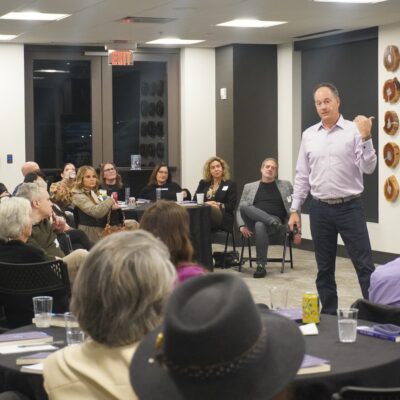
Recently I’ve been reflecting on my experience leading the 7th Annual Moishe House Russian Speaking Jews (RSJ) Training Conference, held in Chisinau, Moldova this September. Well-timed with Rosh Hashanah, the three days spent learning together with 45 young leaders (22-32 years old) from the Moishe House RSJ global network truly brought to life the meaning of community and the efforts to engage the RSJ community to fruition.
Moishe House was built from the idea of building community, being able to belong to something greater than yourself and to share in meaningful Jewish experiences with peers. RSJs have been navigating this space with a particular complexity. In many situations, RSJs are deemed Russian, in other contexts, Jewish. Many feel they do not belong to the American Jewish community or the Russian community – but they do belong to the RSJ community – this beautiful and diverse community inextricably linked by culture, heritage and history.
In 2009, Moishe House Chisinau and Moishe House Chicago RSJ launched as the first RSJ Moishe House communities. Moishe House facilitates experiences that empower Jewish young adults to explore their identities and the values that bring the community together. Each month, there are over 100 Moishe House programs around the world for RSJs to gather together with their peers, from celebrating Shabbat, participating in a Passover Seder for the first time or discussing the influence of Russian food on culture. Moishe House’s peer-led, home based model fosters an environment in which RSJs can connect to their peers and lead and participate in programming on their terms.
Today, there are approximately 400,000 Jews living in the Former Soviet Union (FSU) and nearly two million living outside of it. 55% of Jews from the FSU are living outside their homeland and within at least two cultures. The migration of RSJs has greatly influenced the new environments in which they have found a home, including in Israel, North America, Germany and Australia.
RSJ communities now represent nearly 20% of all Moishe Houses worldwide. In the past three years, RSJ programming has grown into a full department with an international network through Moishe Houses, Immersive Jewish Learning Retreats and Moishe House training conferences around the world.
Although RSJs often possess a strong connection to their Jewish identities, many are not involved and don’t feel connected to Jewish organizational life. While RSJs have found a home in the communities in which they’ve settled, they are often still seeking a true sense of belonging. Built on the values of community building and meaningful Jewish experiences, Moishe House is leading a targeted effort to engage these RSJ young adults in partnership with Genesis Philanthropy Group (GPG).
Beyond Moishe Houses and programming, Moishe House has developed an entire support system for RSJ communities and a global network currently consisting of 20 houses in nine countries around the world, including four houses in North America, 13 houses in the FSU, Australia, Israel, Germany and soon, London. The true essence of “glocal” – building strong peer led local communities and a global network. GPG remains a key partner for RSJ programming, supporting houses and programming worldwide. As a global program, JDC and federations, including UJA Federation of NY, the Associated Federation of Baltimore, Combined Jewish Philanthropies of Boston and individual donors have partnered with Moishe House to support and grow RSJ engagement efforts.
With 400,000 Jews in the FSU, the Moishe House platform and model is quite nuanced. It is unique for young adults to be leading community building, to plan and lead retreats and to be engaged in an informal organization (grassroots style). Young adult engagement is limited in many regions in the FSU and religious pluralism is even more rare. In larger cities with more Jewish offerings, Moishe House serves as a platform to bring everyone together – especially in cities that are often deeply politically divided. Through Moishe House, the communities find a common ground in their Judaism. With nearly 2 million RSJs outside of the FSU, this diverse group of RSJs are no longer connected by a home state but rather language, culture and shared experiences. With over five times as many RSJs outside of the FSU, this transnational identity leads to ambiguities and complexity.
In the RSJ global communities (Tel Aviv, Melbourne, Germany and soon, London), Moishe House offers relevant programming for RSJs to express their full identity – often a dual or triple identity – such as German, Russian-speaking and Jewish. Immigrants often live across 2-3 cultures interacting with the different realities of assimilation. RSJ Moishe Houses offer a sense of belonging and a space to create their Jewish home.
I can list numbers and facts, such as one in every five Jews in New York is a RSJ, or RSJs are the largest global diaspora community. I can share profiles of RSJ community builders:
Katya who discovered her Jewish identity at a Seder in Moishe House Kiev or Ksenia who realized how Judaism can be pluralistic after attending the Moishe House RSJ Training Conference. But we cannot capture the moments, the moment where RSJs are able to confront the complex reality of their multifaceted identity, where they finally feel understood amongst peers, where they don’t need to translate who they are, where pride radiates from the uttered phrase, “I’m a RSJ!”
There is a plethora of potential in front of us. How do we strengthen the RSJ community while simultaneously building bridges with the broader Jewish community? How do we address the distinct challenges of RSJ young adults without running the risk of isolation from their peers? How do we contribute to the narrative in Jewish communities with the impact of RSJs?
These are our opportunities. This is our responsibility as Jewish communal professionals and this is the responsibility of my heart.
Yana Tolmacheva is the Senior Director of RSJ Programming at Moishe House.