Opinion
MODEL OF CHANGE
After Gaza, the war on antisemitism continues: Moving from coordination to collaboration




 Add EJP on Google
In Short
Jewish and Israeli communities in the U.S. and Europe don’t need uniformity to be effective. They need an aligned, cross-sector ecosystem that co-owns strategy and outcomes — and builds durable trust.
Jewish and Israeli communities are at a crossroads unlike any other in recent history. In an era marked by rising antisemitism, polarization and unprecedented challenges to Jewish continuity, the need for maximum cooperation and trust among Diaspora and Israeli communities has never been more urgent. This imperative extends across multiple dimensions: within communities, between older and younger generations, among different communities worldwide, between organizations and, crucially, between Diaspora communities and Israel.
Recent comprehensive research validates this urgent need with compelling data. The 2025 Jewish Landscape Report, based on recent survey data of 10,000 Jewish individuals worldwide, reveals that 76% identify rising antisemitism as a critical challenge facing Jewish communities today. Even more telling, 49% recognize polarization and dialogue between different Jewish communities as equally critical — a clear acknowledgment that internal divisions pose as significant a threat as external ones.
The fragmentation threatening Jewish communities today is not merely an internal concern; it represents an existential challenge that demands immediate attention. When communities and organizations drift into parallel efforts, generations struggle to communicate and Diaspora–homeland ties loosen, the foundation of Jewish resilience starts to fray. History has taught us that Jewish survival depends not on individual strength alone, but on the collective power of interconnected, mutually supportive communities.
This is the moment to replace activity with alignment — to move from scattered efforts to a shared strategy and co-owned outcomes. It doesn’t mean uniformity; it means clarity on shared strategy and co-owned outcomes — safer spaces, credible advocacy, resilient communities — while preserving freedom on the how. When we align on the what and respect diverse hows, collaboration accelerates and trust grows.
The contemporary Jewish experience is shaped by a complex web of challenges that no single community or organization can address separately. The data confirms what many have experienced firsthand: antisemitism is not only resurging globally but manifesting in both traditional forms and new, sophisticated variants that exploit digital platforms and contemporary political tensions. From university campuses to social media networks, from legislative halls to neighborhood streets, Jewish communities face threats that transcend geographical and denominational boundaries.
The research reveals the global nature of this threat through direct testimony. As one respondent noted in the survey: “The events of Oct. 7 sharpened my sense of Jewish identity… but Israeli society makes me want to disconnect and raises fundamental questions about whether there really is a Jewish people here that has a common denominator.” This sentiment captures the complex challenge facing Jewish communities: external threats that should unite actually expose internal divisions that weaken collective response.
Simultaneously, internal divisions within Jewish communities have deepened dramatically. The survey data identifies “fractured identity, division and political polarization” as the second most common theme in responses about how recent events have impacted Jewish identity and community. Generational gaps have widened as younger Jews grapple with questions of identity, tradition and relevance in rapidly changing societies. Different Jewish movements and denominations often find themselves at odds over fundamental questions of practice, belief and community standards.
One respondent captured this painful reality: “It’s devastating. There is a real conflict between different groups of Jews. There is no unity, no common ground — instead, there is a clash of interests.” Another observed: “It’s made me realize how fractured our global Jewish community is. American Jews — especially young progressives — have been pressured to boycott Israel, and it’s led to a real schism between religious and secular Jews as well as racism and sexism in our communities.”
Relationships between Israel and diaspora communities have become increasingly complex, with political disagreements sometimes overshadowing shared bonds of peoplehood and destiny. These tensions, while natural in a diverse and dynamic people, pose significant risks when they prevent communities from presenting a united front against external threats or collaborating on shared challenges.
From ‘ego-system’ to ecosystem: A paradigm shift
In my professional journey of creating value through collaboration and partnerships, I developed the effective collaboration analysis (ECA) model: an organizing architecture for dealing with fragmentation and moving beyond coordination, framing how organizations and communities progress to genuine effective collaboration. We start with value, the shared “why” that makes working together worthwhile. Then we give that value structure: clear roles, decision-making processes and simple mechanisms that make joint work doable. We invest in relationships — trust, shared language and dialogue that keep diverse partners at the table — and we embed commitment and implementation — action items, follow-through and institutionalized practice that turn intent into operating routines.
When these elements rise together, communities and organizations move from coordination (information sharing) to cooperation (joint activities) and ultimately to collaboration — co-owned strategy and outcomes with shared accountability.
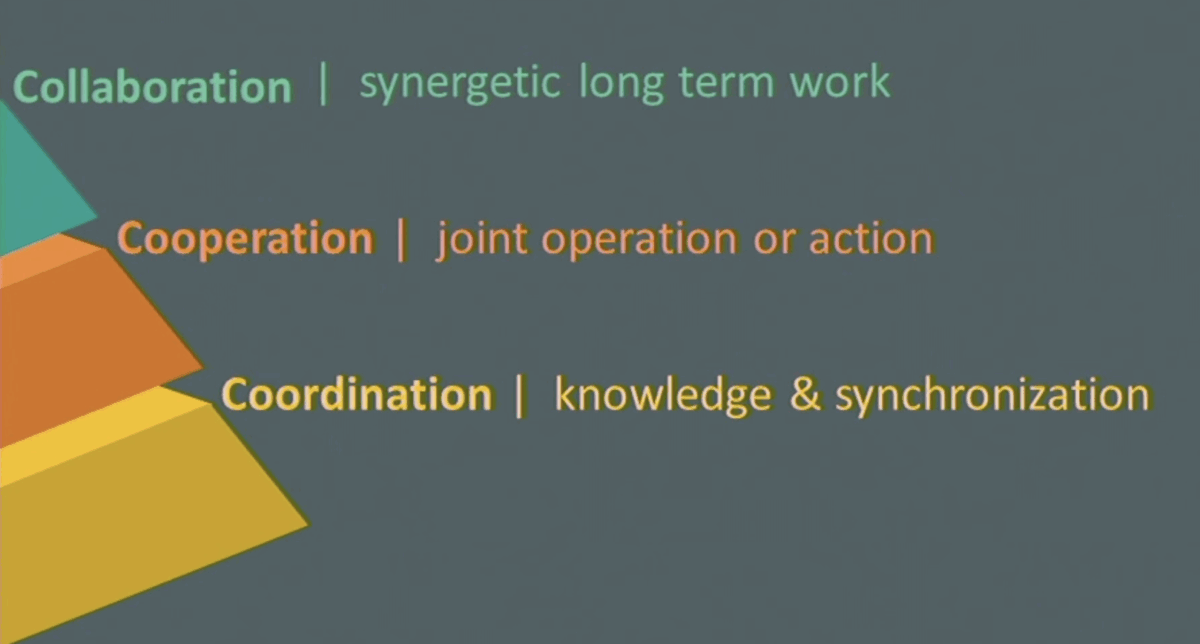
That progression requires a mindset shift many of us already feel: from ego-system to ecosystem. Ego-system thinking prizes ownership and credit; ecosystem thinking prizes shared goals, shared data and shared wins. In practice, it means federations and synagogues, student groups and campus leaders, Israeli and Jewish NGOs, municipalities, businesses and security partners working as one coalition, not by erasing differences but by aligning on the what while preserving freedom on the how. That’s how coordination matures into collaboration, relevance grows and accountability is shared: one outcome, many paths.
Three principles help coalitions move up the ladder without prescribing anyone’s tactics:
1) Process first, solutions later. We naturally tend to start with “What’s the solution?” A better opening is “What’s our shared compass?”— our purpose, interests, objectives, language and process design. When the process is accurate and trust evolves, solutions become accurate. In cross-sector settings, a clear compass gives partners confidence to localize tactics without breaking cohesion.
2) Measure together, move together. Single-organization/community key performance indicatorss can trap us in silos. Define a set of collaborative KPIs — shared outcomes we track together — while leaving room for each partner to contribute in their own way. A lightweight shared dashboard doesn’t erase nuance; it creates shared accountability.
3) From NIH to PFE. The derogatory label “Not Invented Here” is a tax on impact; replace it with “Proudly Founded Elsewhere.” If a campus, a federation, or an NGO cracked a play that works — even in a very different context — adopt it, adapt it and credit it. Learning from those unlike us — religious and secular, small and large, U.S. and EU, campus and municipality — adds perspectives we can’t see from inside our own lane. PFE builds humility and trust; it connects communities, reduces time-to-impact and turns isolated wins into shared capacity.
Networked hate demands a networked us; it’s a hard truth and a hopeful path. If the challenge is coordinated, our response must be coordinated toward powerful collaboration. This message is critical to both Jewish Diaspora communities in general and Israeli communities in the Diaspora. The work is the same wherever we live: align outcomes across sectors, co-own decisions and data, share what works and credit generously. The specifics will and should vary by city, institution and country. The frame endures.
As the Gaza headlines fade, our responsibility does not. Let’s convert fragmentation into collective impact: an aligned ecosystem that protects people, strengthens families and raises credible voices in the public square. No one wins this alone.
Omri Gefen is the author of The Power of Collaboration: From Ego-System to Eco-System.