Opinion
BOUND TOGETHER
Philanthropy and responsibility: Marking two years since the Oct. 7 attacks




 Add EJP on Google
Two years have passed since the horrors of Oct. 7, 2023. Two years since terror struck our homes and our communities, leaving an open wound in the heart of our people. For two years, families have lived with unbearable absence. For two years, mothers and fathers have woken each morning not knowing whether their child is alive. And for two years, the hope has not dimmed — the hope to see every one of the hostages home, a hope that is now much stronger.
On that day, as men, women and children were slaughtered, brutalized and abducted, we also saw the essence of Jewish life revealed: responsibility for one another. In those hours and days, philanthropy in the deepest Jewish sense was not an abstract idea but a lived reality. Strangers took in evacuees. Communities mobilized to care for the wounded. Volunteers worked tirelessly to provide food, clothing, therapy and comfort.

arthobbit/Getty Images
The Jewish value of “Kol Yisrael arevim zeh bazeh,” all of Israel is responsible for one another, has guided us for generations. Rabbi Lord Jonathan Sacks reminded us that Judaism is not a faith of detached individuals but a covenant of shared duties. Since Oct. 7, 2023, this covenant has taken tangible form. It has been expressed in donations, in volunteering, in advocacy for the hostages and in the simple, sacred act of standing with those in pain. And this responsibility has not stopped at the boundaries of the Jewish people. In Israel, Muslims, Christians, Druze and others have given of themselves in the same spirit, demonstrating that our shared humanity is stronger than what divides us.
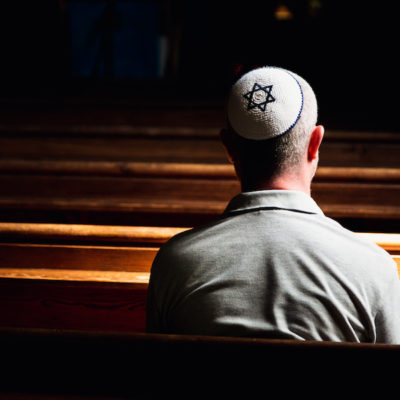
I honor and praise the Jewish communities around the world. They, too, endured and still endure terrible trauma, as we have seen most recently in Manchester: an onslaught of antisemitism in their streets, universities and workplaces, alongside their own grief for the atrocities committed in Israel. And yet, in the midst of their pain, they stood up in unprecedented numbers to show solidarity. They traveled here to embrace us. They organized rallies, vigils and prayers in every corner of the world, and they gave generously and sacrificially to help Israel in its darkest moments.
This wave of solidarity was not just about money, though the support was extraordinary. It was about presence. It was about Jewish people around the world saying to Israelis: You are not alone. Your fate is ours. Your pain is ours. And your future is ours too.
In Jewish life, we walk in the footsteps of those who showed that philanthropy is a way of being. It is not only about meeting physical needs, but about giving hope and shaping the future as well. Philanthropy is broad and multifaceted — not only money but also time, action, courage and advocacy. Above all, it is the refusal to be silent when others are silenced.
As we mark the second anniversary of the Oct. 7 attacks in the days of Sukkot, I am drawn to the imagery of the Arba Minim, the Four Species. Each has its own form, taste and fragrance. Alone, none can fulfill the mitzvah. Only when they are held together do they become whole.
So it is with us. We are a people of many voices, backgrounds and beliefs, yet in the wake of Oct. 7, we have been bound together, like the Arba Minim, in shared responsibility. Philanthropy is the cord that ties us, binding different strands of our people — and even those beyond our people — into a unified expression of care and solidarity.
Philanthropy is more than food for the hungry or shelter for the homeless. Those are sacred obligations, but true philanthropy must also give a voice to the voiceless. In my humbling work promoting the awareness of the sexual violence and atrocities perpetrated by Hamas, I was so starkly reminded of the need to give a voice to the victims. To support them requires more than funds. It requires advocacy, awareness, and the courage to speak where others are silent. This too is philanthropy. And so it is with the hostages. To call for their return, to demand that the world not forget them, is itself a form of philanthropy: the giving of our voices, our time, our platforms, and our hearts.
Philanthropy ensures continuity. It sustains schools, synagogues, youth movements and cultural life. It invests in memory and in the future. It is how we honor those we lost on Oct. 7, 2023, and how we ensure that their light continues through the generations.
And when we think generationally, we are reminded of the need to think long term. In the immediate aftermath of the Oct. 7 atrocities, the Jewish people and our allies stepped up in unprecedented and unimaginable ways. But sadly, the wounds of this war are not short lived. Long after the guns and missiles fall silent, long after — God willing — all the hostages are returned, there will be still needs and causes which will need our support. The challenge is to continue to inspire and engage the philanthropic world, to keep this flame alive to ensure the long term well being of the victims and their families, of the communities in Israel and abroad, who have seen their lives torn apart by the events of the last two years.
Two years on, our grief has not faded. But neither has our hope. We long for the day when every hostage is reunited with their family. We pray for the moment when we can turn the language of absence into songs of homecoming. Until then, we give. We give our money, our time, our strength and our voices. For philanthropy is not optional; it is the heartbeat of Jewish life. It is how we survive tragedy, how we preserve continuity and how we shape a future built on unity and hope.
Just as the Arba Minim must be bound together to fulfill their purpose, so too must we. Bound together in memory, in responsibility and in philanthropy, we can heal, rebuild and carry our people forward.
Michal Herzog is the First Lady of the State of Israel.