Opinion
THE PEOPLEHOOD PAPERS
Founding as an ongoing act: Arendt, authorship and Zionist future




 Add EJP on Google
The following essay is part of a collaboration between eJewishPhilanthropy and the Center for Jewish Peoplehood Education, which will publish a new edition of its Peoplehood Papers series, “Zionism 2025: Reinterpreting Vision, Mission and Boundaries,” with this essay and more, this week.
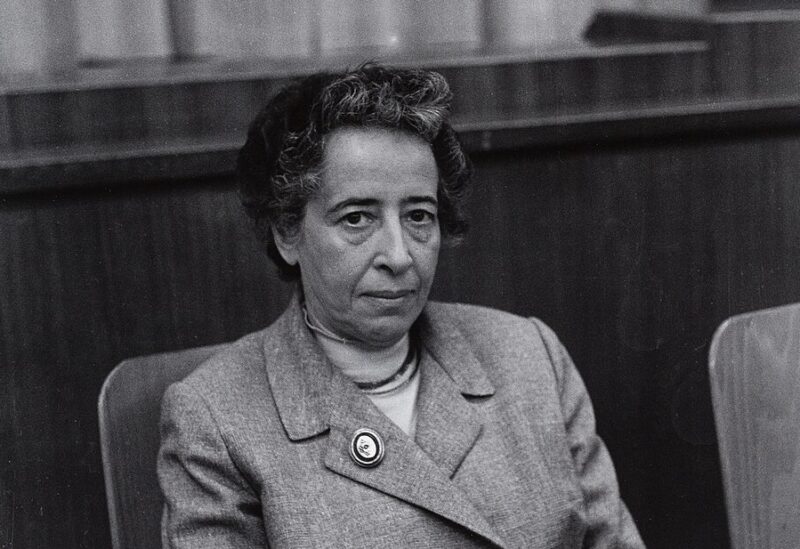
Münchner Stadtmuseum, Sammlung Fotografie/ CC BY-SA 4.0/Wikimedia Commons
Hannah Arendt.
Hannah Arendt’s analysis of revolution offers an uncomfortable truth for moments like ours: the difficulty is not in starting something, but in staying with it long enough to see it become what it was meant to be.
In her 1963 lecture “Founding Fathers,” she writes,
“It was the experience that man can begin something altogether new… And the question of the Foundation of a republic was how to preserve this spirit, the revolutionary spirit, how to find lasting institutions which could prevent this experience from being the experience of one generation.”
Arendt’s positions on Israel were often contentious, yet her insights into political beginnings and their preservation remain instructive.
Founding is not a ceremonial instant but an ongoing discipline that turns the energy of a beginning into durable life: “It is the difference of a Constitution the Government gives, grants, to the people, and the Constitution by which a people constitutes its own government.” The point is less about text than ownership. When a people understand themselves as authors, they accept the obligations of authorship; when they see themselves as recipients, they are tempted to treat the framework as disposable when it disappoints.
Zionism today sits at this juncture. The Jewish people achieved the beginning: a return to political agency in the ancestral homeland; the proclamation of a democratic Jewish state; the gathering of exiles; the declaration freedom, justice and peace would guide public life. The work which remains is the preservation of the beginning in the face of complexity. Israel’s security, the moral strain of conflict, contested boundaries of religion and state and fragility of social trust press against the founding commitments. Diaspora Jewry faces escalating antisemitism, ideological divides and growing distance from Israel.
The temptation is to reach for a clean slate, to say that a new framework is needed because the current isn’t working. That instinct misreads the moment. If we declare a new vision when the existing one demands difficult work, we confess we never fully belonged to the original. Commitment proven only in ease is not commitment. The question is not whether Zionism needs replacing, but whether we will do the unglamorous work to “actualize foundational participation”: translating founding promises into practices.
Arendt’s emphasis on preservation through institutions is instructive. A people sustains its founding not by return alone, but by building participation that keeps ownership alive. Israel’s democratic infrastructure, civic organizations, educational systems and transnational webs of peoplehood connecting Israelis and Diaspora Jews are where preservation happens — or fails. The measure is whether these sites can hold disagreement without dissolving the shared project, and whether we invite the distant back into authorship rather than treating distance as disqualification.
None of this denies the brokenness. The Declaration’s ideals were made for storms, not fair weather. To leave now — out of fatigue, disappointment or betrayal — would abandon our shared claim. A provisional framework never becomes ours; one lived through difficulty becomes the covenant that shapes us.
Education is the lever that turns this argument into culture. The task is to help Jews in Israel and around the world move from studying the founding to owning it. That begins by treating the founding texts and choices as living materials — reading them against the dilemmas of the present, asking what these words obligate now and inviting participants to rearticulate the commitments in actionable language. It continues by training institutional stewardship as a civic habit — guiding students, congregants and campus leaders to see the organizations they inhabit as shared undertakings requiring work when tensions rise, not only when programs run smoothly. Actualizing founding participation is less a curriculum unit than a posture that threads through leadership, service, philanthropy and public discourse.
Arendt’s closing line captures the constructive horizon: “This is the freedom experienced in Revolutions— to be free to begin something new.” The Jewish people have already begun. The question is whether we will preserve that beginning by staying with the work it requires.
We do not need a new vision. We need to prove we were brought in from the start by enduring the hard part now — holding to what was promised, widening the circle of authorship and rebuilding the institutions that can carry the founding across generations.
Shuki Taylor is the founder and CEO of M²: The Institute for Experiential Jewish Education.
The latest edition of the Peoplehood Papers was created by the Center for Jewish Peoplehood Education in collaboration with Z3 and ENTER. The editors of the publication are Shlomi Ravid, Amitai Fraiman and Barrak Sella.