Opinion
SURVIVAL MODE
A trauma-informed look at giving and community resilience




 Add EJP on Google
In Short
What if our goal isn’t simply to raise more, but to help communities recover their capacity to care?
Urgency. Fatigue. Fragmentation. Slow recovery. Over the last five years, we’ve seen philanthropy in America move through the same cycles that trauma clinicians recognize all too well. The numbers tell one story — total charitable giving in 2024 reached a record $592.5 billion, rebounding after years of decline — but beneath that is another story: the number of donors continues to shrink, with dollars coming from fewer people through larger gifts while smaller, community-based giving has become more sporadic and crisis-driven.
In trauma work, we call this adaptive narrowing; it’s when systems under stress redirect energy toward survival. Philanthropy is doing something similar now, tending to the wounds that are closest, visible and pressing.
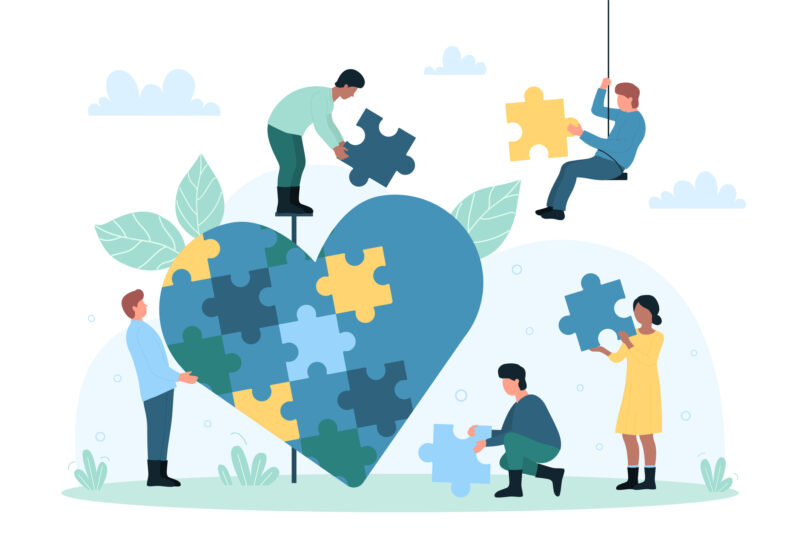
Flashvector/Getty Images
It’s not that donors have stopped caring. It’s that care itself has become embodied as smaller, immediate, relational. Donors are turning inward, toward proximity: The local food pantry. The family in their synagogue who lost a job. The neighbor who is facing eviction. In moments of collective strain, we give to what we can see and touch. That’s not a moral failure, or apathy toward Israel or global causes. It’s human regulation. When life feels unpredictable, we reach for what we can hold.
And that’s where a trauma-informed lens offers something powerful: it reminds us that healing, whether personal or systemic, depends on three capacities: regulation, relationships and meaning making.
Philanthropy needs the same.
A trauma-informed organization understands that predictability builds safety. The same is true for philanthropy. Donors, like clients, need transparency, pacing and trust before they can engage deeply. After years of crisis and information overload, people are craving steadiness — consistent communication, honest reporting and relational continuity. The nonprofit that holds regular touchpoints, offers clear impact updates and treats its supporters as partners rather than payers becomes a source of grounding in a disordered world.
In trauma recovery, relationships are the bridge between survival and growth. The same is true for giving. Nonprofit organizations today are being asked to do more than deliver services or raise money. They are becoming facilitators of community resilience — the connective tissue that holds people together when systems falter.
When donors and organizations co-create purpose, through volunteering, shared learning or local action, giving becomes a two-way process of healing. It’s no longer the donor helping the beneficiary. It’s a relational ecosystem where both sides experience belonging, agency and hope.
We’ve seen this in the Jewish philanthropic world, especially since Oct. 7, 2023. Communities didn’t wait for national directives; they organized drives, matched families, hosted circles of support, and raised funds through networks of trust. That’s not just generosity; that’s resilience in motion.
What trauma-informed practice teaches us is that connection itself is curative. When nonprofits act as relational anchors, cultivating spaces for conversation, ritual and shared meaning, they help regulate the anxiety that comes with constant crisis. They remind people that care is not only a feeling — but a structure.
Finally, compassion, at its core, combines awareness (of others and their needs) with action (mobilizing resources to meet those needs). The current giving trends show that awareness is abundant — donors see the pain, the hunger, the instability — but action has become episodic. In trauma recovery, meaning-making is what allows a person to integrate their story; to see beyond the event and reconnect with purpose. For philanthropy, meaning-making is what transforms crisis generosity into long-term commitment.
Nonprofits play a crucial role here. They can help donors connect the immediate with the systemic, to understand how supporting one family’s rent this month also connects to advocacy for affordable housing policy or how feeding a neighbor ties into strengthening food security for the entire community.
When organizations help donors see themselves as part of a larger continuum of care, giving becomes relationship, identity, and repair.
From crisis response to collective healing
The philanthropic ecosystem, like the people within it, ha
s been living in survival mode for years. Each new emergency resets the emotional field. Urgency dominates the headlines; long-term engagement quietly fades.
But trauma-informed philanthropy invites us to see this differently. It asks what would change if our goal weren’t simply to raise more, but to help communities recover their capacity to care — to care for one another through connection, to care about one another through meaningful giving and to care together through shared purpose. That shift — from extraction to co-regulation, from transaction to relationship — transforms philanthropy into a tool for collective healing.
A trauma-informed fundraiser both asks for money and creates conditions of safety that allow generosity to flourish. They report outcomes and nurture belonging.
And a trauma-informed community doesn’t only survive a crisis — it learns how to stay connected after the crisis fades.
Yes, the data shows fewer donors now than in prior years. Yes, it shows the concentration of wealth shaping giving patterns. But it also shows millions of smaller gifts, sometimes made anonymously, through peer-to-peer campaigns and community drives. Those moments of micro-giving are not insignificant. If we look closely, we see a system learning to adapt, regulate and reconnect.
Philanthropy has always been a reflection of who we are. The question now is whether we will let it become a mirror of how we heal.
Nonprofits today are no longer just intermediaries between donors and beneficiaries. They are facilitators of community resilience – the ones holding space for collective meaning, mobilizing compassion into action and helping us remember that care, when practiced together, is one of the most powerful forms of healing we have.
Philanthropy began as charity. It evolved into strategy.
Its next chapter must be about connection.
Specializing in trauma-informed care and community resilience, Ruthie Bashan’s work focuses on reimagining philanthropy as a tool for collective recovery and belonging. She teaches in the graduate social work program at Montclair State University and consults with organizations building trauma-informed cultures of care and giving.